A clematis that survived the winter has already thrown out three new shoots, and it’s aiming for the fence. Your only support is a flimsy bamboo teepee from two seasons ago, and it leans like a tired fence post. Every gardener who grows climbers eventually hits this moment: the plant needs a real structure, not a temporary crutch.
Wrought iron trellises solve that permanently. A well-made unit lasts decades, shrugs off snow and baking sun, and keeps heavy vines off your gutters and siding. The right one comes down to three things: rust protection that doesn’t quit, a lattice design that matches how your plant climbs, and enough height and stiffness to handle the mature canopy without tipping. Everything else is style.
These three are the units worth buying right now. The YOBAZAN 2-pack delivers serious height for screening and vigorous vines. The Amagabeli scroll trellis keeps things simple for pots and small gardens. The Miuwauer obelisk brings vertical structure to rose beds and container displays. None of them are the cheapest junk on Amazon, and none of them will rot out in eighteen months like cedar. You can check current pricing on each product page, but here is how they actually perform in the garden.
Here’s a quick comparison of the three trellises before we get into the details.
| Features | YOBAZAN 2-Pack | Amagabeli Scroll | Miuwauer Obelisk |
|---|---|---|---|
| Overall Size | 86.7″ H x 19.7″ W | 47″ H x 16″ W | 69″ H x 12″ W |
| Finish | Powder-coated black steel | Powder-coated black iron | Plastic-coated steel pipe |
| Assembly | Tool-free, ground spike | None required | Rotate-fit, no screws |
| Style | Lattice with bird motifs | Scroll design | Round obelisk with tops |
| Best For | Tall vertical screening | Pots and custom fencing | Rose bushes, pot display |
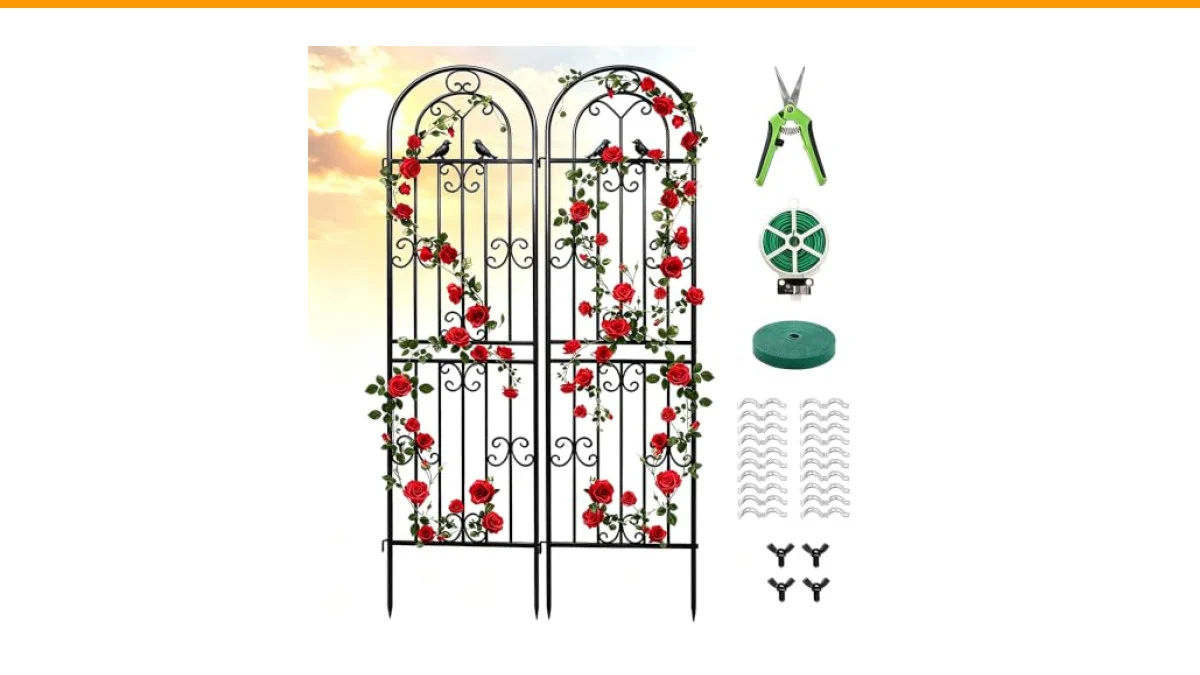
YOBAZAN 2-Pack Lattice

YOBAZAN
2 Pack 86.7" H x 19.7" W Metal Garden Trellis for Climbing Plants Outdoor, Black Lattice Panel, Sturdy Plant Support for Roses, Vines, Cucumbers & Vegetables
- 【Tool-Free Quick Assembly】 No extra tools or complex instructions needed! Just insert the 11.8-inch reinforced ground spike into s…
- 【Heavy-Duty Rustproof Construction】YOBAZAN garden trellis for climbing plants Crafted with thickened steel tubes (2mm thicker than…
- 【Elegant Bird Pattern & Versatile Style】 Unique laser-cut bird motifs add a charming, nature-inspired touch to your outdoor space—…
The YOBAZAN is the tall one. Each panel measures 86.7 inches high and 19.7 inches wide, and you get two panels per order. That height puts it in a different class from most garden trellises, which top out around five feet. It suits gardeners who want to cover a fence gap, screen a utility box, or give a vigorous clematis or climbing rose a full seven feet of upward room.
Assembly is genuinely tool-free. Each panel has an 11.8-inch reinforced ground spike; you push it into prepared soil and you’re done. The steel tubes are thicker than typical trellis frames, and the high-temperature black powder coating handles rain, snow, and harsh UV without fading. The laser-cut bird motifs are a nice touch that makes it feel less like a utility panel and more like garden decor. The open lattice also works as a privacy screen when you cluster several panels.
Two honest drawbacks. First, at 19.7 inches wide, a single panel is narrow; in an exposed, windy spot, it will need staking or a tie to an existing fence to stay vertical. Second, the 86-inch height means the soil must be workable enough for that 11.8-inch spike. Rocky or heavily compacted ground will fight you, so pre-drill or water the soil first. The height also means it deserves a deep-rooted, heavy anchor if you plant a vigorous rose at its base.
- Serious height: 86.7″ per panel, sold in a 2-pack
- 11.8-inch reinforced ground spike presses into soil without tools
- Thickened steel tubes with high-temperature black powder coating
- Laser-cut bird motifs add ornamental value
- Double duty as a climbing support or a decorative screen
Best for: Gardeners who need real vertical reach — screening, tall vines, or fence extensions — and don’t want to build a permanent wooden structure.
Amagabeli Scroll Trellis

AMAGABELI GARDEN & HOME
Amagabeli Garden Trellis for Climbing Plants 47” x 16” Rustproof Black Iron Plant Trellis Potted Vines Vegetables Flowers Patio Metal Wire Lattices Grid Panels for Ivy Cucumbers Clematis 2 Pack GT03
- Versatile Use: The metal great trellis is ideal for a wide variety of climbing plants and long stemmed or vine vegetables such as…
- DIY Trellis Climbing Supports: Create custom fencing, yard dividers, or screens by grouping these versatile trellises. Use them fr…
- Durable & Elegant Design: The metal garden trellis measures 47"H x 16"W, featuring a beautiful scroll design and thick steel wire.…
The Amagabeli is the compact, no-fuss option. Each panel measures 47 inches high and 16 inches wide, and the order ships two panels. It’s small enough for a large patio container, a balcony planter, or a narrow bed, and it suits cucumbers, ivy, clematis, jasmine, and other medium-weight climbers. If you garden mostly in pots, this is the unit to look at first.
The standout feature is simplicity. There is no assembly whatsoever. You pull the spiked legs out of the box and push them into the ground or into container soil. That’s it. The scroll design is genuinely pretty — it looks like a small piece of wrought iron fencing rather than a plain grid. And because it’s lightweight, you can move it around easily, which matters if you rotate crops or rearrange your patio. The powder-coated finish resists rust, UV, and snow, and the panels can be grouped to build custom fencing or yard dividers.
The trade-off is capacity. At 47 inches, this is a support for small to medium plants, not a structure for heavy grapevines or a massive climbing rose. The steel wire is thick and resists bending, but the narrow footprint means a top-heavy plant can pull the whole panel over in soft ground. Use it where you would use a sturdy stake or a tomato cage, not where you would anchor a pergola.
- 47″ H x 16″ W panels, two per order
- No tools and zero assembly required
- Black powder-coated finish resists rust and sun damage
- Scroll design elevates the look beyond a plain grid
- Multiple panels can be arranged as fencing or dividers
Best for: Container gardeners, renters, and anyone who wants an instant, movable support for potted vines and small vegetables.
Miuwauer Obelisk Trellis
The Miuwauer takes a different shape entirely. Instead of a flat panel, it’s a round obelisk that stands 69 inches tall and 12 inches wide. This silhouette works beautifully for a rose bush in the middle of a bed, a clematis in a large patio pot, or a decorative focal point at the back of a border. The manufacturer recommends it for roses, clematis, ivy, jasmine, beans, and similar climbers.
The plastic coating sets it apart. Rather than a traditional powder coat, each steel pipe has a plastic sleeve. That layer cushions plant stems and resists the chipping that powder coating can suffer near the soil line. Assembly requires no screws or tools: you rotate the pieces into position from bottom to top. The height is adjustable to match plant growth, and three interchangeable top decorations are included. The matte black finish fades into the background so the plant stays the star.
Read the fine print before you buy. The manufacturer is explicit that this trellis suits light and small plants, not oversized, heavy ones. A vigorous grape vine or a massive ‘New Dawn’ rose will overwhelm the 12-inch width. The installation instructions also recommend pre-drilling holes in the ground to help the legs sink in, which tells you the soil needs to be soft enough to work with. It’s a refined structure, not a heavy-duty engineering solution.
- 69″ tall, 12″ wide obelisk shape
- Steel pipe with plastic coating for stem-friendly support
- Tool-free, twist-fit assembly; height is adjustable
- Three top decoration options included
- Matte black finish works in beds or large containers
Best for: Homeowners who want an ornamental, vertical feature for roses and small vines, and who value the obelisk form over flat panel trellises.
How We Chose These Products
We started with the failures. Most trellis complaints center on rust that bleeds onto the plant, panels that buckle under a heavy vine, and bases that tip in the first strong wind. Every product above was selected because it addresses at least the first two of those problems. We looked for real rust protection, not a thin painted layer. The YOBAZAN uses a high-temperature powder coat, the Amagabeli uses a powder-coated finish, and the Miuwauer uses a full plastic sleeve.
Then we matched each trellis to an honest use case. The YOBAZAN covers tall screening and vigorous climbers. The Amagabeli covers containers and quick, movable support. The Miuwauer covers ornamental obelisks in beds and pots. We prioritized units with clear assembly instructions, adaptable placement options, and support that won’t strangle or trap tendrils. We skipped flimsy green wire panels and iron-look plastic that fails after one season. Price-to-longevity ratio mattered more than the lowest upfront cost.
Buying Guide: What Really Matters
First, match the lattice to the plant’s climbing mechanism. Twining vines like morning glories and pole beans wrap their stems around anything thinner than about a quarter inch. Tendril climbers like clematis and sweet peas grip onto wires, rods, and slats. Clingy vines like ivy use aerial roots and will latch onto nearly any surface. A trellis with wide gaps, like the YOBAZAN lattice, suits twining and tendril climbers well. A denser grid favors plants with smaller tendrils. The wrong aperture means stems get trapped between bars or slip through and flop over.
Second, think about anchoring and wind. Height multiplies leverage. An 86-inch freestanding panel will catch wind like a sail; the YOBAZAN requires workable soil for its 11.8-inch spike, and the Amagabeli needs a stake or a tied position in exposed areas. For a permanent, heavy planting, consider setting the base in concrete or tying the top to a fence. The Miuwauer’s instructions to pre-drill holes reveal a broader rule: soft, well-prepared soil anchors better than a hard-packed bed ever will.
Third, plan for winter. Dead vines left on a trellis trap moisture and can cause rust at the base. Cut them down each fall. In freeze-thaw climates, water seeps into any chip or crack in the coating and expands, so inspect the legs every spring. Repair minor rust spots before they spread: sand the area, apply a rust-inhibiting primer, and touch up with black metal paint. With that minimal care, a powder-coated steel trellis outlasts three or four wooden ones, making the higher upfront cost worth it over a decade or two.
Our Top Recommendation
The YOBAZAN 2-Pack Lattice Trellis is the winner. It is the only one of the three that fixes the two biggest trellis complaints at once: too-short height and flimsy construction. The 86.7-inch panels give a full-grown clematis or climbing rose a proper vertical range, and the thickened steel tubes with high-temperature powder coating offer the best durability of this group. The laser-cut bird motifs also make it the most attractive flat panel, which matters when it sits in a prominent spot against a fence.
For container gardeners or anyone who wants zero hassle, the Amagabeli Scroll Trellis is the smarter pick. It costs less in physical presence if not necessarily in price, stores flat, and handles potted vines perfectly. For a traditional rose bed or an ornamental centerpiece, the Miuwauer Obelisk adds a classic structure that the flat panels simply can’t match. Each has a clear job. If you need one trellis to do the most work, the YOBAZAN is the one.
Frequently Asked Questions
Is a 12-inch-wide obelisk big enough for a climbing rose?
Mostly yes, for modest shrub roses and repeat bloomers. The Miuwauer was designed for light and small plants, so a compact rose will spiral nicely up the 69-inch height. A vigorous rambler or a climbing rose with long, thick canes will outgrow the 12-inch width in two seasons. Select the plant first, then buy the trellis to match the plant’s mature spread, not its current size.
How do I keep a tall trellis from tipping over in a windy yard?
Push the ground spike into soil that has been loosened and watered first. In exposed areas, add a second anchor: drive a stake next to the panel and tie the frame to it with wire or zip ties, or attach the top to an existing fence. The YOBAZAN’s open lattice also lets wind pass through, which reduces the tipping force compared to a solid board fence of the same size.
Can I leave a powder-coated iron trellis outside all winter?
Yes, with one routine job. Cut the dead vines off in late fall so the structure sheds snow and ice. Then inspect the base for chips or scratches that could let moisture in. Touch these up with rust-inhibitor primer and black paint. Small, portable units like the Amagabeli can go into a shed if you prefer, but frost won’t hurt the metal as long as no water sits trapped inside hollow legs.
Will these trellises hold heavy plants like grapes or tomatoes?
Tomatoes, yes, up to a point. Cucumbers, beans, and peas, definitely. Grapes are the line in the sand: a mature grapevine can pull down a lightweight panel or obelisk. The YOBAZAN’s thickened steel handles more load than the others, but for grapes, consider a braced arbor or a permanent post-and-wire system. These trellises earn their keep on ornamentals and medium vegetables, not on perennial fruit vines that double in weight every year.