
You’ve got a lawn that takes an hour and a half to mow. Maybe two. The robotic mowers you see advertised everywhere claim they handle it, then you read the fine print and the coverage number assumes perfect conditions, flat ground, and a battery that never ages.


Size matters in this category, but not the way the spec sheets suggest. What separates a genuinely big robotic mower from a small one comes down to three things: how many square feet it actually cuts per charge, how wide the deck is, and whether the navigation system can find its way home across a property with trees, sheds, and flower beds in the way. A 20-inch deck and a 4Ah battery behave very differently from a 9-inch deck and a 2Ah battery, even if both claim similar coverage.
Below you’ll find five products that solve the large-lawn problem in different ways. Three are mowers built for serious acreage, and two are weather shelters that protect a big mower and its charging station from rain, UV, and overheating. If you’re comparing options across a range of yard sizes, our large yard mower guide covers additional models worth a look.
Here’s the quick spec comparison before we get into the details.
| Features | Universal Mower Garage | LEBOSBO V3 Mower | WORX 1/4 Acre | YARDCARE AI Mower | CNAINFC Mower Garage |
|---|---|---|---|---|---|
| Type | Fabric shelter | Robotic mower | Robotic mower | Robotic mower | Ventilated shelter |
| Coverage | Fits most mowers | 1600 sq ft | 1/4 acre | 1600 sq ft | Large mowers |
| Navigation | Not applicable | AI vision | RTK plus V-SLAM | AI vision | Signal-permeable build |
| Key Strength | 600D Oxford shell | Wire-free setup | Centimeter RTK accuracy | Magnetic no-go zones | 3D airflow cooling |
| Best For | Mid-size mower storage | Small-to-mid lawns | Complex quarter-acre yards | Simple wired-free lawns | High-end large mowers |
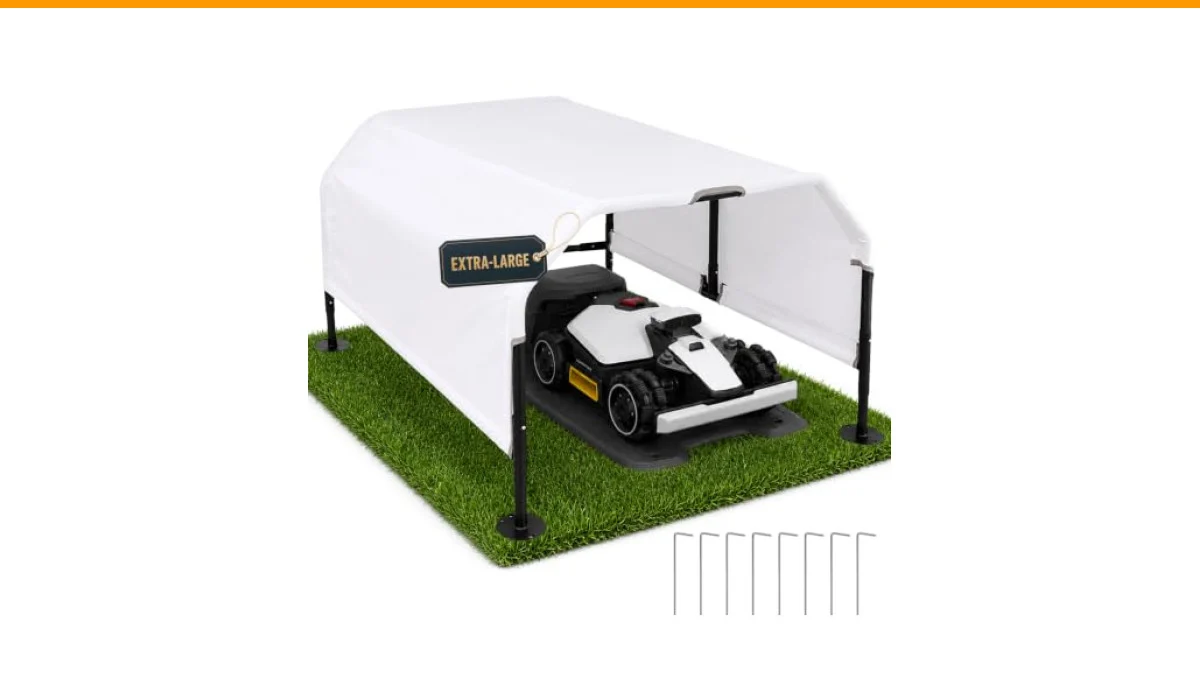
37.4″x29.1″x20.7″ Univers…
yes dre
37.4"x29.1"x20.7" Universal Robot Mower Garage, Waterproof, UV-Proof | Large Robotic Lawn Mower Shelter, Snap-Together Steel Frame, Garage for Lawn Mower with 600D Oxford
- LARGE SIZE FOR MOWER & STATION: Large Robot Mower Garage measures 37.4" L × 29.1" W × 20.7" H, providing spacious coverage for man…
- THICK 600D OXFORD FABRIC: Robot Lawn Mower Cover is made with thickened 600D Oxford fabric and a PU coating, creating a durable ou…
- OUTDOOR WEATHER PROTECTION: Robot Mower Garage helps shield your mower from rain, snow, hail, intense sunlight, falling branches a…
The one you buy when your mower needs a home and you don’t want to build one. This is a fabric-and-steel garage that shelters a robotic mower and its charging dock from rain, snow, hail, and direct sun. It’s best for anyone running a mid-size robot who’s tired of pulling wet grass out of the deck every morning.
The dimensions tell the real story here. At 37.4 inches long and 29.1 inches wide, it accommodates a mower plus its station without the mower scraping the walls on entry. The 600D Oxford fabric with PU coating is the same material used on high-end grill covers, which matters because thin 210D covers tear at the seams within a season or two. The snap-together steel frame assembles without tools or bolts, and the included anchoring hardware keeps it planted on both grass and hard surfaces.
Where it falls short: the 20.7-inch height limits headroom. Taller mowers with raised charging towers may not clear the roof panel. The side opening is generous but not adjustable, so if your dock sits at an awkward angle you’ll need to reposition the dock, not the garage. And the fabric shell won’t survive a fallen branch the way a rigid plastic or metal unit would.
- Measures 37.4 x 29.1 x 20.7 inches, sized for mower plus dock
- 600D Oxford fabric with PU coating resists rain and UV
- Snap-together steel frame, no tools required
- Anchoring hardware included for lawn or hard surface
- Detachable for seasonal storage
Best for: Owners of a mid-size robotic mower who want affordable weather protection without a permanent structure.
LEBOSBO V3 AI Vision Robo…
A wire-free mower that skips the boundary cable job entirely. The LEBOSBO V3 covers up to 1,600 square feet and uses AI vision to spot obstacles rather than bump sensors. It suits someone with a modest but obstacle-heavy lawn who wants plug-and-play setup and app control.
The standout feature is the 32-foot magnetic strip. Instead of trenching cable around flower beds or pet areas, you lay the strip down and the mower treats it as a wall. That’s a genuinely useful trick on a lawn with multiple garden islands, because you can move the strip when you replant. AI vision handles the rest, recognizing obstacles and adjusting the path rather than plowing into them. Cutting height is adjustable, and the mower runs quiet enough for early-morning scheduling without waking the neighbors.
Two honest caveats. The 1,600 square feet rating is modest, so on anything approaching half an acre you’ll be running it daily to keep up. Availability is also listed as scarce, which means stock fluctuates and you may wait for a restock. Vision-based navigation also struggles in deep shade or heavy leaf cover, so a heavily wooded yard isn’t the ideal match.
- 1,600 square foot coverage rating
- AI vision obstacle sensing, no bump-and-turn
- 32-foot magnetic strip for flexible no-go zones
- Wire-free setup, no perimeter cable
- App scheduling and remote monitoring
Best for: Small-to-mid lawn owners who want zero installation work and flexible no-go zones.
WORX Robot Lawn Mower for…

WORX
WORX Robot Lawn Mower for 1/4 Acre, Wire-Free with Brushes | Landroid Vision Cloud with App Control, AI Obstacle Avoidance, RTK Cloud Navigation, App Control, Handles 30% Slope
- Centimeter-Level RTK Cloud Accuracy: Commercial-grade RTK Cloud technology delivers centimeter-level positioning for this robotic…
- Auto Mapping for More Complete Coverage: Vision AI helps the robot lawn mower understand lawn shapes and boundary types, then auto…
- AI Obstacle Avoidance with Neural Processing: Vision AI recognizes and understands common yard objects, using a trained neural net…
The most technically ambitious mower in this group. The WORX unit covers a quarter acre and relies on RTK Cloud positioning for centimeter-level accuracy, with V-SLAM sensor fusion picking up the slack in shaded areas. It’s built for someone with a genuinely complex quarter-acre property: multiple zones, tight passages, and trees that block sky view.
RTK Cloud is the headline. Instead of installing a local antenna, the mower pulls correction data from the cloud, and WORX doesn’t charge a subscription for it. That matters over a five-year ownership window, because some competitors bundle RTK behind a monthly fee. Vision AI handles obstacle avoidance with neural processing rated up to 10 trillion operations per second, which in practice means it recognizes common yard objects like hoses, toys, and lawn furniture instead of treating them all as walls. Auto mapping builds your yard map on the first pass, and the app lets you create unlimited zones, edit boundaries, and set custom paths.
The trade-off is complexity. RTK Cloud needs a clear sky view to lock on, and while V-SLAM covers shaded stretches, the transition between the two modes can produce slightly uneven edge-following in heavily treed yards. Setup also takes longer than a magnetic-strip mower because you’re mapping zones rather than laying a physical boundary. For a quarter acre with real obstacles, though, the precision is worth the extra hour.
- Quarter-acre coverage
- RTK Cloud positioning, no local antenna, no cloud fees
- V-SLAM fusion for navigation in shade
- Vision AI obstacle avoidance with neural processing
- Unlimited zones and app-based map editing
Best for: Quarter-acre properties with multiple zones, shade, and obstacles that trip up simpler mowers.
YARDCARE AI Vision Roboti…
A close cousin of the LEBOSBO V3 in both specs and approach, dressed in dark grey. The YARDCARE covers the same 1,600 square feet with AI vision obstacle sensing and a 32-foot magnetic strip. It’s aimed at the same buyer: someone with a compact lawn who wants wire-free operation and doesn’t want to dig trenches.
What sets it apart is mostly cosmetic and ergonomic. The dark grey shell shows less grass staining than lighter finishes, which sounds trivial until you’ve scrubbed dried clippings off a white mower for a season. The magnetic strip works the same way, giving you flexible no-go zones around decorations, garden beds, or pet areas. App control handles scheduling and monitoring, and the adjustable cutting height lets you dial in grass length through the season. Quiet operation keeps it usable in the early morning.
The limitations mirror the LEBOSBO closely: 1,600 square feet is a small-to-mid lawn rating, not a large-lawn one. If your property runs past a quarter acre, this mower will spend most of its life running and recharging rather than finishing the job comfortably. Vision-based navigation also degrades in dense shade. Treat it as a compact-lawn specialist, not an acreage workhorse.
- 1,600 square foot coverage
- AI vision obstacle detection
- 32-foot magnetic strip for no-go zones
- Wire-free, no boundary cable needed
- App control with scheduling and monitoring
Best for: Compact lawn owners who want wire-free mowing and prefer a darker finish that hides grass stains.
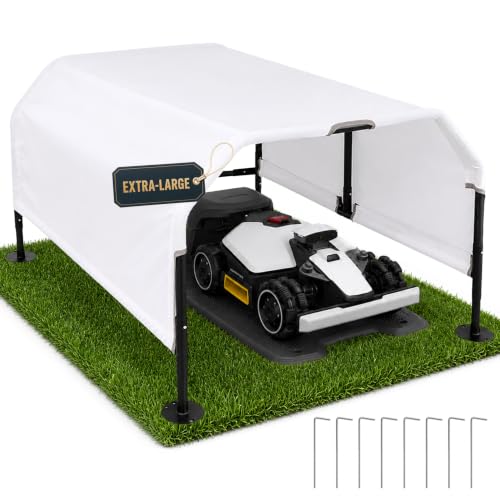
Robot Mower Garage, Rainp…

CNAINFC
Robot Mower Garage, Rainproof UV-Proof Shelter for All Mowers(Large Size) | zero signal obstruction, 35.5×29×17in,Applicable to segway navimow x430 x450, mammotion luba 2 luba 3, worx landroid garage.
- 1. Suitable for large auto mower Features exclusive signal-permeable structure that allows full GPS and RTK signal penetration. co…
- 2. 3D Convection Ventilated System Upgraded upper and lower air circulation design prevents overheating and stuffiness in hot weat…
- Compatible with all robot lawn mowers on the market: Lymow, Segway Navimow, Sunseeker, Mammotion LUBA, ANTHBOT, ECOVACS, MOVA, Gre…
The garage built for the biggest mowers on the market. The CNAINFC shelter is designed around large, high-end robots like the Segway Navimow X430 and X450, Mammotion LUBA 2 and 3, Lymow One Plus, and the MOVA LiDAX Ultra series. If you’ve spent serious money on a large robotic mower, this is the shelter that won’t block its GPS signal.
Signal permeability is the feature that separates this from generic covers. RTK and GPS navigation depend on clear satellite reception, and a metal-roofed or foil-lined shelter can degrade positioning accuracy enough to cause docking failures. The CNAINFC build lets signals pass through while still blocking rain and UV. The 3D convection ventilation system moves air through upper and lower vents, which prevents the heat buildup that cooks charging stations in summer and creates the moisture that corrodes contacts in winter. The white roof reads like a camping tent rather than a shed, so it blends into garden design instead of dominating it.
Honest trade-offs: this is a premium shelter at a premium size, so it will look oversized on a small patio. It’s also fabric-based, meaning a heavy snow load needs clearing rather than ignoring. And the manufacturer recommends storing the mower frost-free when temperatures drop below freezing, so the garage isn’t a full winter solution in cold climates.
- Compatible with Segway Navimow, Mammotion LUBA, Lymow, MOVA, WORX, and more
- Signal-permeable structure for GPS and RTK reception
- 3D convection ventilation prevents overheating and moisture
- White tent-style roof blends into garden design
- Easy to disassemble and store in winter
Best for: Owners of large, RTK-dependent robotic mowers who need shelter that won’t interfere with navigation signals.
How We Chose These Products
We started with coverage ratings and worked backward. A mower claiming a quarter acre needs to prove it can actually cut that much per charge without running the battery to zero and crawling home at 10 percent. We looked at deck width, battery capacity, and navigation method because those three variables determine real-world throughput more than any marketing number.
Navigation came next. Boundary wire is reliable but permanent, and on a large, complex property it’s a genuine installation project. Wire-free systems trade that labor for different constraints: RTK needs sky view, vision needs light, and magnetic strips need to be laid and occasionally repositioned. We favored systems that acknowledge those limits rather than pretending they don’t exist. If you’re weighing GPS against virtual boundary approaches, our virtual boundary comparison breaks down the trade-offs in more detail. Shelters were judged on signal permeability, ventilation, and material durability, since a garage that blocks GPS is worse than no garage at all.
Buying Guide: What Really Matters
Coverage ratings assume ideal conditions. A mower rated for a quarter acre will handle a flat, open quarter acre fine. Add slopes, tight passages, and multiple zones, and effective coverage drops by 20 to 30 percent because the mower spends more time navigating and less time cutting. Buy one size up from your actual lawn if your property is complex. For a deeper look at how GPS-assisted navigation handles hills, our GPS hillside guide covers slope behavior in detail.
Cutting width drives mowing time per acre more than battery size does. A wider deck covers more ground per pass, which means fewer passes and less battery drain per square foot. If your lawn is genuinely large, prioritize deck width over a slightly bigger battery. Battery capacity still matters for total runtime, but a wide deck on a modest battery often outperforms a narrow deck on a big one.
Navigation type determines your setup work and your long-term reliability. Boundary wire is the most proven but requires trenching and can break. RTK Cloud is precise but needs sky view. Vision AI is flexible but struggles in shade. Magnetic strips are quick to install but need occasional repositioning. Pick the system that matches your yard’s actual conditions, not the one with the best spec sheet.
Our Top Recommendation
For most large-lawn buyers, the WORX Robot Lawn Mower for 1/4 Acre is the strongest overall pick. RTK Cloud gives it centimeter-level accuracy without a subscription, V-SLAM keeps it navigating through shade, and the unlimited zone system handles genuinely complex properties. It’s the mower that solves the hard problems.
If your lawn is smaller and you want the simplest possible setup, the LEBOSBO V3 or YARDCARE AI Vision are both solid wire-free choices with flexible magnetic no-go zones. They’re compact-lawn tools, not acreage machines, so match them to the right yard size. And if you’ve already invested in a large mower, the CNAINFC garage protects it without blocking the GPS signal it depends on, while the Universal Mower Garage offers a budget-friendly option for mid-size models.
Frequently Asked Questions
How long does a large robotic mower actually take to cut an acre?
It depends on deck width and battery runtime. A mower with a wide deck and a large battery might cover an acre in 6 to 10 hours of cumulative runtime across multiple charge cycles. Narrow-deck mowers on the same lawn can take 15 hours or more. The mower works in sessions, returning to charge between them, so the total time from start to finish is longer than the runtime figure suggests.
Do I need a garage for a robotic mower, or can it sit outside?
Most robotic mowers are weather-rated and can handle rain. The garage matters more for UV protection, which degrades plastic and rubber over years, and for keeping the charging contacts dry. Ventilation is the underrated benefit: a closed shelter without airflow traps heat and moisture, which is worse than open air. The CNAINFC’s 3D convection design addresses this specifically.
Will a GPS or RTK mower work under trees?
Partially. RTK needs a clear sky view to maintain centimeter accuracy. Under dense canopy, accuracy drops and the mower may drift or fail to dock. V-SLAM sensor fusion, like the WORX system uses, helps bridge shaded stretches by using visual landmarks instead of satellites. Pure RTK mowers without a fallback navigation method struggle in heavily wooded yards.
What’s the real cost of owning a large robotic mower beyond the purchase price?
Blades need replacing every 1 to 3 months on a large lawn, and a set runs modestly. Batteries typically last 2 to 4 years before capacity drops enough to affect runtime, and replacements aren’t cheap on large-capacity packs. RTK subscriptions are the wildcard: some brands charge monthly for cloud corrections, others include them free. The WORX system includes RTK Cloud at no additional cost, which saves real money over a five-year window. For more on battery life expectations, our GPS and battery life guide covers what to expect long term.


