Best Sprinklers for Low Water Pressure: 5 Picks That Actually Work Under 20 PSI
Contents
Your hose dribbles out a weak stream and the lawn is turning brown. You’ve probably tried a standard oscillating sprinkler already, and it just sat there sputtering. Low water pressure ruins most sprinklers, but it doesn’t have to ruin your yard.
A sprinkler built for low pressure has a wider internal flow path, a nozzle designed to work at 15–20 PSI, and a spray pattern that doesn’t collapse when flow drops. The wrong sprinkler needs 40+ PSI just to spin, which is why so many people give up on well systems or older municipal lines.
Below are five sprinklers that genuinely function at low pressure, plus a diagnostic guide so you can measure your own PSI before buying. If you want a broader overview of the category, our lawn sprinklers guide covers more options.
Here’s a quick spec comparison before the detailed reviews:
| Features | Dramm 15073 Yellow | Dramm 15074 Green | SYOOY 360 Metal | Dramm Berry Spinning | BILAL Metal Spot |
|---|---|---|---|---|---|
| Material & Build | Heavy-duty stationary base | Heavy-duty stationary base | Polished heavy-duty metal | Heavy-duty stationary base | Solid rust-resistant alloy |
| Minimum PSI | 20 PSI | 20 PSI | Not specified | 20 PSI | 15 PSI |
| Max Coverage | 38 ft diameter | 38 ft diameter | 0–8 m diameter | 38 ft diameter | 30 ft diameter |
| Spray Pattern | Spinning circular | Spinning circular | 360-degree circular | Spinning circular | 360-degree circular |
| Best Use Case | Well systems, medium lawns | Well systems, medium lawns | Small beds, patios | Well systems, flowerbeds | Small lawns, tight spaces |
This is the pick for someone on a well system who’s tired of watching sprinklers stall out. The Dramm 15073 spins into motion at just 20 PSI, which is roughly the pressure a typical residential well pump produces at the tap. If your kitchen faucet runs weak, this sprinkler will still work.
The spinning action throws water in a circular pattern up to 38 feet across. That’s a genuine coverage number for a stationary sprinkler, and the heavy base keeps it from tipping when the hose tugs on it. The molded hook on top makes it easy to hang in the garage between uses. It’s also available in six colors, which sounds trivial until you’ve lost a green sprinkler in tall grass.
The trade-off is that spinning sprinklers distribute water less evenly than a good oscillating model at high pressure. At 20 PSI you’ll see slightly heavier coverage near the center. You’ll also want to move it every 20–30 minutes for even watering. It’s not a set-and-forget sprinkler.
- Works from 20 PSI, ideal for well systems
- 38-foot diameter coverage
- Heavy stationary base resists tipping
- Molded storage hook
- Available in six colors
Best for: Well-system homeowners with medium lawns who need a sprinkler that starts moving at low PSI.
Dramm 15074 ColorStorm Spinning Sprinkler
1st Pick

Dramm
Dramm 15073 ColorStorm Spinning Sprinkler, Yellow
- Creates a very unique and beautiful spray pattern
- Covers an area up to 38 Feet in diameter
- Works with a water pressure from a low of 20 PSI, great for well systems
Functionally, this is the same sprinkler as the 15073 above, just in green. It targets the same buyer: someone with a low-pressure well or an older municipal line who needs reliable spinning coverage without a booster pump. The 20 PSI minimum is the headline feature.
Coverage reaches 38 feet in diameter, and the stationary base holds firm on uneven ground. The green colorway blends into a lawn better than yellow, which matters if you leave sprinklers out for days at a time. Storage hook is molded into the body, so no extra bracket needed.
Availability is the real limitation here. This color tends to sell out faster than the others, so if you specifically want green, check stock before committing. Performance-wise, expect the same slightly uneven distribution as the yellow version at low pressure.
- Same 20 PSI minimum as the yellow model
- 38-foot diameter spray coverage
- Green colorway hides in grass
- Heavy stationary base
- Stock can be limited
Best for: Buyers who want the Dramm spinning design in a color that disappears into the lawn.
360 Degree Metal Spot Sprinkler
2nd Pick

Dramm
Dramm 15074 ColorStorm Spinning Sprinkler, Green
- Creates a very unique and beautiful spray pattern
- Covers an area up to 38 Feet in diameter
- Works with a water pressure from a low of 20 PSI, great for well systems
Spot sprinklers solve a different problem than full-lawn coverage. This SYOOY model is for the person watering a flowerbed, a patio planter row, or a small vegetable patch where a 38-foot sprinkler would soak the sidewalk and the fence.
The body is polished heavy-duty metal, which holds up better than the plastic heads that crack after one season. It sprays in a full 360-degree circle with a range of 0–8 meters depending on your pressure. At low PSI the spray stays close, which is actually useful for tight beds. The metal construction also means it won’t warp if you leave it in the sun.
Here’s the honest catch: the manufacturer doesn’t publish a minimum PSI rating. The 5 kg pressure tolerance suggests it handles moderate flow, but if your system is truly anemic, you’ll get a small wet circle and nothing more. It’s a spot waterer, not a lawn sprinkler.
- Polished heavy-duty metal construction
- 360-degree circular spray
- Coverage scales with pressure (0–8 m)
- Fits standard garden hose threads
- No published minimum PSI
Best for: Gardeners watering small beds, planters, or patio containers where a full-size sprinkler overshoots.
Dramm ColorStorm Spinning Sprinkler (Berry)
3rd Pick

SYOOY
360 Degree Metal Spot Sprinkler,Small Sprinkler Garden for Small Areas | Lawn Sprinklers for Yard Circle Pattern with Gentle Water Flow Garden Watering (1, Yellow)
- 360 Degree Metal Spot Sprinkler: Small sprinkler is made of heavy-duty metal with bright colors, the surface of the garden sprinkl…
- 30FT Coverage Watering: Sprinklers for yard the distance of water jet is related to the size of water pressure. Small water pressu…
- Easy to Use: The lawn sprinkler circular pattern design enables 360-degree spray without leaks. Even spray, water-saving design, e…
This is the same ColorStorm platform in a berry colorway. The audience is identical to the other two Dramm spinning models: low-pressure homes that need a sprinkler to actually rotate at 20 PSI.
What stands out is the combination of the gentle spin and the heavy base. The water lands softly, which is easier on seedlings and young transplants than a hard oscillating spray. Coverage reaches 38 feet in diameter, so it handles small to medium lawns and mixed flowerbeds without repositioning constantly.
The berry color is the least common of the six options, so stock is often scarce. If you’re not set on the color, the yellow and green versions are usually easier to find. Performance is identical across all three.
- Gentle spinning spray, easy on young plants
- 20 PSI minimum for well systems
- 38-foot diameter coverage
- Heavy stationary base
- Scarce stock in this colorway
Best for: Gardeners with seedlings or new plantings who want gentle watering at low pressure.
Metal Spot Sprinkler, Lawn Sprinkler for Yard
4th Pick

Dramm
Dramm ColorStorm Spinning Sprinkler with Heavy Duty Stationary Base , Works with Low PSI of 20 or More, Perfect for Well Systems, Berry, Covers 38 Sq Feet
- Unique & Beautiful Spray Pattern – Provides a gentle, spinning water distribution that enhances plant hydration.
- Covers Up to 38 Ft in Diameter – Ideal for small to medium-sized lawns, gardens, and flowerbeds.
- Works with Low Water Pressure (20+ PSI) – Perfect for well systems and areas with lower water flow.
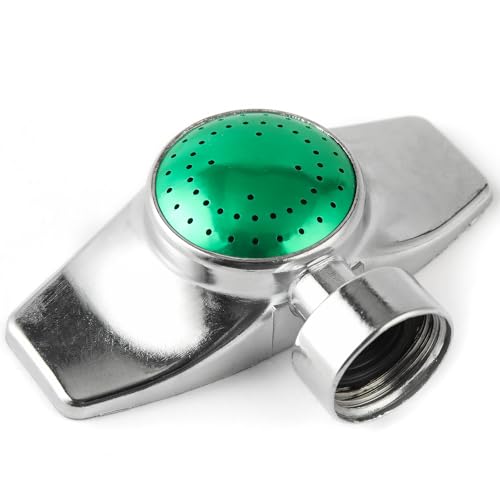
This BILAL spot sprinkler is the most pressure-tolerant option in the group. It’s rated to work from 15 to 80 PSI, which means it functions on genuinely weak systems and doesn’t blow apart if your pressure spikes. That range is unusual for a spot sprinkler.
Coverage tops out around 30 feet in diameter, and the water falls in a soft 360-degree rain pattern. Rubber O-rings at the connector reduce leaks, which matters when every drop of pressure counts. Solid alloy metal resists rust, so it survives seasons of outdoor storage better than plastic heads.
The limitation is the same as any spot sprinkler: it’s not built for large lawns. A 30-foot circle is fine for a small yard or a cluster of beds, but you’d need several to cover a quarter-acre. The 15 PSI floor is the real selling point here.
- Works from 15 to 80 PSI
- 30-foot diameter coverage
- Rust-resistant solid alloy metal
- Rubber O-rings reduce leaks
- Fits standard 3/4-inch hose threads
Best for: Anyone with pressure so low that most sprinklers won’t even start, especially small-yard owners.
How Low Water Pressure Affects Sprinkler Performance
5th Pick
BILAL
Metal Spot Sprinkler, Lawn Sprinkler for Yard, 1 Pack | with Gentle Water Flow for Small Area-Coverage Up to 30FT, Watering Sprinkler Head for Hose
- Metal Spot Sprinkler: Small sprinkler is made of heavy-duty solid alloy metal, resistant to rust, more durable than other plastic…
- 30FT Coverage: The low pressure sprinkler can watering coverage up to 30FT diameter area. The water jetting distance is adjustable…
- Easy to Use: Fitting with all US standard 3/4 inch garden hose, equipped with rubber O-rings, can protect the connector more sturd…
Most sprinklers are designed around 40–60 PSI. Drop below 30 and the mechanics start failing. Oscillating sprinklers stop sweeping. Impact sprinklers stop hammering. Rotary gear drives stall out entirely.
Two numbers matter: PSI (pressure) and GPM (flow rate). Pressure is the push. Flow rate is the volume. A sprinkler can have plenty of pressure and still underperform if the flow rate is too low to supply the nozzle.
PSI vs. GPM explained
Think of a garden hose like a straw. PSI is how hard you blow. GPM is how much air moves. A sprinkler rated for 20 PSI needs both 20 PSI at the head and enough GPM to feed the spray pattern.
Here’s a rough guide to what different PSI levels can support:
- 15–20 PSI: Spot sprinklers, some spinning models, drip irrigation
- 20–30 PSI: Spinning sprinklers, small oscillating models
- 30–40 PSI: Most oscillating and rotary sprinklers
- 40+ PSI: Impact sprinklers, traveling sprinklers, large coverage models
How to measure your water pressure at home
Buy an inline pressure gauge that screws onto a hose bib. They’re cheap and take thirty seconds to use. Attach it to the spigot closest to where you’ll run the sprinkler, turn the water on full, and read the dial.
Do this before you buy anything. A reading of 25 PSI tells you to skip oscillating sprinklers entirely. A reading of 45 PSI means you have more options than you thought. Also test at a second spigot if you have one, since pressure drops along the line.
Comparison Table — PSI, GPM, Coverage
Here’s how the five picks stack up on the specs that matter most for low-pressure systems:
| Model | Min PSI | Max Coverage | Type | Best For |
|---|---|---|---|---|
| Dramm 15073 Yellow | 20 | 38 ft diameter | Spinning | Medium lawns, wells |
| Dramm 15074 Green | 20 | 38 ft diameter | Spinning | Medium lawns, wells |
| SYOOY 360 Metal | Not specified | 0–8 m diameter | Spot | Small beds, patios |
| Dramm Berry Spinning | 20 | 38 ft diameter | Spinning | Seedlings, flowerbeds |
| BILAL Metal Spot | 15 | 30 ft diameter | Spot | Very low pressure, small yards |
How to Choose a Low-Pressure Sprinkler
Nozzle design decides whether a sprinkler works at low PSI. Wide internal flow paths let water move without needing high pressure to push it through. Narrow nozzles create backpressure and kill performance.
Nozzle design and internal flow path
Spinning sprinklers like the Dramm models use a rotating deflector instead of a gear drive. Fewer moving parts means less pressure needed to start motion. Spot sprinklers use a simple fixed deflector, which is even more forgiving.
Avoid impact sprinklers and traveling sprinklers if your PSI is under 35. They rely on mechanical force to operate and simply won’t cycle at low pressure.
Minimum PSI by sprinkler type
Spot sprinklers typically need 15–20 PSI. Spinning sprinklers need around 20. Oscillating models need 25–30. Rotary gear drives need 30–35. Impact and traveling sprinklers need 40+.
If you’re unsure which type fits your yard, our best water sprinklers for yard breakdown covers the trade-offs in more detail.
Hose diameter, length, and elevation loss
A 5/8-inch hose loses less pressure than a 1/2-inch hose over the same distance. If your run is longer than 50 feet, use 5/8-inch or 3/4-inch hose. Every foot of elevation gain costs you roughly 0.43 PSI, so a sprinkler at the top of a slope gets noticeably less pressure than one at the bottom.
Well Water vs. Municipal Water Systems
Well systems usually deliver 20–40 PSI at the tap, and the pressure drops as the pump cycles. Municipal systems are more consistent but can sag during peak demand hours, especially in older neighborhoods with undersized lines.
Well owners should prioritize sprinklers rated for 20 PSI or lower. Municipal users with borderline pressure can often get away with a spinning sprinkler and a shorter hose run. Either way, measure before you buy.
When No Sprinkler Works: Booster Pumps and Regulators
Sometimes the problem isn’t the sprinkler. If your PSI is under 15, no off-the-shelf sprinkler will perform well. A booster pump raises pressure at the spigot, and a pressure regulator protects fixtures if your pressure is too high in other parts of the system.
Booster pumps are the more common fix for low-pressure irrigation. Our water pressure booster pump guide covers sizing and installation if you want to go that route. For most small yards, though, a 15 PSI spot sprinkler is cheaper and simpler than adding a pump.
Our Top Recommendation
The Dramm 15073 ColorStorm Spinning Sprinkler is the best overall pick for low-pressure lawns. It starts at 20 PSI, covers 38 feet, and the heavy base stays put. For well-system owners, it’s the most reliable off-the-shelf option.
If your pressure is below 20 PSI, the BILAL Metal Spot Sprinkler is the safer choice. It works down to 15 PSI and costs less. For small beds and patios, the SYOOY 360 Metal Spot Sprinkler handles tight spaces where a full-size sprinkler would overspray.
Frequently Asked Questions
Can I run a sprinkler on a well system with 20 PSI?
Yes, but only sprinklers rated for that pressure. The Dramm spinning models and the BILAL spot sprinkler both work at or below 20 PSI. Standard oscillating sprinklers will not.
Will a longer hose reduce my sprinkler’s performance?
Yes. Every additional 10 feet of hose costs pressure, especially with 1/2-inch diameter. Use 5/8-inch hose for runs over 50 feet, and keep the sprinkler as close to the spigot as practical.
Do I need a booster pump for my sprinkler?
Only if your measured PSI is below 15 and you need broad coverage. For small yards, a low-PSI spot sprinkler is usually enough. A booster pump makes sense when you’re irrigating a large area and want to run a standard sprinkler.
How do I know if my low pressure is a sprinkler problem or a plumbing problem?
Test with a pressure gauge at the spigot. If the reading is under 20 PSI with no hose attached, the issue is your supply, not the sprinkler. If the reading is fine at the spigot but weak at the sprinkler, the hose or the sprinkler itself is the bottleneck.