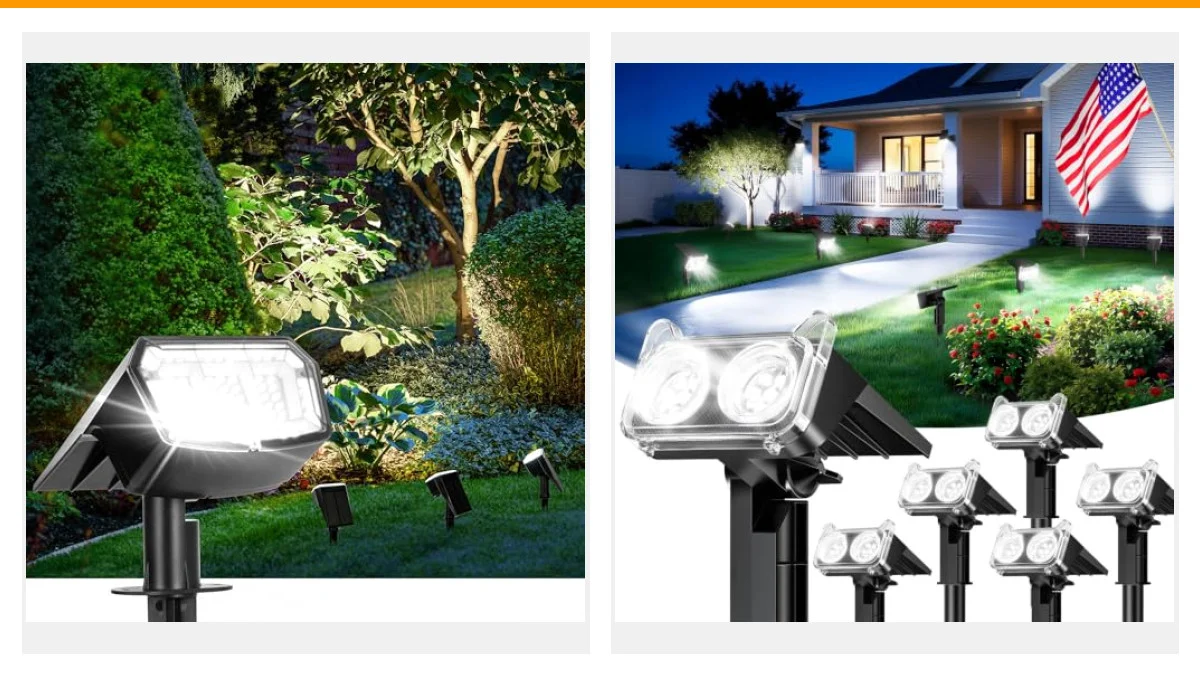
You’ve probably done the dance: dragging extension cords across the lawn, tripping a breaker, or forgetting to switch off the path lights before bed. Solar rock lights solve all three problems at once. They hide in the garden like actual stones during the day, then wake up at dusk and light the walkway without you lifting a finger.
A good solar rock light needs four things to earn its spot in your yard. It has to charge fast enough to survive cloudy stretches. The output must be bright enough to see where you’re stepping without looking like a runway beacon. The housing has to shrug off rain and frost. And the spot angle should be adjustable, because a rock pointed at the fence is a wasted rock.
We looked at what’s currently available and found one standout option worth your attention: the DGSCAK Solar Rock Lights 4-Pack. Below is our full breakdown, including a spec table, real-world runtime expectations, winter behavior, cost math, and troubleshooting tips. If you want the short version: it’s a solid pick for most yards, with a couple of caveats worth knowing before you buy.
Here’s a quick side-by-side of the key specs to help you decide at a glance.
| Features | DGSCAK Solar Rock 4-Pack |
|---|---|
| Material & Build | High-density resin, faux rock texture |
| Key Specification | IP44 water-resistant rating |
| Main Feature | Adjustable up/down spotlight angle |
| Performance | Auto dusk-to-dawn, larger solar panel |
| Best Use Case | Pathways, flower beds, yard accents |
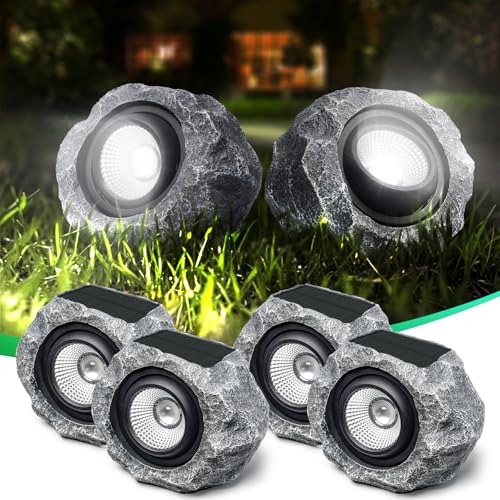
DGSCAK Solar Rock Lights 4-Pack
DGSCAK
Solar Rock Lights Outdoor 4 Pack, Gray Faux Rock Landscape Spotlight Yard | Solar Landscape Lights, Realistic Stone Design, Auto On/Off, IP65 Waterproof, Adjustable Outdoor Spotlights for Patio Garden
- 【Upgraded Larger Solar Panel & Efficient Power Supply】Equipped with newly upgraded larger solar panels, these solar powered outdoo…
- 【Realistic Rock Shape & Multi-Scene Decorative Lighting】Realistic natural rock texture and size blend seamlessly into your garden,…
- 【Water-Resistant & All-Weather Durability】Made of high-density resin material, the solar spotlights outdoor waterproof feature IP4…
This is the one we’d hand to a homeowner who wants path lighting without running wire. The 4-pack covers a typical front walk or a flower bed border in one purchase. It suits renters too, since there’s no mounting hardware and no holes to drill. You set the rock down, flip the switch, and you’re done.
The standout feature is the adjustable head. Most rock lights lock you into a fixed beam, which means half your light ends up aimed at the shrubs. Here you can tilt the spotlight up or down to hit the exact patch of ground you care about. The upgraded solar panel is noticeably larger than the older generation of rock lights, so it pulls in more charge during short winter days. That matters more than the marketing copy suggests. A bigger panel means the battery recovers faster after a gray weekend, and you’ll see fewer nights where the light fades by 9 p.m.
Two honest trade-offs. First, IP44 means splash-resistant, not submersible. It handles rain and sprinkler overspray fine, but don’t leave it sitting in a puddle or buried in wet mulch. Second, the sensor can get confused if another light source shines on it at night. A porch lamp or a bright streetlight within a few feet will keep it off. Placement is the whole game here.
- 4-pack covers roughly 12–16 feet of pathway when spaced evenly
- Larger solar panel improves recharge speed on cloudy days
- Adjustable head lets you aim light at steps, plants, or walls
- Resin body resists frost, rain, and high heat year-round
- No wiring, no tools, no mounting bracket needed
Best for: Homeowners who want quick, wire-free path lighting and don’t mind repositioning rocks once to nail the sensor placement.
How We Chose These Products
We started with the basics: does the light charge itself, turn on at dusk, and survive a real winter? Products that failed any of those got cut. From there we weighed panel size against battery behavior, because a big panel with a weak cell still dies by midnight in January.
We also factored in placement flexibility. A rock light is only useful if you can aim it. Fixed-angle models lost points against adjustable ones. Finally, we looked at pack size against real coverage. A 4-pack that covers a full walkway beats a 2-pack that leaves gaps, even if the 2-pack has slightly better specs on paper.
Buying Guide: What Really Matters
Brightness is the first thing buyers obsess over and the last thing that actually matters. Lumens tell you raw output, but beam angle decides whether that output hits the ground or scatters into the dark. A 100-lumen light with a tight 30-degree beam will look brighter on a path than a 200-lumen light spread over 120 degrees. Check both numbers, not just the first one.
Solar panel and battery efficiency drive everything else. Monocrystalline panels convert more sunlight per square inch than older poly panels, which is why the DGSCAK unit’s larger panel is a real upgrade and not just a size boast. Pair that with a battery rated for cold weather and you get lights that still work in February. If a listing doesn’t mention the panel type or battery chemistry, treat that as a warning sign.
Waterproof ratings get fudged constantly. IP44 means protected against splashing water. IP65 means protected against water jets. IP67 means it can survive brief submersion. For rock lights sitting in mulch or on a lawn, IP44 is workable but IP65 is safer if you live somewhere with heavy rain or snowmelt. Verify the rating in the product description, not the marketing headline. And check the warranty. A one-year warranty on an outdoor light is thin. Two years is reasonable. Anything less suggests the maker doesn’t trust its own seals.
Winter and Cold-Weather Performance
Cold drains batteries. That’s physics, not a defect. A lithium cell that runs 8 hours in July might deliver 5 or 6 hours in January, and shorter days mean less charge to begin with. Expect reduced runtime from any solar light between November and February, including this one.
The workaround is placement. Move rocks to the sunniest spot in your yard during winter, even if that’s not where you want them aesthetically. Clear snow off the panels after a storm. If you get long stretches of heavy overcast, plan on the lights running dim or not at all for a few days. That’s normal. If you need guaranteed year-round output, you’d want a wired fixture instead. For more options that handle cold weather better, see our guide to the best solar ground lights.
Cost-Per-Unit Value Breakdown
A 4-pack spreads the cost across more lights, which drops the per-unit price compared to a 2-pack. That’s the obvious math. The less obvious math is lifespan. Resin housings can crack after years of freeze-thaw cycles, and batteries lose capacity after 500 to 800 charge cycles, which works out to roughly two to three years of nightly use.
So the real cost isn’t just the sticker price divided by four. It’s that number divided by the usable years. A cheap 4-pack that dies in 18 months costs more per year than a slightly pricier set that runs three seasons. Check the current price on Amazon and compare it against replacement battery availability. If you can swap the cell, you’ll double the light’s life for a few dollars.
Common Problems and Troubleshooting
Dim output is the most common complaint. Nine times out of ten it’s a dirty panel or a shaded location. Wipe the panel with a damp cloth and check for tree cover. If the light worked fine for months and suddenly faded, the battery is probably aging out.
Lights that stay off at night usually have a sensor problem. Something nearby is shining light on the photocell and tricking it into thinking it’s daytime. Move the rock a few feet away from porch lamps, security lights, or reflective surfaces. Moisture inside the housing is a seal failure. If you see fog behind the lens, the IP rating has been compromised. Dry it out and consider relocating it away from sprinkler heads.
For a broader comparison of outdoor lighting styles, our roundup of the best solar lawn lights covers stake-mounted and flush options that pair well with rock lights along a walkway.
Frequently Asked Questions
How many hours will these actually run per night? In summer, expect 6 to 8 hours on a full charge. In winter, plan on 4 to 5 hours, sometimes less during overcast stretches. The auto dusk-to-dawn sensor means they’ll stay on until the battery drains, not until sunrise, so runtime depends entirely on how much sun the panel got that day.
Can I leave them outside all winter? Yes, the resin housing handles frost and snow. But clear snow off the panels and move them to a sunny spot. The battery will run shorter, and that’s normal for any solar fixture in cold weather.
Will they work under a porch or in shade? No. Solar lights need direct sun for several hours a day to charge. A shaded spot means a dead light by the second night. If your path is fully shaded, you’ll need a wired option instead.
Do they attract insects? White LEDs attract far fewer bugs than warm or UV-heavy bulbs. You’ll see some moths on humid nights, but nothing like a porch light. Keep them aimed at the ground rather than up at eye level to minimize it.
If you want a different look entirely, our guide to the best flickering flame solar lights covers the warm, decorative end of the spectrum.
Our Top Recommendation
The DGSCAK Solar Rock Lights 4-Pack is the pick for most yards. The adjustable head, larger solar panel, and four-light coverage make it a practical one-purchase solution for a front walk or garden bed. It’s not the brightest option on the market, and IP44 means you should keep it out of standing water, but for the price and convenience it’s hard to beat.
If your budget is tighter, a 2-pack of the same style will cover a short path. If you need something brighter for a long driveway, look at higher-lumen stake lights instead. And if cold weather is your main concern, prioritize models with IP65 ratings and user-replaceable batteries.
For a second opinion on this category, the team at Smart Home Review has tested several rock light models side by side.