

Best Solar Electric Fence Chargers: 5 Trusted Picks for Livestock, Gardens, and Remote Pastures
Contents
I spent three weekends last spring trying to keep a neighbor’s goats out of my vegetable garden. The first solar charger I bought died after two cloudy days. The second one claimed ten miles of coverage but barely pushed a pulse through wet grass. The third arrived with instructions that looked like they were translated twice. Somewhere between returning boxes and re-reading product pages, I figured out which specs actually matter and which ones are marketing noise.
A good solar fence charger does three things well: it stores enough energy to run through the night, it pushes a pulse strong enough to get an animal’s attention, and it survives weather that would ruin a cheaper unit. Joule rating, output voltage, battery capacity, and mounting flexibility matter far more than the mileage claim on the box. Soil conditions and grounding quality also shape real-world performance, which is why two farms with identical chargers can get very different results.
Below are five chargers I’d actually recommend, sorted by use case. The Epoify 24-Hour model is the best all-rounder for most livestock setups. The Zareba is the proven workhorse for anyone who wants a long track record. The other three cover portability, large-animal power, and short-circuit safety. If you’re also sorting out fencing for smaller animals, our guide to the best electric fence for dogs covers a different set of priorities.
Here’s a quick spec comparison of all five chargers before we get into the details.
| Features | Epoify 24-Hour | Zareba Solar Charger | Zhangmengge 10-Mile | Epoify LD02 | Gorhope 10-Mile |
|---|---|---|---|---|---|
| Output Energy | 0.18J | 0.15J | 0.18J | 1.2J | 0.18J |
| Coverage Claim | Up to 10 miles | Up to 5 miles | Up to 10 miles | Not specified | Up to 10 miles |
| Voltage Output | 5700-10200V | Not specified | 5700-10200V | 7-11kV | 5700-10200V |
| Standout Feature | 24/7 day-night operation | 2-week battery reserve | Ultra-portable design | 1.2J for large livestock | Short-circuit alarm |
| Best Use Case | Small to medium pastures | Remote cattle fencing | Movable pet and garden fences | Cattle and horse enclosures | Weather-exposed fence lines |
Epoify 24-Hour Solar Elec…
1st Pick
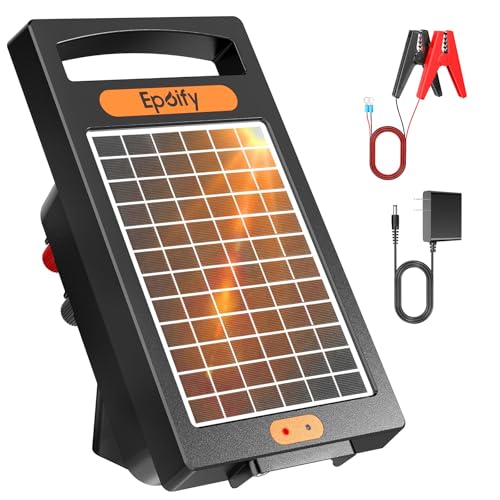
Epoify
Epoify 24-Hour Solar Electric Fence Charger, 0.18J, 10-Mile for Livestock
- 0.18J OUTPUT FOR LIVESTOCK CONTROL & PREDATOR DETERRENCE: This solar fence charger delivers a consistent 0.18 Joule pulse to conta…
- Ground Rod Setup: Rod Placement Rod 1: within 20 ft of energizer. Rod 2: 10 ft from Rod 1. Rod 3: 10 ft from Rod 2. Use 20 kV insu…
- 24/7 CONTINUOUS OPERATION—DAY CHARGING, NIGHT PROTECTION: Built-in large capacity battery,this all-in-one solar electric fence sto…
The Epoify 24-Hour charger is the one I’d hand to a smallholder with a mixed herd. It runs cattle, goats, and poultry on the same fence line, and the 0.18J pulse is enough to get a raccoon’s attention without being overkill for smaller animals. The all-in-one design means no separate battery box to mount or wire, which saves an hour of setup on a hot afternoon.
What sets this model apart is the day-charging, night-protection cycle. The built-in battery soaks up sun during daylight and keeps the fence live after dark, when predators tend to move. Output sits between 5700 and 10200 volts, which is a healthy range for pasture fencing. The grounding instructions are unusually detailed, and that matters. Most fence failures I’ve seen trace back to a lazy ground rod setup, not a weak charger.
The honest catch: the 10-mile rating assumes clean fence lines and properly maintained vegetation. Let weeds grow into the wire and effective coverage shrinks fast. You’ll also want to follow the grounding layout exactly, with rods spaced as directed and kept well away from utility grounds. Skip that step and the unit underperforms in ways that look like a defect but aren’t.
- 0.18J output with 5700-10200V pulse range
- Built-in battery charges by day, runs all night
- Detailed three-rod grounding instructions included
- Suited to cattle, goats, poultry, and predator deterrence
- Rated for up to 10 miles with proper vegetation control
Best for: Small to medium farms that want one solar charger covering mixed livestock and predator control without daily battery checks.
Zareba Solar Electric Fen…
2nd Pick
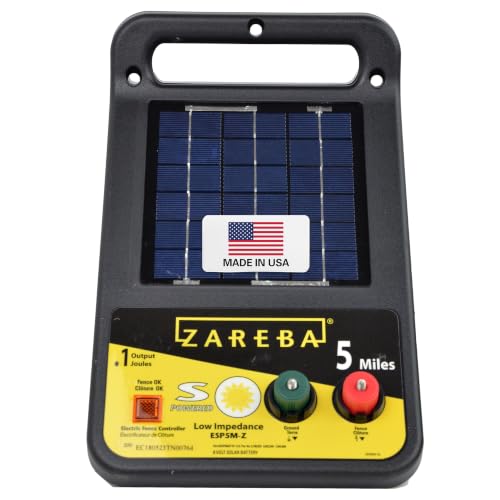
Zareba
Zareba Solar Electric Fence Charger, 5 Mile Range Low Impedance Energizer
- SOLAR POWER: Use this solar electric fence charger to energize up to 5 miles of electric fencing in ideal conditions, providing re…
- VERSATILE MOUNTING: Featuring a built-in mounting bracket that’s compatible with T-posts, Y-posts, and round-wood posts, this catt…
- EXTENDED OPERATION: Operate continuously for up to 2 weeks without sunlight, as the solar cattle fence energizer stores sufficient…
Zareba has been making fence energizers for decades, and it shows in the small details. This 5-mile unit is the pick for anyone fencing remote pasture where AC power simply isn’t an option. The 0.15J low-impedance output drains the battery slowly, which means less strain during long stretches of gray weather.
The standout number here is two weeks of operation without sunlight. That’s not a marketing flourish; it’s the difference between a fence that stays hot through a rainy week and one that quits on day three. The built-in bracket rotates 360 degrees and fits T-posts, Y-posts, and round wood, so you can angle the panel toward the sun no matter how the fence runs. Full-load testing happens in the USA after manufacturing, and the unit is designed to shrug off lightning damage.
Coverage tops out at 5 miles, which is half of what the Epoify claims. That’s the trade-off. For a smaller paddock or a rotational grazing setup, 5 miles is plenty. For a sprawling ranch perimeter, you’d need two units or a bigger energizer. The lower joule rating also means it’s less punchy on extremely dry, rocky ground where grounding is already a challenge.
- 0.15J low-impedance output reduces battery drain
- Runs up to 2 weeks without sunlight
- 360-degree rotating bracket fits T-posts, Y-posts, and round wood
- Lightning-damage protection built in
- Full-load tested in the USA after manufacturing
Best for: Ranchers and homesteaders fencing remote cattle or horse pasture who value proven reliability over maximum coverage claims.
10 Miles Solar Powered El…
3rd Pick

Zhangmengge
10 Mile Solar Powered Eiectic Fece Chaler, 0.18J PortabiIe for Livestook
- 【Ultra-Portable Solar Charger】Designed for convenience, this lightweight solar electric fence charger can be quickly moved between…
- 【24/7 Power, Rain or Shine】Don't worry about your ground safety, as it provides 24/7 uninterrupted protection all day long. Our al…
- 【Upgrade Solar Panels】We have upgraded the solar panel of the solar powered electric fence to a thicker and larger size, which can…
If the last pick felt like a permanent installation, this Zhangmengge unit is the opposite. It’s built to move. The lightweight body and all-in-one design mean you can carry it from the backyard chicken coop to a grazing paddock in a single trip. Dog owners, goat keepers, and gardeners rotating poultry netting will get the most out of it.
The upgraded solar panel is noticeably larger and thicker than what you’ll find on many budget chargers, which helps it recover charge faster on partly cloudy days. Output matches the Epoify at 0.18J and 5700-10200V, so it can handle deer and bear pressure around crops, not just small pets. The kit includes everything needed to run without an external battery, which keeps the setup simple for first-time fence owners.
Portability comes with a cost. A charger you move often is a charger that gets bumped, unplugged, and left in odd positions. The 10-mile rating assumes ideal conditions, and in practice you’ll see less on a fence line with tall grass. It’s also not the unit I’d choose for a permanent cattle perimeter where vibration and weather exposure are constant.
- 0.18J output with 5700-10200V pulse
- Upgraded larger solar panel for faster recharge
- All-in-one kit, no external battery needed
- Lightweight enough to relocate between fences
- Rated up to 10 miles in ideal conditions
Best for: Homesteaders and pet owners who move their fence line regularly and want a grab-and-go solar charger.
Epoify Solar Electric Fen…
4th Pick

Epoify
Epoify Solar Electric Fence Charger LD02, 1.2J with Short Circuit Alarm
- Powerful 1.2J Energy for Large Livestock: Deliver 1.2J stored energy with a stable 7–11kV pulse output to maintain reliable fence…
The Epoify LD02 is a different animal from the rest of this list. At 1.2J, it delivers roughly six times the stored energy of the 0.18J units. That extra punch matters for cattle and horses, which have thicker hides and more muscle mass than goats or poultry. If your current charger makes animals flinch but not back off, this is the upgrade path.
Output holds steady between 7 and 11kV, which is a tight, predictable range. That consistency is what keeps a long fence line working from the first post to the last. The short-circuit alarm is a practical addition too. When a branch drops on the wire or a gate gets left open, the alarm tells you before you walk the whole perimeter looking for the problem.
Here’s the caveat: 1.2J draws more from the battery, so solar recharge time matters more. In heavy shade or a string of dark days, you’ll notice the difference faster than you would with a 0.18J model. It’s also more charger than a backyard chicken setup needs. Pairing it with poultry netting is like using a tractor to pull a garden cart.
- 1.2J stored energy, roughly six times the 0.18J models
- Stable 7-11kV pulse output for long fence lines
- Short-circuit alarm alerts you to fence faults
- Built for cattle, horses, and other large livestock
- Reduces escapes on high-pressure fence lines
Best for: Cattle and horse owners who need serious stopping power and want an alarm to flag fence problems early.
10 Miles Solar Electric F…
5th Pick

Gorhope
10 Miles Solar Eiectric Fence Charger wlth Short Circuit Alarm,0.18JPowered
- 【Short-Circuit Alarm System】Our solar electric fence charger features a built-in buzzer that instantly alerts you to short-circuit…
- 【Continuous and reliable power supply】This solar fence charger is equipped with a large-capacity lithium-ion battery. Fence charge…
- 【Efficient and stable energy output】This electric fence charger can provide a powerful output voltage ranging from 5700 to 10200 v…
The Gorhope charger is the one I’d recommend for anyone who has ever walked out to find their fence dead and no idea why. A built-in buzzer sounds the moment a short circuit develops, so you know something’s wrong before the animals do. That single feature saves more time than any spec on the box.
The tempered glass face is a real upgrade over the plastic housings common at this price point. It handles rain, snow, and dust without the clouding and cracking that plague cheaper panels. Output runs 5700-10200V at 0.18J, which is the same ballpark as the Epoify and Zhangmengge units. The lithium-ion battery holds enough charge to run up to 14 days without sunlight, which is the longest reserve on this list.
Two things to weigh. The glass surface adds a bit of weight, so it’s not quite as featherlight as the Zhangmengge for constant relocation. And the alarm is loud enough to be useful but not so loud it’ll wake the neighbors, which is either a plus or a minus depending on how far your barn sits from the house.
- Built-in buzzer alerts you to short circuits instantly
- 0.18J output with 5700-10200V pulse range
- Tempered glass housing resists rain, snow, and dust
- Runs up to 14 days without sunlight on a full charge
- Compact design installs or removes in about 2 minutes
Best for: Anyone fencing in exposed weather who wants early warning when a branch or wet vegetation shorts the line. If you’re lighting the same fence line, our roundup of the brightest solar fence lights pairs well with this setup.
How We Chose These Products
I started by filtering out chargers with vague specs. If a listing wouldn’t state joule output or voltage range, it didn’t make the cut. From there I weighed four things: real-world coverage versus claimed mileage, battery reserve for cloudy stretches, grounding and installation guidance, and how each unit handles weather. A charger that quits after two gray days is useless no matter how impressive the box looks.
I also looked at who each charger actually serves. A 1.2J unit is wasted on a chicken tractor. A 0.15J unit will frustrate a cattle rancher. Matching output to animal type and fence length matters more than chasing the highest number. The five picks here each fill a distinct role, and none of them are filler.
Buying Guide: What Really Matters
Joule rating is the first number to check. It measures stored energy per pulse. Small pets and poultry do fine on 0.15J to 0.18J. Cattle and horses need closer to 1J or more to feel a meaningful shock through thick hide. A higher joule rating also helps on long fence lines where voltage drops between posts.
Coverage claims assume ideal conditions. Clean wire, no vegetation touching the fence, moist soil, and a proper ground rod setup. In dry or rocky ground, you may need extra ground rods to get the rated performance. If your soil is sandy or the fence runs through tall grass, cut the claimed mileage in half and plan accordingly.
Battery reserve is the spec most buyers overlook. A charger that runs two weeks without sun gives you breathing room during stormy stretches. One that runs eight hours doesn’t. Look for the reserve figure, not just the solar panel size. If you’re fencing near a garden or coop, our guide to the best hedge trimmers for electric fence trimming helps keep vegetation off the wire.
Our Top Recommendation
The Epoify 24-Hour charger is the pick for most people. It balances output, coverage, and price without forcing you to choose between livestock classes. The 0.18J pulse handles goats, poultry, and predators, and the built-in battery keeps the fence live overnight when it matters most.
For remote pasture with no power access, the Zareba is the safer long-term bet thanks to its two-week reserve and decades of field testing. If you’re fencing cattle or horses, step up to the Epoify LD02 and its 1.2J output. And if you’ve ever lost a day hunting down a fence fault, the Gorhope’s short-circuit alarm is worth the modest premium.
Frequently Asked Questions
How many ground rods do I actually need?
Three is the standard starting point for most solar chargers, spaced as the manufacturer directs and kept at least 50 feet from utility grounds. Dry, sandy, or rocky soil needs more. A weak ground is the most common reason a new charger underperforms.
Will a 0.18J charger stop a bear or a wolf?
It can deter them, but it’s not a guarantee. The 5700-10200V pulse is unpleasant enough to discourage most predators, especially when paired with a well-maintained fence line. For high-pressure areas, a higher-joule unit gives you more margin.
Can I use one charger for both poultry netting and cattle fence?
Technically yes, but the output has to match the toughest animal on the line. A 1.2J unit will work fine on poultry netting, just with more power than needed. A 0.18J unit won’t reliably hold cattle. Match the charger to the largest animal, not the smallest.
What happens to the fence during a week of rain?
It depends on the battery reserve. The Zareba runs up to two weeks without sun. The Gorhope claims up to 14 days. Most 0.18J units manage a few days to a week. If you get long gray stretches, prioritize reserve over coverage claims.