

Top 4 Full Spectrum Light Bulbs: Lab-Style Verification and Room-by-Room Picks
Contents
You flip on the office light at 3 PM and the room feels like a cave. Your eyes ache, your focus drops, and the winter gloom outside does not help. A standard LED at 2700K gives you warm amber light, but it does nothing for alertness or color accuracy.
A good full spectrum bulb fixes that. It mimics daylight across the visible range, holds a high color rendering index, and stays flicker-free. The trick is separating real full spectrum performance from marketing copy. You need to check correlated color temperature, CRI, lumen output, and whether the bulb actually delivers a smooth spectral power distribution.
Below you will find four bulbs worth your attention, matched to specific buyers and rooms. The Neporal 3-pack suits most homes, the Briignite is the pick for indoor gardeners, the LQ BSDERA works for mood support, and the Neporal 4-pack is the value play. Each section covers who it fits, what stands out, and where it falls short.
Here is a quick spec comparison to help you scan the key differences before reading the full reviews.
| Features | Neporal 3-Pack | Briignite Grow Bulb | LQ BSDERA 2-Pack | Neporal 4-Pack |
|---|---|---|---|---|
| Color Temperature | 6000K daylight | 4000K neutral white | 6000K daylight | 6000K daylight |
| CRI Rating | 90 | Not specified | Not specified | 90 |
| Brightness | 800 lumens | 1000 lumens | Not specified | 800 lumens |
| Wattage | 9W (60W equivalent) | 11W (100W equivalent) | 9W | 9W (60W equivalent) |
| Best Use Case | Home offices, reading | Indoor plants, herbs | Mood support, lamps | Whole-home replacement |
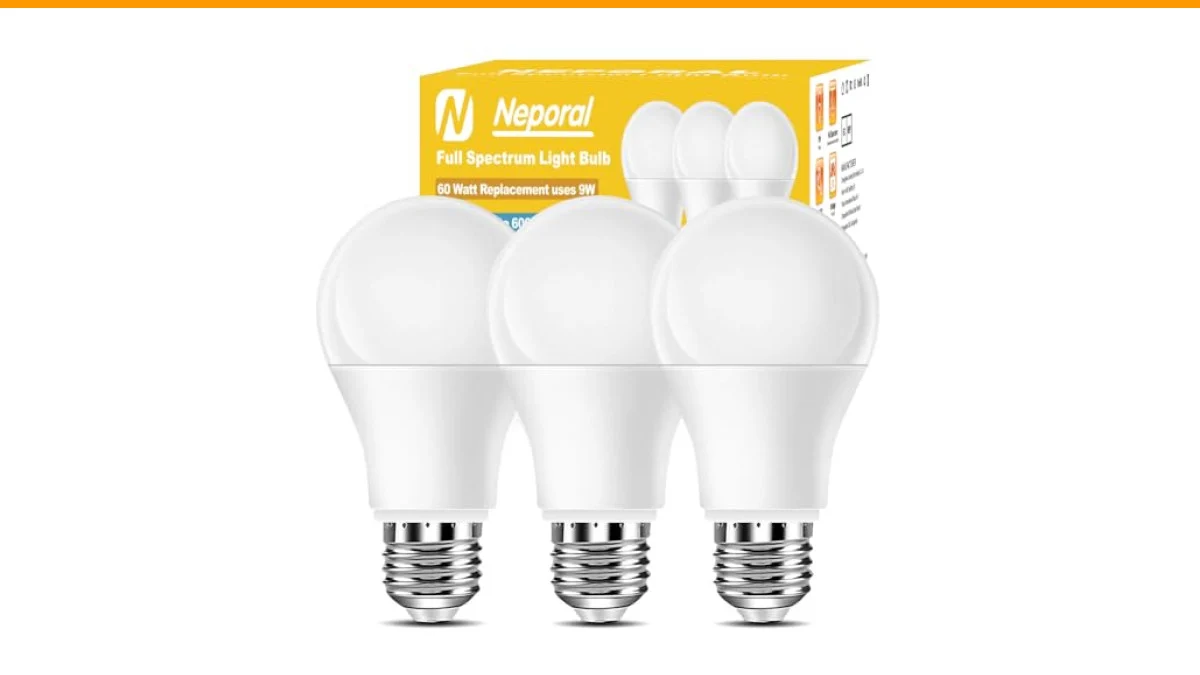
Neporal Full Spectrum 3-Pack
1st Pick

Neporal
Full Spectrum Light Bulb, 6000K Natural Sunlight Bulbs, 9W 60W Equivalent LED Light Bulb, Natural Light Bulbs A19, E26/E27 LED Light Bulbs for Home, 3 Pack
- 💡 Enjoy Your Natural SunLight:Bring the revitalizing energy of a bright day indoors. Neporal full spectrum light bulb expertly rep…
- 🔴 High Color Rendering -True-to-Life Color Clarity:Compare to the similar sunlight light bulbs in the market, our natural sunlight…
- 😌 Gentle on Eyes: Sun light bulbs engineered with flicker-free technology; delivers 800 lumen of bright yet soft light that reduce…
Picture a remote worker who spends eight hours at a desk in a north-facing room. The Neporal 3-pack targets that person. It also suits readers, crafters, and anyone who wants daylight color without installing a fixture. The A19 shape and E26/E27 base fit most standard lamps and ceiling sockets, so setup takes seconds.
The standout number here is CRI 90. That means colors look close to how they appear under real daylight. Reds stay red, blues stay blue, and skin tones do not turn gray the way they can under cheap 5000K LEDs. The 6000K rating sits at the cool end of the spectrum, which most people read as crisp and energizing. Flicker-free operation matters too. If you have ever noticed a subtle strobe from a bargain bulb, you know how quickly it drains your eyes. Neporal engineers this one to avoid that.
One honest caveat: 800 lumens is fine for a desk or reading nook but dim for a large living room. You may need two bulbs in a wide space. And the 6000K tone is noticeably blue-white. If you want a cozy evening glow, this is not that bulb. It is built for daytime alertness, not ambiance.
- 6000K daylight tone with CRI 90 for accurate color
- 800 lumens from 9W, replacing a 60W incandescent
- Flicker-free driver reduces eye strain during long sessions
- 3rd Gen chip design for stable brightness and heat control
- Standard A19 shape fits E26 and E27 sockets
Best for: Home office workers and readers who want daylight accuracy in a standard fixture.
Briignite Grow Light Bulb
2nd Pick

Briignite
Briignite Grow Light Bulbs, LED Grow Light Bulb A19 Bulb, Full Spectrum
- FULL SPECTRUM & NATURAL LIGHT: A19 full spectrum grow light appears 4000K white to eyes but has a red/blue light spectrum. Same as…
- HIGH BRIGHTNESS & ENERGY SAVING: A19 LED plant grow light bulbs deliver 180-degree 1000LM bright light output. Use High Lumen LED…
- HIGHER EFFICIENCY: LED grow bulb with high light transmission improves plant absorption more effectively. Balanced lighting of ful…
Indoor gardeners face a different problem. They need light that plants can actually use, not just light that looks bright to human eyes. The Briignite A19 grow bulb fills that gap. It suits anyone growing tomatoes, peppers, leafy greens, or herbs on a shelf, counter, or small tent.
What separates this bulb from the others on the list is the red and blue spectrum hidden inside a 4000K white appearance. Plants absorb those wavelengths for photosynthesis, and the full spectrum covers all growth stages. The 1000-lumen output and 25 micromoles per second PPF give seedlings and mature plants enough energy to thrive. Unlike the purple grow lights you see in some setups, this one looks like a normal neutral white bulb. That means you can keep it in a living space without the eerie magenta glow.
Trade-offs exist. The 4000K tone is warmer than the 6000K bulbs here, so it feels less like midday sun and more like an overcast afternoon. If your main goal is human alertness, this is not the pick. Also, 11W draws slightly more power than the 9W options, though it still replaces a 100W incandescent. And the plastic-aluminum housing runs warm over long photoperiods, so give it some airflow.
- 4000K white appearance with red and blue spectrum for plants
- 1000 lumens and 25 micromoles per second PPF output
- 11W draw replaces a 100W traditional bulb
- 180-degree beam spread covers a wide plant canopy
- 25,000-hour rated lifespan with aluminum heat sinking
Best for: Indoor gardeners who want effective plant light without purple-tinted rooms.
LQ BSDERA 2-Pack Full Spectrum
3rd Pick

LQ BSDERA
LQ BSDERA 2PK Full Spectrum Light Bulbs, 9W, 6000K Natural Light that Mimic Sunlight, Boosts Mood, Energy, Focus, A19, Sunlike Happy Light Bulbs with E26/27 Base for Most Lamps
- Sunlike Full Spectrum Light Bulbs: Simulate the sunlight, bring sunlike natural light indoors, create a vibrant ambiance for peopl…
- Boosts Mood and Health: Sunlike light help you feel more energetic, boost your mood, focus, especially in rainy days or winter wit…
- A Comfortable Light Source: Clean white & no flicker light,contribute to the clarity of vision, is a comfortable & healthy illumin…
Some buyers want a bulb for mood, not tasks. The LQ BSDERA 2-pack speaks to that group. If you live somewhere with long gray winters, work night shifts, or just feel sluggish on cloudy days, this bulb aims to bring sunlike light into your space. It also works for pets and plants in a pinch, though it is not a dedicated grow light.
The 6000K output mimics daylight, and the clean white, flicker-free beam supports focus during reading, crafting, or studio work. The A19 shape with E26/E27 base drops into most lamps without an adapter. Build quality leans on a plastic and aluminum cooling system, which helps the bulb hold steady brightness and resist breakage. Rated life reaches 25,000 hours.
Here is where you should temper expectations. The listing does not publish a CRI number or lumen figure, so you cannot verify color accuracy or brightness before buying. That is a real gap compared to the Neporal bulbs, which state CRI 90 and 800 lumens upfront. The 2-pack size also means fewer spares. If you plan to swap every bulb in the house, you will need multiple orders.
- 6000K sunlike tone for mood and focus support
- Flicker-free white light for reading and detailed work
- A19 shape with E26/E27 base fits most lamps
- Plastic and aluminum build with 25,000-hour rating
- 2-pack format, so order extra for full-home swaps
Best for: Anyone chasing mood and energy support during dark seasons or night shifts.
Neporal Full Spectrum 4-Pack
4th Pick

Neporal
Full Spectrum Light Bulb, 6000K Natural Sunlight Bulbs, 9W 60W Equivalent LED Light Bulb, Natural Light Bulbs A19, E26/E27, 4 Pack
- 💡 Enjoy Your Natural SunLight:Bring the revitalizing energy of a bright day indoors. Neporal full spectrum light bulb expertly rep…
- 🔴 High Color Rendering -True-to-Life Color Clarity:Compare to the similar sunlight light bulbs in the market, our natural sunlight…
- 😌 Gentle on Eyes: Sun light bulbs engineered with flicker-free technology; delivers 800 lumen of bright yet soft light that reduce…
Whole-home replacement is its own project. The Neporal 4-pack targets that buyer. If you want to swap bulbs in a home office, kitchen, bathroom, and hallway without reordering, this bundle covers it. It shares the same core specs as the 3-pack but adds a fourth bulb for a modest step up in total cost.
Specs match the 3-pack almost exactly: 6000K, CRI 90, 800 lumens, 9W, flicker-free. The 3rd Gen Neporal chip handles heat and keeps brightness stable over time. For color-critical work like photo editing or matching paint swatches, the CRI 90 rating is the real draw. Most budget LEDs sit closer to CRI 80, where subtle color shifts show up. This one keeps things honest.
The limitation is the same as its sibling: 800 lumens per bulb. A single bulb will not light a large open-plan kitchen on its own. You will want two or three in bigger rooms. And the 6000K tone is unapologetically cool. Bedrooms may feel clinical with this bulb overhead. Use it where you want alertness, not where you want to wind down.
- 4-pack covers multiple rooms in one order
- CRI 90 for accurate color in task and detail work
- 9W replaces 60W incandescent, cutting energy use
- Flicker-free output reduces eye fatigue
- UV-free daylight tone at 6000K
Best for: Households replacing several bulbs at once who want consistent daylight color throughout.
How We Chose These Products
We started with the specs that actually change how a bulb performs: CRI, correlated color temperature, lumen output, wattage, flicker behavior, and rated lifespan. Bulbs missing key specs, like a CRI number or lumen figure, lost points against those that published them. We also weighed base compatibility and shape, since an A19 with an E26 base fits far more fixtures than oddball formats.
Then we matched each bulb to a buyer type. A plant owner has different needs than a night-shift worker. A reader cares about eye strain, while a homeowner replacing ten bulbs cares about cost per bulb and consistency. Ranking by specs alone would miss those differences. You can see a similar verification approach in this lab-tested breakdown of natural full spectrum bulbs if you want a second opinion on measurement methods.
Buying Guide: What Really Matters
Full spectrum is not a regulated term. Any brand can print it on a box. What you can verify is the correlated color temperature (Kelvin), the color rendering index (CRI), and the lumen output. A bulb claiming full spectrum should sit between 5000K and 6500K for daylight mimicry, hit CRI 90 or higher, and publish a lumen figure so you know what you are getting. If a listing hides those numbers, treat the claim with suspicion.
An SPD graph, or spectral power distribution chart, shows how much light the bulb emits at each wavelength. Real daylight has a smooth curve across the visible range. Cheap LEDs often show sharp spikes in blue and dips elsewhere. Few Amazon listings publish SPD charts, but brands that do are usually more transparent. When you cannot find one, CRI is the next best proxy. CRI 95+ is excellent, CRI 90 is very good, and anything under 80 is not really full spectrum.
Fixture compatibility trips up more buyers than any spec. Check three things: base type (E26 or E27 for most US and EU lamps), whether the fixture is enclosed, and whether a dimmer switch is in play. Heat builds up inside enclosed fixtures, and not every LED tolerates that. Standard dimmers also may not work with non-dimmable LEDs, causing flicker or buzzing. None of the bulbs here are listed as dimmable, so plan around that. If you want a wider range of options, this roundup of full spectrum bulbs for home use covers additional models worth comparing.
Matching CCT to Each Room
Kelvin rating drives how a room feels. For bedrooms, aim for 2700K to 3000K to support melatonin and wind-down. For offices and kitchens, 4000K to 5000K keeps you alert without feeling harsh. Bathrooms and utility spaces work well at 4000K. The 6000K bulbs here lean cool, which suits daytime task areas but feels clinical in bedrooms. If sleep quality is your priority, use a lower Kelvin bulb near the bed.
Eye Safety, Flicker, and Blue Light
Flicker is the most underrated spec. Even flicker you cannot consciously see can trigger headaches and eye strain over long sessions. Look for the words flicker-free on the listing. Blue light is a separate concern. High-Kelvin bulbs emit more blue, which is fine during the day but disruptive close to bedtime. If you use a 6000K bulb in the evening, you may suppress melatonin and push your sleep schedule later.
Cost and Energy Use: LED vs Incandescent
Run the math on a 9W LED replacing a 60W incandescent. At four hours of daily use, that is roughly 13 kWh per year for the LED versus about 88 kWh for the incandescent. At a typical US rate near 15 cents per kWh, the LED costs about $2 per year to run, while the incandescent runs closer to $13. Multiply that across five bulbs and the gap widens fast. LEDs also last years longer, so replacement cost drops too.
Buying Checklist
- CRI 90 or higher for accurate color
- Kelvin matched to room function, not one bulb for everything
- Lumen output sized to the space, roughly 800 per small room
- Flicker-free driver listed in the specs
- E26 or E27 base confirmed before ordering
- Not dimmable unless the listing says otherwise
- Lifespan rating of 25,000 hours or more
Our Top Recommendation
The Neporal 3-pack takes the top spot for most households. CRI 90, 6000K daylight, 800 lumens, and a flicker-free driver cover the essentials without guesswork. It is the safest pick if you want one bulb for a home office, reading corner, or kitchen counter. The 4-pack is the better call if you plan to replace several bulbs at once.
For indoor gardeners, the Briignite grow bulb is the clear runner-up. It delivers the red and blue spectrum plants need while keeping a neutral white look. If mood support during dark months is your main goal, the LQ BSDERA 2-pack works, though the missing CRI and lumen specs make it a harder blind buy.
Frequently Asked Questions
Are full spectrum bulbs worth it?
Yes, if you spend most of your day indoors under dim or warm lighting. The jump from CRI 80 to CRI 90 is noticeable, especially for reading, crafts, and color work. The energy savings over incandescent add up too. If you only need a bulb for a closet or hallway, a standard LED is fine.
Do they help with SAD or sleep?
Bright daylight-tone light in the morning can support alertness and mood during dark seasons. The effect depends on timing, duration, and distance from the bulb. A 6000K bulb used in the morning is more helpful than one used at night, which can delay sleep. These bulbs are not a medical treatment, so talk to a doctor if symptoms are serious.
Are they safe for eyes?
Flicker-free bulbs at CRI 90 with UV-free output are generally comfortable for long use. The main concern is blue light exposure late in the day. Keep high-Kelvin bulbs for daytime hours and switch to warmer tones in the evening. If you notice headaches or eye strain, check whether your fixture or dimmer is causing flicker.
Can I use these in enclosed fixtures or with dimmers?
None of the bulbs here are rated for dimming, so avoid dimmer switches unless the listing says otherwise. Enclosed fixtures trap heat, which can shorten LED life. If your fixture has a glass cover, check the bulb’s heat tolerance or choose an open fixture instead.