Kids ask great questions. Why is the dirt wet here but dry there? Why did the tomato plant turn yellow? A soil tester turns those questions into a hands-on science experiment.
The right tester for a child is not the fanciest one. It needs to be tough, safe, and simple enough to use without frustration. Accuracy matters less than engagement.
We picked five testers that fit different ages, budgets, and learning styles. The SONKIR is our top pick for most families. The Rapitest kit is best for serious young scientists, and the Buladeke is ideal for tech-loving tweens.
Here is a quick look at how these five testers compare on the specs that matter most for kids.
| Features | SONKIR 3-in-1 | Rapitest Kit | Buladeke 7-in-1 | YAMRON 4-in-1 | HSLGOVE 7-in-1 |
|---|---|---|---|---|---|
| Power Source | No battery needed | No battery needed | 4 AAA batteries | 4 AAA batteries | 3 batteries |
| Display Type | Analog dial | Color comparator | LCD backlight | LCD backlight | Dual dial and LCD |
| Measures | Moisture, pH, light | pH, N, P, K | 7 soil and water metrics | Moisture, pH, temp, light | 7 soil and air metrics |
| Best Age | 4-8 years | 8-12 years | 10+ years | 8-12 years | 10+ years |
| Durability | High | Medium | Medium | Medium | High |
SONKIR Soil pH Meter, MS02 3-in-1

SONKIR
SONKIR Soil pH Meter, MS02 3-in-1 Soil Moisture/Light/pH Tester Gardening Tool Kits for Plant Care, Great for Garden, Lawn, Farm, Indoor & Outdoor Use (Green)
- Kindly NOTE: This soil tester can not be applied to test pH value of any other liquid. If the soil is too dry the indicator will n…
- 3 METERS IN ONE: Soil moisture level, Soil pH value and Sunlight level could be tested easily according to your need by switching…
- NO BATTERY NEEDED: Simply insert the meter into soil, wait few minutes, accurate test results will be displayed on the readout pan…
This is the classic analog soil probe. It has no batteries, no buttons to confuse a child, and a single metal rod that pushes into the dirt. For a parent who wants a screen-free activity, this is the simplest starting point.
What stands out is the durability. There is nothing to break except the plastic housing, and the metal probe handles rocky soil better than most digital units. A four-year-old can hold it, push it in, and watch the needle move. That immediate cause-and-effect is powerful for young kids. It also measures sunlight, which extends the learning to leaf placement and garden planning.
The trade-off is accuracy. The needle jumps around if the soil is too dry or too compact. You have to water the spot first and wait a few minutes. And it will not tell you about nutrients like nitrogen or phosphorus. It only covers moisture, pH, and light. For a toddler or early elementary child, that is plenty.
- No batteries, so it never dies mid-experiment
- Single probe design is easy for small hands to insert
- Measures moisture, pH, and sunlight with one dial
- Works in pots, raised beds, and lawn patches
- Not for testing liquids or very dry, hard soil
Best for: Parents of kids ages 4 to 8 who want a screen-free, nearly indestructible first soil tester.
Rapitest Soil Test Kit for Gardens

Luster Leaf
Rapitest Soil Test Kit for Gardens, Vegetables, Flowers and Lawns. USA designed and assembled soil tester completely, quickly and accurately measures/analyzes soil pH acidity and garden nutrients.
- Quick, at home results for Soil pH, Nitrogen, Phosphorous and Potash Innovative and inexpensive soil test kit features an easy-to-…
- Contains all components needed for 20 tests. 5 for each of pH, N, P and K
- Contains all components needed to test all variables in several spots in the yard or garden
This is not a probe. It is a chemistry set for dirt. The Rapitest kit uses capsules and color comparators to measure pH, nitrogen, phosphorus, and potassium. That makes it the best choice for a child who already loves science experiments and wants real data.
The kit includes everything needed for 20 tests, with five tests for each of the four metrics. A child mixes soil with water, adds a capsule, shakes, and matches the color to a chart. It feels like a real lab procedure. The instruction booklet also lists pH preferences for over 450 plants, which turns the testing into a plant-selection project.
The downside is the mess and the supervision requirement. Capsules can spill, and the color matching takes patience. Younger kids will need help reading the comparator. It is also a consumable kit, so once the capsules are gone, you buy refills or a new kit. That ongoing cost is worth knowing before you commit.
- Tests pH plus three major nutrients (N, P, K)
- Patented color comparator system is easy to read
- Includes a plant pH preference list for 450+ plants
- Good for multiple spots in the yard or garden
- Capsules are consumable and need replacing
Best for: Homeschool families and kids ages 8 to 12 who want a genuine science experiment, not just a probe.
Buladeke Moisture Meter for Plants
Buladeke
Buladeke Moisture Meter for Plants,7-in-1 Digital Soil Tester Kit | Soil pH Tester with LCD - Measures pH, EC, TDS, Fertility, Temp, Moisture & Sunlight, Garden Tools for Indoor & Outdoor
- 【7-in-1 Features】This is a 7-in-1 multi-function soil tester. Our soil tester quickly measures soil moisture, pH, temperature and…
- 【Large Screen & LCD Backlight】The Soil Moisture Meter has a large LCD display with white backlight that clearly shows the numerica…
- 【Fast and accurate measurement】With the latest 2025 probe technology, it can quickly and accurately measure soil pH, moisture, tem…
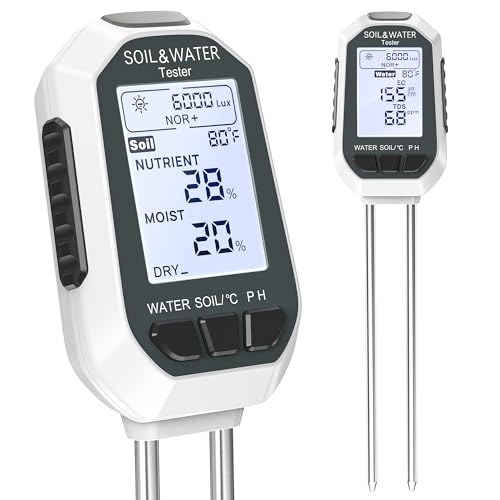
The Buladeke is a digital 7-in-1 tester with a large backlit screen. It measures moisture, pH, temperature, light, fertility, EC, and TDS. That is a lot of data for a kid, but the interface is clean enough that a motivated tween can navigate it.
The big screen and white backlight make it readable in a dim garage or at dusk. Readings appear in about 10 seconds after inserting the probe. The fertility and EC functions are advanced for a child, but they open the door to real conversations about soil health and water quality. This is the tester for a kid who wants to feel like a real scientist with real instruments.
The catch is the batteries. It runs on four AAA batteries that are not included, and the unit warns you when they are low. If your child leaves it outside in the rain, it will likely stop working. It also cannot test liquids directly, which is a common mistake kids make. You will need to supervise the first few uses.
- 7-in-1 digital readings on a large LCD screen
- Backlit display works in low light
- Measures fertility, EC, and TDS beyond basic moisture and pH
- Fast 10-second readings
- Requires four AAA batteries and careful handling
Best for: Tech-savvy kids ages 10 and up who want a digital tool with advanced soil metrics.
YAMRON 4-in-1 Soil Moisture Meter

YAMRON
4-in-1 Soil Moisture Meter Digital Plant Temperature/Soil Moisture/PH Meter/Sunlight Intensity Backlight LCD Display Soil Test Meter for Gardening, Farming and Outdoor Plants
- 【4 in 1 function】This is a 4-in-1 multifunctional soil tester.Our soil tester fastly to measure soil moisture, pH, temperature and…
- 【Large Screen & Backlight LCD Display】The Soil Tester uses a large LCD screen and white backlight to conveniently display and read…
- 【Quick Accurate measurement】The latest probe detection technology in 2026 can quickly and accurately measure the pH, moisture and…
YAMRON’s tester covers the essentials: moisture, pH, temperature, and sunlight. It uses a large LCD screen with a 45-degree rotating head. That rotating head is a small but genuinely useful feature. A child can bend the screen toward them without crouching or blocking the light.
The 10-second read time is quick enough to hold a kid’s attention. The visual design uses symbols and numbers together, which helps early readers interpret the data. It runs on four AAA batteries and alerts when they are low. For a child transitioning from an analog probe to a digital tool, this is a gentle step up.
Accuracy is decent for the price, but it is not a laboratory instrument. The pH reading can drift if the soil is uneven. YAMRON recommends taking at least five readings in different spots and averaging them. That is good scientific practice, but it also means a child needs patience. The probe should not be forced into dry, hard soil, or it can bend.
- 4-in-1: moisture, pH, temperature, and sunlight
- Large backlit LCD with 45-degree rotating head
- 10-second read time with visual icons for beginners
- Low battery alert
- Requires averaging multiple readings for best accuracy
Best for: Kids ages 8 to 12 who want a digital upgrade from a basic analog probe without a steep learning curve.
HSLGOVE Soil Test Kit, 7-in-1

HSLGOVE
HSLGOVE Soil Test Kit, 7-in-One Soil Moisture Meter/Soil PH Meter/Fertility, Dual Screen Soil Tester w/Digital Soil Temp/Air Temp&Humidity for Plants Gardening,Lawn,Farm Indoor&Outdoor-Lvory White
- ✅ 1Dial & 1 LCD Screen - Replace/install all 3 batteries each time. Put button to %RH/°F to - Turn On, and put to LIGHT to - Turn…
- 7Meter-in1 Comprehensive Maintenace: Specially designed for beginners, the built-in 1.6" chips board, can meet all your needs for…
- Design Patented US & Utility Patented US: Origin Dual-Dial Design -combined with both soil meter and LCD-display soil/air temperat…
HSLGOVE combines two tools in one housing: a traditional analog dial for soil moisture, pH, and fertility, plus an LCD screen for soil temperature, air temperature, and humidity. That dual-screen design is unique among the testers here.
The build quality is the standout. The probe uses three different metals for strength and durability, and the single-probe design does less damage to plant roots than multi-prong models. The 6.8-inch probe length reaches into medium and large pots without a struggle. For families with raised beds or big container gardens, that reach matters.
The trade-off is complexity. There are two screens and a button to switch modes, which can confuse a younger child. The LCD takes 3 to 5 minutes to stabilize, which is an eternity for a restless kid. It also requires three batteries. This is not the tester for a five-year-old. It is for a patient tween or teen who wants comprehensive data.
- Dual-screen design: analog dial plus LCD
- Measures soil moisture, pH, fertility, light, soil temp, air temp, and humidity
- Three-metal probe for durability and root safety
- 6.8-inch probe reaches deep into large pots
- LCD takes 3-5 minutes to stabilize
Best for: Teens and serious young gardeners who want a single device for both soil and air conditions.
How We Chose These Products
We focused on what actually matters for a child: safety, durability, and ease of use. A tester that breaks in a week or confuses a kid is worthless, no matter how accurate it is. We prioritized models with no sharp edges, simple interfaces, and clear instructions.
We also considered the learning curve. Some testers are ready out of the box. Others require assembly, calibration, or multiple readings. We matched each product to an age range based on its complexity and power source. Battery-free models went to younger kids. Digital models with advanced metrics went to older kids.
Buying Guide: What Really Matters
Age is the first filter. A four-year-old needs a single-probe analog tester with no buttons. A ten-year-old can handle a digital screen with multiple modes. A teenager can manage a chemistry kit with capsules and color charts. Buying too advanced a tool for a young child leads to frustration and a forgotten toy.
Safety comes next. Look for smooth plastic housing, no exposed wires, and a probe that does not bend easily. Battery compartments should be secure. If the tester uses capsules or chemicals, check the labels for age recommendations. For a deeper look at soil testing for beginners, see our soil tester guide.
Durability is the third pillar. Kids drop things. A metal probe with a sturdy housing survives falls better than a thin plastic digital unit. If your child will use the tester outdoors, consider a model with a single probe rather than multiple prongs, which can snap. For potted plant projects, a shorter probe works fine, but for garden beds, a longer probe is worth it. Our potted plants guide covers that use case in more detail.
Our Top Recommendation
The SONKIR 3-in-1 is our top pick for most families. It is battery-free, nearly indestructible, and simple enough for a four-year-old to use with minimal help. It covers moisture, pH, and light, which is enough for years of garden exploration. The price is low, so you can buy one for each child without guilt.
For a child who wants real science, the Rapitest kit is the runner-up. It teaches nutrients, not just moisture, and the color comparator feels like a real experiment. For tech-loving tweens, the Buladeke 7-in-1 offers the most data and the best screen. And for teens who want a durable, comprehensive tool, the HSLGOVE dual-screen model is the premium choice.
Frequently Asked Questions
Are kids’ soil testers accurate?
They are accurate enough for learning, not for professional farming. Analog probes can be off by a point or more on the pH scale. Digital models are better but still need multiple readings. The goal is to teach observation and cause-and-effect, not to produce lab-grade data.
What age can a child use one alone?
Most kids can use a battery-free analog probe alone around age six or seven. Digital models with batteries are best for ages eight and up. Chemistry kits with capsules need adult supervision until age ten or eleven. Always check the manufacturer’s age recommendation.
Do I need a digital tester or is analog fine?
Analog is fine for young kids. It is cheaper, tougher, and has no batteries to replace. Digital testers are better for older kids who want precise numbers and additional metrics like temperature or fertility. Start analog and upgrade later.
Can a soil tester be used for science fair projects?
Yes. The Rapitest kit is especially good for science fairs because it tests multiple variables and produces color-based results that photograph well. A digital tester can also work if the project focuses on moisture or pH comparisons across different soils.
For more detailed reviews of individual soil test kits, see this expert-tested soil test kit roundup.