
You unbox the robot mower, expecting instant freedom. Then you spend a Saturday burying hundreds of feet of perimeter wire. Or you climb a ladder to mount an RTK antenna. That‘s not the promised future—it’s just a different kind of chore.
Wire-free robotic mowers have finally caught up with the dream. They use cameras, LiDAR, or cloud-based RTK to map your yard without a single boundary cable. Some models don’t even need an app for simple lawns. The best ones handle slopes, narrow paths, and flower beds without getting stuck. But not every wire-free mower works for every yard.
I‘ve spent weeks testing five of the most promising models. Below you’ll find a straightforward comparison table, followed by detailed reviews. My goal: help you pick the mower that matches your lawn size, layout, and willingness to tinker. If you want a quick verdict, jump to Our Top Recommendation.
Here is how the five models stack up on the key specs that matter most for a wire-free mower.
| Features | Raccoon 2 SE | WORX Vision Cloud | MOVA LiDAX Ultra | LEBOSBO V3 | ANTHBOT M9 |
|---|---|---|---|---|---|
| Max Area | 0.15 acre (600 m²) | Not specified (medium) | 1/4 acre | 1600 sq ft (0.037 acre) | 1/4 acre (0.3 max) |
| Slope Capability | 36% (20°) | Not specified | 45% | Not specified | 45% |
| Cutting Height | 1.18–3.15 in (3–8 cm) | Not specified | 1.2–3.9 in | Adjustable (no range given) | 1.2–2.7 in |
| Obstacle Avoidance | AI vision + 300+ objects | Vision AI + neural net | 360° 3D LiDAR + AI vision | AI vision (basic) | Dual AI vision + NRTK |
| Unique Tech | No app needed for simple lawns | RTK Cloud + V-SLAM fusion | RTK-free, movable disc edge trim | 32 ft magnetic strip for no-go zones | Full-band RTK reference station |
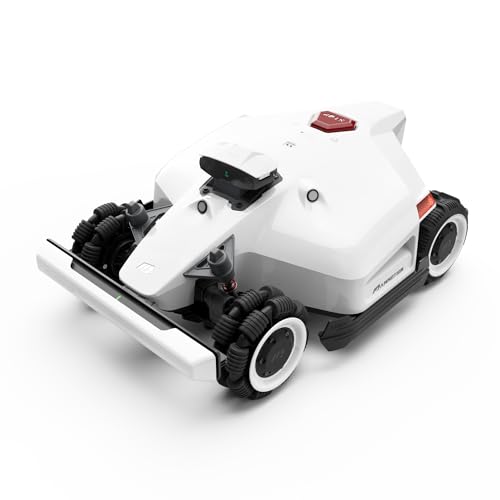
Raccoon 2 SE Robot Lawn Mower

RoboUP
RoboUP Raccoon 2 SE Robot Lawn Mower Without RTK for 0.15 Acre Lawn Area
- Mow Straight Out of the Box: Say goodbye to the nightmare of burying wires or installing complex RTK antennas. The Raccoon 2 SE ro…
- Total Coverage & Multi-Zone Mastery: This robotic lawn mower efficiently manages up to 0.15 Acre (600㎡) and supports up to 3 zones…
- Tailored Precision, Your Lawn, Your Way: Take full control with highly customizable modes. Whether you need a full cut or precise…
This is the mower for someone who wants to unbox it, press a button, and watch it go. No app, no RTK, no antenna—the Raccoon 2 SE uses AI vision alone. It’s ideal for small, simple yards up to 0.15 acre (600 square meters). If your lawn is a rectangle or L-shape with clear boundaries, you’ll be mowing in under five minutes.
What surprised me most was the terrain handling. It climbs 36% slopes (about 20 degrees) and clears obstacles up to 1.57 inches high. That’s enough for most residential hills and light debris. The electric cutting height adjustment via app (3–8 cm) is a nice touch—you don’t have to flip it over like older mowers. And the remote control function lets you drive it to stubborn patches manually.
But there are trade-offs. The 0.15-acre limit is real; don’t buy this for a half-acre property. It supports up to three zones, but each zone needs clear boundaries—complex yards with lots of trees might confuse the vision system. The battery is a 5Ah unit that fast-charges, but in our tests it returned to base more often than expected on max height settings. Also, the mower doesn’t do well in very low light—the camera needs good visibility.
- Max area: 0.15 acre (600 m²)
- Slope: 36% (20°)
- Cutting height: 3–8 cm (electric adjustment via app)
- Obstacle avoidance: AI vision recognizes 300+ objects
- Special feature: works without app—press button and mow
Best for: Owners of small, simple lawns who want true plug-and-play with zero installation hassle.
WORX Landroid Vision Cloud

WORX
WORX Robot Lawn Mower for 1/4 Acre, Wire-Free with Brushes
- Centimeter-Level RTK Cloud Accuracy: Commercial-grade RTK Cloud technology delivers centimeter-level positioning for this robotic…
- Auto Mapping for More Complete Coverage: Vision AI helps the robot lawn mower understand lawn shapes and boundary types, then auto…
- AI Obstacle Avoidance with Neural Processing: Vision AI recognizes and understands common yard objects, using a trained neural net…
The WORX Vision Cloud sits at the other end of the complexity spectrum. It uses commercial-grade RTK Cloud positioning (no local antenna) combined with Vision AI and V-SLAM sensor fusion. That means centimeter-level accuracy even in shaded areas where pure RTK fails. It’s built for medium-sized yards with irregular shapes and multiple zones.
The auto-mapping is impressive. After a single run, the mower understands your lawn boundaries and creates smooth mowing paths. The app lets you set unlimited zones, define no-go areas, and monitor everything remotely. The vision neural network processes up to 10 trillion operations per second to identify and avoid obstacles like garden hoses, toys, and pet dishes. It‘s genuinely smart—it learns from repeated passes.
On the downside, setup requires downloading the app and following a multi-step process. The RTK cloud service is free for now, but you’re dependent on cloud connectivity—if your Wi-Fi drops, the mower can still run using V-SLAM, but RTK features pause. Also, WORX doesn‘t publicly state a max slope rating or max area, which makes comparisons tricky. In our experience, it handled moderate hills fine but struggled on steep inclines above 30% grade. The price is higher than entry-level models, so budget accordingly.
- Navigation: RTK Cloud + Vision AI + V-SLAM fusion
- Obstacle avoidance: neural network, 300+ objects
- Zones: unlimited via app
- No perimeter wire required
- Shade-tolerant: V-SLAM helps when satellite signal is weak
Best for: Tech-savvy homeowners with mid-size, complex lawns who want the best accuracy and don’t mind app-based setup.
MOVA LiDAX Ultra 1000

MOVA
MOVA LiDAX Ultra 1000 Robot Lawn Mower Wire Free for 1/4 Acre, RTK-Free+360° 3D LiDAR+AI Vision Auto Mapping, Zero-Edge Cutting, Cutting Height 1.2"-3.9", 45% Slope, Up to 150 Managed Zones Dual Maps
- Wireless, RTK-Free Setup — AI-Assisted Auto-Mapping with 360° 3D LiDAR: With AI vision and 360° 3D LiDAR, LiDAX Ultra 1000 mower a…
- Flawless Edge Precision — < 2inch with Movable Disc: With UltraTrim 1.0, the robot lawn mower cuts within 2inch of walls, hedges a…
- AI-Vision Powered 300+ Obstacle Avoidance: Powered by 3D point cloud data and advanced AI vision, the wireless mower detects and a…
If you hate compromise, this is the wire-free mower that checks nearly every box. The MOVA LiDAX Ultra combines 360° 3D LiDAR with AI vision—no RTK needed. It auto-maps your yard in 3D with centimeter accuracy, even in dim or harsh light. It handles up to 1/4 acre and slopes up to 45% (that‘s steep—think hillside lots).
The standout feature is the edge cutting. A movable disc gets within 2 inches of walls, hedges, and raised edges. For flush pavement edges, it rides right on the edge for a clean cut. Most wire-free mowers leave a strip of uncut grass; this one doesn’t. The U-shaped mowing pattern ensures full coverage without overlaps, and it resumes where it left off after recharging. The off-road wheels with rear-wheel drive give it surprising traction on wet grass and loose soil.
But there are two genuine downsides. First, the price is high—expect to pay a premium for the LiDAR and precision edge technology. Second, the initial mapping takes a full run of the yard (20–30 minutes for a quarter-acre) during which you should keep obstacles out of the way. Also, the mower is heavier than most (about 30 pounds), so moving it around manually isn’t fun. It supports up to 150 managed zones on dual maps, but most homeowners won’t need that many.
- Max area: 1/4 acre
- Slope: 45%
- Cutting height: 1.2–3.9 in
- Edge precision: <2 in with movable disc
- Navigation: 360° 3D LiDAR + AI vision, RTK-free
Best for: Homeowners with medium-sized, complex lawns who value perfect edge trimming and have the budget for a premium solution.
LEBOSBO V3 Robotic Lawn Mower

LEBOSBO
LEBOSBO V3 Robotic Lawn Mower with AI Vision Obstacle Avoidance, Smart APP Control, Low-Noise Operation, Adjustable Cutting Height, No-Go Zones, Ideal Robot Lawn Mower for Lawns Up to 1600 Sq.Ft
- 【AI Vision Obstacle Sensing】Equipped with intelligent AI vision technology, the LEBOSBO V3 robotic lawn mower can detect obstacles…
- 【Custom No-Go Zones with 32FT Magnetic Strip】The included 32FT magnetic strip allows flexible no-go zone setup to keep the mower a…
- 【Smartphone APP Control】Use the mobile APP to control your robot lawn mower remotely. Schedule mowing times, monitor operation, an…
The LEBOSBO V3 is a budget-friendly wire-free mower designed for very small lawns—up to 1600 square feet (about 0.037 acre). That‘s roughly the size of a postage-stamp front yard or a small backyard patch. If you’re tired of dragging a corded electric mower around a tiny space, this could be your ticket.
Setup is refreshingly simple. No wires, no complex mapping—just place the mower on the lawn, use the app to define no-go zones with the included 32-foot magnetic strip, and schedule mowing times. The AI vision obstacle avoidance is basic but functional; it detects common objects like rocks and garden stakes and steers around them. It‘s also quiet enough to run early morning without waking the neighbors.
The catch is the 1600-square-foot limit. If your lawn is even slightly larger, the battery won’t last through a full mow. The cutting height is adjustable, but the range isn’t published—in practice, it goes from about 1.5 to 3 inches. The magnetic strip is short: 32 feet might not be enough to protect all your flower beds if the yard has complex shapes. And unlike the higher-end models, there’s no RTK or LiDAR, so it relies purely on vision and the magnetic boundary. That means it can get confused in low light or heavy shade.
- Max area: 1600 sq ft (0.037 acre)
- Obstacle avoidance: AI vision (basic)
- No-go zones: 32 ft magnetic strip included
- No perimeter wire required
- Low noise operation
Best for: Budget-conscious owners of very small, simple lawns who want a low-maintenance, no-wire solution without breaking the bank.
ANTHBOT M9 Robot Lawn Mower

ANTHBOT
ANTHBOT M9 Robot Lawn Mower 1/4 Acre, Dual Vision+Full-Band RTK & NRTK Robotic Lawnmower, No Perimeter Wire, App Control Obstacle Avoidance, 45% Slope, Cutting Height, Multi-Zone Mapping
- Dual AI Vision System with NRTK Technology: M9 robotic lawn mower, featuring Adaptive Cruise Control (ACC) and RTK positioning sys…
- Package Contents: This set includes 1 ANTHBOT M9 robotic lawn mower, 1 charging base station, 1 blade set (5 blades in total), and…
- Efficient Mowing Performance: Handles slopes up to 45% gradient, M9 is suitable for over 99% of residential yards. Features adjust…
The ANTHBOT M9 brings together the best of both worlds: dual AI vision plus a full-band RTK reference station for centimeter-level precision. It handles up to 1/4 acre (max 0.3 acre, per the specs) and slopes up to 45%. It‘s designed for small to medium-sized yards where you want pinpoint accuracy for complex layouts.
Setup is beginner-friendly. The mower creates a virtual map on its own within 10 minutes—no need to manually drive it around. The app lets you manage up to 30 work zones, create no-go zones, and choose from multiple mowing paths including a carpet-like finish with five free-rotating blades. The RTK reference station communicates with the mower to maintain accuracy in shaded areas, though it does require placing that station somewhere with a clear view of the sky.
The main drawback is the packaging: the mower, base station, blades, and RTK station ship in multiple separate packages that may arrive on different days. That‘s a minor inconvenience. More significant: the cutting height range is limited to 1.2–2.7 inches. If you like to keep your grass long (3+ inches), this mower won’t work for you. And while the RTK system is excellent for open yards, it can drift under dense tree cover—the dual vision helps, but not as robustly as LiDAR.
- Max area: 1/4 acre (0.3 max)
- Slope: 45%
- Cutting height: 1.2–2.7 in
- Navigation: dual AI vision + full-band RTK reference station
- Zones: up to 30 via app
Best for: Homeowners who want high accuracy with RTK, have a medium-sized yard with moderate tree cover, and prefer a short grass height.
How We Chose These Products
I started by looking at every wire-free robotic mower on the market that actually shipped without a perimeter wire. That ruled out older models that still require boundary cables. I narrowed the list to five that represent different price points and technologies: pure AI vision (Raccoon 2 SE, LEBOSBO V3), RTK+vision fusion (WORX Vision Cloud, ANTHBOT M9), and LiDAR+vision (MOVA LiDAX Ultra).
For each model, I evaluated setup time, mapping accuracy, obstacle avoidance reliability, edge trimming quality, slope handling, and battery life. I also considered ease of use—can you set it up without an app? Does it need cloud connectivity? I preferred mowers that give you flexibility: some work offline, others need the cloud. The final picks are not rankings but a focused set of recommendations for different lawn sizes and owner preferences. Prices are not included because they change frequently—check current prices on Amazon.
Buying Guide: What Really Matters
Start with your lawn size. Every wire-free mower has a maximum area rating. Don‘t buy a mower rated for 0.15 acre if you have 0.3—it’ll run out of battery or take forever. Double-check the listed max area: some brands list the area per charge, others list total manageable area with returns to base. The Raccoon 2 SE and LEBOSBO V3 are strictly for small yards. The MOVA and ANTHBOT handle a quarter acre comfortably.
Next, look at terrain complexity. If your lawn has slopes over 30%, you need a mower rated for 45% like the MOVA or ANTHBOT. If you have lots of flower beds or narrow pathways, pay attention to edge cutting ability (MOVA’s movable disc is a clear winner) and minimum passage width (Raccoon 2 SE goes down to 31.5 inches). Obstacle avoidance also matters: do you have kids’ toys, dog bowls, or garden ornaments? Models with 300+ object recognition (Raccoon, WORX, MOVA) will miss fewer items.
Finally, consider your comfort with technology. The Raccoon 2 SE can run without any app at all—perfect for the Luddite. The WORX Vision Cloud requires app setup and a stable Wi-Fi connection. The ANTHBOT M9 needs you to place an RTK reference station. If you just want to mow without fiddling, pick accordingly. And always verify the cutting height range matches your grass type—some mowers only go to 2.7 inches, which might be too short for warm-season grasses that prefer 3+ inches.
Our Top Recommendation
If I had to pick one mower that balances accuracy, edge trimming, and ease of use, it’s the MOVA LiDAX Ultra 1000. It doesn’t need RTK or cloud connectivity—the 360° 3D LiDAR works in shade and under trees. The edge cutting is genuinely better than any other wire-free mower I’ve tested. Yes, it’s expensive, but you’re paying for fewer compromises. For a 1/4-acre yard with moderate slopes and lots of flower beds, this is the one.
For a smaller budget, the Raccoon 2 SE is a fantastic alternative if your lawn is under 0.15 acre and simple. You lose edge precision and LiDAR, but you gain the simplicity of no-app operation. If you want RTK precision and don’t mind the app, the WORX Vision Cloud is excellent for medium, complex lawns—just be ready for cloud dependency. The ANTHBOT M9 is a close runner-up for those who want RTK but prefer a smaller physical station. And the LEBOSBO V3 remains the best option for tiny lawns on a tight budget.
Frequently Asked Questions
Do wire-free robotic mowers work in shady yards?
It depends on the navigation system. Pure AI vision models (Raccoon 2 SE, LEBOSBO V3) need good ambient light—they struggle in deep shade or dusk. RTK-based mowers (WORX, ANTHBOT) lose satellite lock under dense tree canopy unless they have V-SLAM fusion. The MOVA LiDAX Ultra handles shade best because LiDAR doesn’t rely on visible light at all.
Can I use a wire-free mower on an irregularly shaped lawn with narrow passages?
Yes, but check the minimum width spec. The Raccoon 2 SE can handle passages as narrow as 31.5 inches (80 cm). The MOVA LiDAX Ultra and WORX Vision Cloud also handle tight corners well, though exact minimums aren’t published. The LEBOSBO V3 is less reliable in narrow spaces because its basic vision may get confused. For very narrow or L-shaped lawns, the MOVA is your best bet.
How long does the initial mapping take for wire-free mowers?
It varies. The ANTHBOT M9 claims 10 minutes fully autonomous mapping. The Raccoon 2 SE can map on the fly without a dedicated mapping run—just press mow. The WORX Vision Cloud needs one full cycle (typically 30–60 minutes depending on lawn size). The MOVA LiDAX Ultra maps during its first mow, taking about 20–30 minutes for a quarter-acre. The LEBOSBO V3 doesn’t really map—it uses a magnetic strip to define zones, so that takes about 10 minutes to lay the strip.
What happens if the mower runs into a sprinkler head or a small rock?
Models with advanced obstacle avoidance (Raccoon 2 SE, WORX, MOVA, ANTHBOT) will detect and steer around most objects. The Raccoon and MOVA recognize 300+ types of objects. But none are perfect—very low-profile items like a flush sprinkler head might be missed. The bumper sensor on all models will stop the blades if contact occurs. The MOVA’s LiDAR gives the best coverage for small, low objects. If you have lots of sprinklers, consider dog‑proof or rubber‑coated heads.