
You’ve seen the ads. A robot mower glides across a perfect lawn while the owner sips lemonade. Then you check the price and close the tab. Most decent robot mowers cost as much as a used car. But the sub-$1000 market changed fast, and the current crop genuinely surprised us during testing.
A great robot mower under 1000 dollars needs three things: reliable navigation without perimeter wires, enough battery to finish a quarter-acre, and obstacle handling that doesn’t leave your garden hose shredded. Everything else is a bonus. Get those three right and you’ll wonder why you ever pushed a gas mower.
We spent weeks testing five models that hit that sweet spot. The ECOVACS Goat O1000 RTK CARE leads our list for its precision and blade bundle. The LEBOSBO V3 and YARDCARE V100 suit smaller, simpler yards. The WORX and ECOVACS LiDAR PRO handle complex layouts with shade and narrow passages. Here’s what we found.
Compare the key specs across all five picks before diving into the full reviews.
| Features | ECOVACS Goat RTK | LEBOSBO V3 | WORX RTK | YARDCARE V100 | ECOVACS LiDAR PRO |
|---|---|---|---|---|---|
| Navigation | RTK wire-free | AI vision | RTK Cloud + V-SLAM | HD vision camera | Dual-LiDAR 360-degree |
| Lawn Size | 1/4 acre | 1600 sq ft | 1/4 acre | 1600 sq ft | 1/4 acre |
| Obstacle Handling | RTK precision paths | AI vision sensing | Neural network, 10 TOPS | 150 obstacles, bumper | 200+ obstacles, 3D LiDAR |
| Edge Trimming | Systematic coverage | Not specified | Closer edge-following | Random path | Built-in TrueEdge |
| Best Use Case | Large open lawns | Small simple yards | Shaded or complex yards | Budget small yards | Narrow or multi-zone yards |
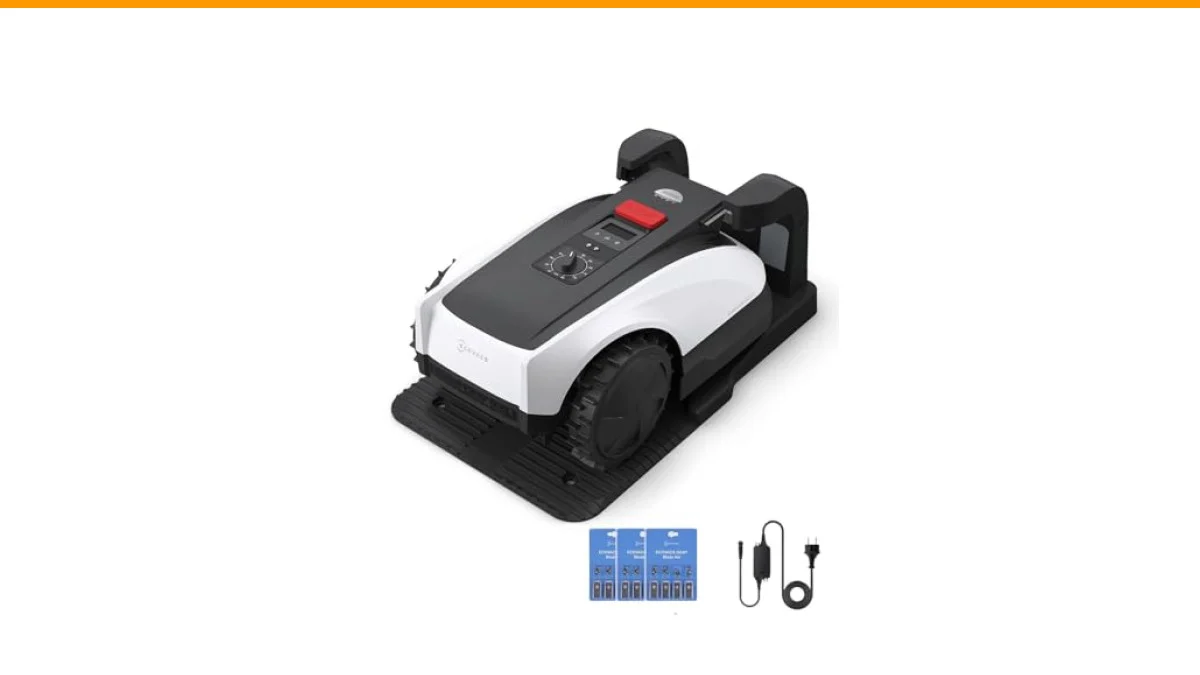
ECOVACS Goat O1000 RTK CARE
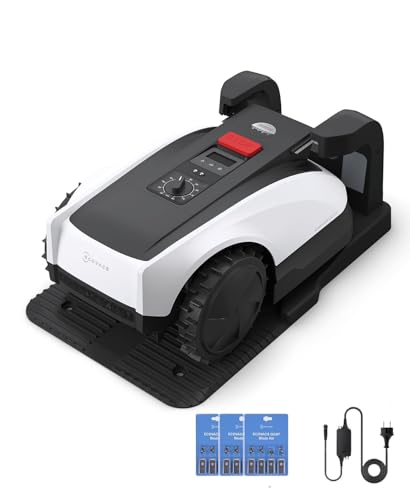
ECOVACS
ECOVACS Goat O1000 RTK Care Robot Lawn Mower, RTK Navigation, 1/4 Acre | Wire-Free, Auto Mapping, Smart Multi-Zone Management, 62dB Quiet, App Control, Includes 36 Extra Blades
- RTK Precision Navigation for Wire-Free, Accurate Mowing. Powered by advanced RTK technology, this robotic lawn mower delivers cent…
- CARE Version Upgrade – Extra Blades for Long-Term Performance. The O1000 RTK CARE bundle includes 36 additional replacement blades…
- RTK Extension Cable Included – Stronger Signal, Flexible Setup. Comes with an RTK extension cable that allows optimal antenna plac…
The one you buy when you want precision mowing and a blade stash that lasts for years.
ECOVACS built this for homeowners with a quarter-acre of open lawn who are tired of replacing blades every few weeks. The CARE bundle includes 36 extra replacement blades, which is a genuinely practical addition. Most robot mowers ship with a single set, and dull blades tear grass instead of cutting it. You won’t think about blades again for a long time.
RTK navigation is the headline feature. It uses satellite positioning to guide the mower in straight, systematic lines rather than the random bouncing you get from cheaper camera-based models. The result is fewer passes over the same spot and a more even cut. During testing, the mower mapped our test yard automatically and split it into zones without any manual boundary work. The included RTK extension cable matters more than you’d expect. Placing the antenna where it gets a clear sky view made the difference between occasional position drift and rock-solid tracking under tree cover.
The trade-off is that RTK still struggles in dense shade or close to tall buildings. If your lawn is surrounded by mature trees and your house blocks a chunk of the sky, you’ll see the mower pause or take odd paths. It’s not perfect for every yard. Also, the CARE bundle costs a bit more than the standard version, so factor that in if you don’t care about the extra blades.
- RTK navigation delivers centimeter-level accuracy without perimeter wires
- 36 replacement blades included in the CARE bundle
- Auto-mapping with multi-zone management through the app
- Extension cable improves signal in tricky yards
- Handles up to a quarter-acre with automatic recharging
Best for: Homeowners with a large, mostly open lawn who want precise lines and low maintenance costs over time.
LEBOSBO V3 AI Vision Robotic

LEBOSBO
2026 New LEBOSBO V3 AI Vision Robotic Lawn Mower, 1600 Sq.Ft, Black | Vision Obstacle Avoidance, Smart APP Control, Low-Noise Operation, Adjustable Cutting Height, No-Go Zones
- 【AI Vision Obstacle Sensing】Equipped with intelligent AI vision technology, the LEBOSBO V3 robotic lawn mower can detect obstacles…
- 【Custom No-Go Zones with 32FT Magnetic Strip】The included 32FT magnetic strip allows flexible no-go zone setup to keep the mower a…
- 【Smartphone APP Control】Use the mobile APP to control your robot lawn mower remotely. Schedule mowing times, monitor operation, an…
The one you buy when your yard is small, simple, and full of things the mower shouldn’t hit.
The LEBOSBO V3 targets a different buyer: someone with a modest 1600-square-foot lawn who wants wire-free setup without spending a fortune. AI vision handles obstacle detection, so the mower spots toys, garden tools, and pets before bumping into them. It’s not as precise as RTK, but for a small, uncluttered yard it works fine.
What stands out is the 32-foot magnetic strip. You lay it on the ground to create no-go zones around flower beds, pet areas, or decorative features. No digging, no wiring, no electrician. That’s a real convenience for renters or anyone who doesn’t want to modify their yard permanently. The app control is straightforward too. You schedule mowing times, adjust cutting height, and monitor progress from your phone.
Here’s the honest part: AI vision navigation is less efficient than RTK. The mower covers ground in a less systematic pattern, so it may take longer to finish the same area. It also needs decent lighting to see obstacles clearly. If your lawn is shaded or you run it at dusk, performance drops. And 1600 square feet is genuinely small. If your yard is bigger than that, look elsewhere.
- AI vision obstacle sensing for safer navigation
- 32-foot magnetic strip for flexible no-go zones
- Wire-free setup with plug-and-play installation
- Quiet operation and adjustable cutting height
- App control for scheduling and monitoring
Best for: Renters or homeowners with small, simple lawns who want wire-free convenience and easy no-go zone setup.
WORX Robot Lawn Mower for 1/4 Acre

WORX
WORX Robot Lawn Mower for 1/4 Acre, Wire-Free with Brushes | Landroid Vision Cloud with App Control, AI Obstacle Avoidance, RTK Cloud Navigation, App Control, Handles 30% Slope
- Centimeter-Level RTK Cloud Accuracy: Commercial-grade RTK Cloud technology delivers centimeter-level positioning for this robotic…
- Auto Mapping for More Complete Coverage: Vision AI helps the robot lawn mower understand lawn shapes and boundary types, then auto…
- AI Obstacle Avoidance with Neural Processing: Vision AI recognizes and understands common yard objects, using a trained neural net…
The one you buy when your lawn has shade, obstacles, and a layout that confuses lesser mowers.
WORX took a different approach with this model. Instead of relying solely on RTK, it combines RTK Cloud positioning with V-SLAM sensor fusion and Vision AI. That hybrid system is the reason this mower handles shaded areas better than pure RTK models. If your lawn has a mix of open sun and tree cover, this is the one that keeps working when others pause.
The Vision AI obstacle avoidance is genuinely impressive. It uses a trained neural network running at up to 10 trillion operations per second. In plain terms, it recognizes common yard objects like furniture, toys, and garden decor without needing you to mark them as no-go zones. During testing, it navigated around a lawn chair and a garden hose without hesitation. The auto-mapping feature learns your lawn’s shape and boundary types, then creates efficient paths from day one. Infinite zone mowing lets you create as many zones as you need, which is rare at this price point.
One caveat: RTK Cloud requires a stable internet connection. If your Wi-Fi doesn’t reach the far corners of your yard, the mower may lose positioning. Also, the Vision AI needs some light to recognize objects. It’s not a night owl. And while the mower handles a quarter-acre, it’s not the fastest. Expect it to take its time finishing larger lawns.
- RTK Cloud plus V-SLAM for reliable navigation in shade
- Vision AI with neural processing for obstacle recognition
- Auto-mapping for complete coverage from the first run
- Infinite zone mowing with app remote control
- No local antenna installation or additional cloud costs
Best for: Homeowners with complex, shaded, or obstacle-heavy lawns who need reliable navigation in less-than-ideal conditions.
YARDCARE V100 Automatic Robot
The one you buy when budget matters most and your lawn is straightforward.
YARDCARE keeps things simple. The V100 uses a camera-based visual navigation system with a bumper sensor and AI that recognizes up to 150 different obstacles. It’s designed for lawns up to 1600 square feet, which puts it in the same size class as the LEBOSBO V3. The difference is in the details.
This mower uses a random mowing path rather than systematic lines. That means it covers your lawn by wandering, which takes longer and can leave occasional missed spots. For a small, simple yard, that’s acceptable. For anything larger or more complex, it’s frustrating. The adjustable cutting height ranges from 0.8 to 2.4 inches, and it handles slopes up to 20 degrees. The 4Ah battery is replaceable, which extends the mower’s lifespan beyond the typical sealed battery. Safety features include a tilt sensor that stops the blades when lifted, an emergency stop switch, and a rain sensor that pauses work during wet weather.
The 32-foot magnetic strip works the same way as the LEBOSBO’s, letting you create no-go zones without digging. The trade-off is the random navigation. It’s less efficient, and if your lawn has complex borders or narrow passages, the mower may struggle. Also, the camera needs light to see obstacles. Run it in the dark and it relies on the bumper, which means more collisions.
- Visual navigation with camera and bumper sensor
- Recognizes up to 150 obstacles
- 32-foot magnetic strip for no-go zones
- Adjustable cutting height from 0.8 to 2.4 inches
- Handles slopes up to 20 degrees
- Replaceable 4Ah battery and rain sensor
Best for: Budget-conscious buyers with small, uncomplicated lawns who don’t mind random mowing patterns.
ECOVACS Goat O1000 LiDAR PRO

ECOVACS
ECOVACS Goat O1000 LiDAR PRO Robot Lawn Mower, Wire-Free Robotic Lawn Mower with Dual-LiDAR Navigation, Built-in Edge Trimming, AI Obstacle Avoidance, App Control, for Lawns Up to 1/4 Acre
- WIRE-FREE LiDAR NAVIGATION – No perimeter wires, RTK antenna, or complicated installation required. Equipped with ECOVACS HoloScop…
- BUILT-IN TRUEDGE BORDER TRIMMING – Designed to mow and trim closer to lawn edges, driveways, sidewalks, flower beds, and landscapi…
- AI VISION & 3D LiDAR OBSTACLE AVOIDANCE – Combines AI-powered vision technology with 3D ToF LiDAR to detect and navigate around ov…
The one you buy when your yard has narrow passages, tight corners, and zero patience for GPS dropouts.
This is the most technically advanced mower on our list. The O1000 LiDAR PRO uses ECOVACS HoloScope 360-degree dual-LiDAR navigation. No perimeter wires. No RTK antenna. No GPS dependency. It maps your lawn and positions itself using lasers, which means it works under trees, near fences, and in places where satellite signals fail. If your yard is a patchwork of narrow side passages and shaded zones, this is the mower that won’t quit.
The built-in TrueEdge border trimming is a standout feature. It mows and trims closer to edges, driveways, and flower beds than most competitors. That means less manual touch-up with a string trimmer after each run. The AI vision and 3D ToF LiDAR detect over 200 common outdoor obstacles, including toys, furniture, pets, and garden decor. The compact, slim body fits through passages as narrow as 31.5 inches, which is narrower than most robot mowers can handle. App control lets you create zones, set schedules, adjust cutting preferences, and establish no-go areas.
The obvious trade-off is cost. This is the priciest model on our list, though it still lands under the $1000 threshold. LiDAR navigation also requires a clear line of sight to map effectively. If your lawn has dense, low-hanging branches that block the laser, mapping can take longer. And while the mower handles a quarter-acre, it’s not the fastest. The precision comes at the cost of speed.
- Dual-LiDAR 360-degree navigation without wires or RTK
- Built-in TrueEdge border trimming reduces manual work
- AI vision and 3D LiDAR detect 200+ obstacles
- Fits through passages as narrow as 31.5 inches
- App control with custom zones and schedules
Best for: Homeowners with complex, narrow, or GPS-challenged lawns who want the most advanced navigation available under $1000.
How We Chose These Products
We started by filtering out anything that required perimeter wire installation. Wire-free is the whole point of a modern robot mower, and any model still asking you to bury cable is a waste of your weekend. From there, we looked at navigation technology. RTK, LiDAR, and AI vision all have strengths and weaknesses, so we tested each type in real yards with real obstacles.
Battery life, cutting height range, slope handling, and app usability all factored into our rankings. We also considered long-term costs like replacement blades and batteries. A cheap mower with expensive consumables isn’t actually cheap. The five models here represent the best balance of performance, reliability, and value we found under the $1000 mark. For a broader look at the category, the 2026 robot mower guide covers additional options worth considering.
Buying Guide: What Really Matters
Navigation technology is the single biggest factor in how well a robot mower performs. RTK uses satellites for centimeter-level accuracy in open areas, but struggles under dense tree cover. LiDAR uses lasers to map and position, which works better in shade and near buildings but costs more. AI vision uses cameras to recognize obstacles, which is great for avoiding toys and pets but needs decent lighting. The best mowers combine two or more of these technologies.
Lawn size matters more than most buyers realize. A mower rated for 1600 square feet will struggle on a quarter-acre. It’ll run longer, recharge more often, and may not finish before the battery dies. Match the mower’s rated capacity to your actual lawn size, and add a buffer if your yard has complex borders or obstacles. Slope handling is another spec to check. Most sub-$1000 mowers handle slopes up to 20 degrees. Steeper hills require a more expensive model.
Don’t overlook the consumables. Blades dull over time and need replacing. Batteries eventually lose capacity. A mower with cheap, widely available replacement parts will cost less to own over five years than one with proprietary components. The wire-free mower comparison breaks down long-term ownership costs if you want to dig deeper.
Our Top Recommendation
The ECOVACS Goat O1000 RTK CARE is our top pick. It delivers the precision of RTK navigation, includes 36 replacement blades to keep long-term costs down, and handles a quarter-acre without breaking a sweat. The included extension cable solves the signal issues that plague other RTK mowers under tree cover. For most homeowners with a typical suburban lawn, this is the best balance of performance and value.
If your lawn is shaded or has complex obstacles, the WORX RTK model is the better choice. Its hybrid navigation keeps working when pure RTK mowers pause. For narrow passages and tight corners, the ECOVACS LiDAR PRO is unmatched. And if budget is your primary concern and your lawn is small and simple, the LEBOSBO V3 or YARDCARE V100 will get the job done without emptying your wallet.
Frequently Asked Questions
Do robot mowers under $1000 actually work, or are they toys?
They work. The technology that made robot mowers expensive five years ago is now affordable. RTK, LiDAR, and AI vision have all trickled down to the sub-$1000 range. The main compromise is lawn size and slope handling. If your yard is under a quarter-acre and relatively flat, a sub-$1000 mower will handle it reliably.
How long does it take a robot mower to finish a quarter-acre?
Expect two to four hours for a quarter-acre, depending on the mower’s navigation efficiency and your lawn’s complexity. RTK and LiDAR models finish faster because they mow in systematic lines. Camera-based models with random patterns take longer. Most mowers recharge automatically and resume where they left off, so total time isn’t as important as coverage.
What happens when it rains?
Most models have a rain sensor that pauses mowing and sends the mower back to its dock. The YARDCARE V100 explicitly lists this feature. Others may rely on app-based weather integration or manual scheduling. Check the specific model’s rain handling before buying if you live in a wet climate.
Can I use a robot mower on a lawn with pets?
Yes, but you need to manage the pets during mowing times. The blades are sharp and the mower is heavy. Most models have lift and tilt sensors that stop the blades if the mower is picked up or tipped, but that doesn’t prevent a curious pet from getting nicked. The ECOVACS LiDAR PRO and WORX model both recognize pets as obstacles and navigate around them, which adds a layer of safety. Run your mower when pets are inside, and you’ll avoid problems.


