

The Best Remote Control Lawn Mower: 5 Machines Built for Slopes, Brush, and Big Yards
Contents
Some lawns don’t want to be mowed. A 40-degree bank behind the house, a ditch that holds water until June, an orchard row too tight for a tractor — these are the spots where a push mower turns into a physics problem and a riding mower turns into a rollover risk.
A remote control lawn mower solves that by letting you stand on flat ground while the machine does the climbing. The category splits into two camps: battery-powered units that run quiet and need no fuel, and gas-hybrid or gas-powered crawlers that cut through brush a battery simply can’t touch. Slope rating, drive type, and cutting width matter more than brand name here.
Below are five machines that cover the realistic range of buyers — from a homeowner with one nasty slope to a property manager cutting acres of overgrown field. The Mowrator S1 4WD is the best all-round pick for most people. The AIWEIYA hybrid is the value play for extreme terrain, and the SYKEND is the brute-force option when nothing else will do.
Here’s how the five stack up on the specs that actually change your buying decision.
| Features | AIWEIYA Hybrid | Mowrator S1 4WD | Infront Snow Plow | Infront Enclosed Cabin | SYKEND SKD-608 |
|---|---|---|---|---|---|
| Power Source | Oil-electric hybrid | 56V LiFePO4 battery | Hybrid oil-electric | Gas engine | 22hp Loncin gasoline |
| Drive System | Crawler tracks | 4WD wheels | Crawler tracks | Crawler tracks | Crawler tracks |
| Max Slope | 45 degrees | 37 degrees | Not listed | 55 degrees | 65 degrees |
| Cutting Width | Not listed | 21 inches | Not listed | 20 inches | 35.4 inches |
| Best Use Case | Steep mixed terrain | Year-round suburban yard | Mowing plus snow | Extreme slopes, orchards | Large acreage, heavy brush |

AIWEIYA Hybrid Crawler Mower
1st Pick

AIWEIYA
AIWEIYA-Remote Control Lawn Mower,Oil-Electric Hybrid Crawler Track Mower,1.1-5.9 Inch Cutting Height Professional Landscape and Estate Mower for 100% Slope(45°) Large Turf Grass Cutting
- ⚡【Adjustable mowing height】: The robot mower can adjust the cutting height by remote control. The height of the chassis can be rai…
- ⚡【Mowing Efficiency】: Using a two-piece manganese blade ensures a precise, fine cut that covers the grass and actually helps ferti…
- ⚡【Brushless Motor】 - 1600W 24V permanent magnet drive motor provides optimal power and lifespan, improving the performance of your…
The AIWEIYA is a hybrid oil-electric crawler aimed at people who own terrain that laughs at conventional mowers. Think terraced hillsides, reed-choked ponds, orchard rows, and grassy banks steep enough that you’d rather not walk them. It’s a working machine, not a suburban trimmer.
Two things separate it from the pack. First, the 1600W 24V brushless motor paired with a gearbox — that combination tends to outlast the brushed motors found on cheaper crawlers, and it holds torque under load instead of bogging down in tall grass. Second, the cutting height adjusts from the remote while you’re mowing, so you can drop the deck for a finish pass and raise it for the first cut through overgrowth without walking back to the machine. The manganese two-piece blade is a nice touch too; it produces a fine enough cut that clippings break down and feed the lawn rather than matting on top.
Where it stumbles is documentation and support clarity. The spec sheet doesn’t list a cutting width, which makes it hard to estimate coverage time before you buy. And hybrid drivetrains add a layer of maintenance a pure battery unit doesn’t have — you’re still dealing with oil and a small engine alongside the electric drive. It’s not a machine you buy and forget.
- 1600W brushless motor with gearbox for durability under load
- Cutting height adjustable from the remote mid-job
- 360-degree rotation and on-the-spot climbing
- Handles lawns, reeds, terraces, orchards, and boggy ground
- Hybrid power means fuel plus electric maintenance
Best for: A rural or semi-rural owner with genuinely steep, mixed terrain who wants hybrid power without paying flagship prices.
Mowrator S1 4WD 12Ah
2nd Pick
Mowrator
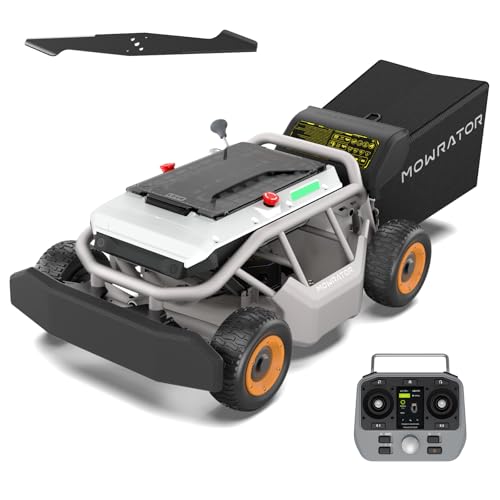
Mowrator S1 4WD 12Ah Remote Control Lawn Mower, 21-Inch, 37° Slope
- Year-Round Yard Maintenance — One Machine for Every Season: Built for all-season yard care! In spring, add the optional Tow Hitch…
- Strong 4WD Drive & Blade Power: With a total 1000W 4WD system, it delivers strong traction and stability. The blade motor peaks at…
- 21” Cutting Width — Cleaner Cuts, Stronger Performance: The 21" cutting width covers more ground per pass for faster, cleaner mowi…
Mowrator built the S1 for the person who wants one machine doing yard work all year, not just in July. It’s a 21-inch battery mower on four driven wheels, and the design brief is clearly suburban-plus: sloped lawns, ditches, pond edges, tree roots. If your property is under an acre and you’re tired of pushing a mower up a hill, this is the one to look at first.
The standout detail isn’t the slope rating — it’s the seasonal flexibility. A tow hitch for spring hauling, a mulching blade for fall leaves, and a snow plow with chains for winter turn this into a four-season tool rather than a one-trick mower. The 56V 12Ah LiFePO4 battery runs about 1.5 hours and covers roughly 0.75 acres, and the 600W charger refills it in 70 minutes — that’s genuinely fast for this class, and it means you can mow, charge over lunch, and mow again. The 21-inch deck with a lift blade handles dense St. Augustine without tearing it, and the remote has no RTK setup or app pairing to fight through. Turn it on and drive.
Two honest caveats. First, the 37-degree slope limit is real — this is not the machine for a near-vertical bank, and the wheels will lose traction before the motor gives up. Second, the runtime figure assumes ideal conditions; wet, thick grass eats into that 1.5 hours noticeably. Budget for a second battery if you’re cutting close to the acre limit.
- 1000W 4WD system with 1985.6W peak blade motor
- 21-inch deck, three mowing modes: mulch, discharge, bag
- 56V 12Ah LiFePO4 battery, 70-minute recharge
- 63 dB operation — quiet enough for early mornings
- Optional snow plow, tow hitch, and mulching blade
Best for: A homeowner with up to three-quarters of an acre and moderate slopes who wants one battery machine to handle mowing, leaves, and light snow.
Infront Crawler with Snow Plow
3rd Pick

INFRONT
Infront Remote Control Lawn Mower with Snow Plow, Crawler Track All-Terrain System, Hybrid Oil-Electric Power for Steep Slopes and Large Lawns, Adjustable Cutting Height
- Remote control operation and adjustable mowing height. With the intuitive and user-friendly remote, you can easily control every d…
- This remote control lawn mower, equipped with a brushed motor, offers exceptional power and excellent durability. It is specifical…
- This remote control lawn mower uses two alloy blades, achieving precise, even cuts and providing stable performance similar to a t…
This Infront model is the practical workhorse of the group. It uses a brushed motor rather than brushless, runs on hybrid oil-electric power, and ships with a dedicated snow plow. The pitch is simple: cut grass three seasons, clear the driveway in the fourth.
The dual alloy blades are the most interesting engineering choice here. They have a rebound function — hit a rock or a buried stump and the blade kicks back instead of shattering or bending the spindle. On rough, unmaintained ground full of debris, that feature will save you real money over a couple of seasons. The zero-turn design also makes it far more maneuverable around fence posts, fruit trees, and garden beds than a fixed-axle crawler. And the snow plow isn’t a gimmick; it clears driveways, sidewalks, and paths, and pushes rocks and dirt piles too.
The trade-off is the brushed motor. Brushed motors are cheaper to make and easier to service, but they wear faster than brushless equivalents, especially in dusty conditions. Expect to replace brushes eventually. The spec sheet also omits a slope rating, which is frustrating if you’re buying specifically for a steep bank. Ask the seller before committing.
- Brushed motor — powerful but shorter lifespan than brushless
- Dual alloy blades with rebound protection on impact
- Zero-turn steering for tight obstacle work
- Includes snow plow for winter driveway clearing
- Adjustable cutting height from the remote
Best for: A homeowner who needs one tracked machine for both mowing rough ground and clearing snow, and who values maneuverability over motor longevity.
Infront Mower with Enclosed Cabin
4th Pick

INFRONT
Infront Remote Control Lawn Mower with Enclosed Cabin, 55° Slope Climbing
- Versatile All-Terrain Remote Control Lawn Mower perfect for steep slopes, tall grass, large lawns, hillsides, orchards, gardens, a…
- Upgraded Brushless Motor with downward cooling duct design delivers stable and efficient performance while ensuring better heat di…
- The Infront Remote Control Lawn Mower features a powerful drive system that easily handles 55° steep slopes. It delivers stable an…
Infront’s second entry pushes into serious terrain. The headline number is 55 degrees of slope capability, which is steep enough that you’d think twice about standing on it, let alone mowing it. This machine targets orchard owners, hillside properties, and anyone with land that borders on unmanageable.
The enclosed cabin and warning lights are the differentiators. On a 55-degree incline, debris flies, and having the engine and cutting assembly shielded matters for both machine life and anyone standing nearby. The brushless motor uses a downward cooling duct, which keeps the motor running cooler during long sessions — heat is what kills electric motors on sustained slope work, so this is a genuinely useful design choice, not marketing. The 20-inch cutting width with 0.79 to 5.9 inches of height adjustment covers everything from a light trim to knocking down tall grass. And the gas engine delivers strong torque with reasonable fuel consumption, so runtime isn’t limited by a battery.
It’s a heavy machine, and heavy machines are harder to transport between properties. If you’re moving it on a trailer regularly, factor in the loading hassle. Also worth noting: the spec sheet leans on the engine and drive system but doesn’t quantify cutting output per hour, so estimating job time takes some guesswork.
- 55-degree slope rating — the steepest in this group after the SYKEND
- Brushless motor with downward cooling duct for heat management
- Fully enclosed cabin and warning lights for safety
- 20-inch cut, adjustable 0.79 to 5.9 inches
- Gas engine with low fuel consumption for extended runtime
Best for: An orchard or hillside property owner who needs to mow slopes near 55 degrees and wants engine protection and safety features built in.
SYKEND SKD-608-90 Remote Mower
5th Pick

SYKEND
Remote-Controlled Robotic Lawnmower with A 22hp High-Horsepower Engine and a 48v Brushless Motor; an All-Terrain, Off-Road Lawnmower(SKD-608-90)
- This remote-controlled lawnmower features a 22hp Loncin gasoline engine, providing powerful cutting performance. Its wide 35.43-in…
- High-Efficiency Mowing: This remote-controlled lawnmower has a 35.5-inch mowing width, and the included remote control allows for…
- The tracked surface protects lawns from damage caused by vehicles. A robust chassis and high-torque motor ensure smooth operation…
The SYKEND is a different animal entirely. A 22hp Loncin gasoline engine, a 35.4-inch cutting deck, and a 65-degree slope rating put it in commercial territory. This is the machine you buy when the job is measured in acres, not square feet, and the grass hasn’t been cut since last fall.
Raw throughput is the point. The 35.4-inch width combined with a mowing efficiency of roughly 28,700 to 35,880 square feet per hour means it can clear a large field in a single session. The tracked undercarriage distributes weight so it doesn’t gouge turf the way wheels can, and the high-torque motor keeps the deck spinning through thick growth. Electric start and full remote operation of major functions keep it usable without climbing aboard. Cutting height adjusts from 0 to 7.87 inches remotely — that range covers everything from a scalp cut on pasture to a taller finish on a lawn.
The obvious drawbacks are weight, fuel, and noise. A 22hp gas engine is loud, needs regular servicing, and drinks fuel on long jobs. Storage also requires space and ventilation. And there’s a delivery wrinkle: the seller asks buyers to check messages promptly after ordering, which suggests shipping logistics can get complicated. Read those messages.
- 22hp Loncin gasoline engine with electric start
- 35.4-inch cut — the widest here by a large margin
- 65-degree slope capability, tracked for stability
- Mows roughly 28,700 to 35,880 square feet per hour
- Remote height adjustment from 0 to 7.87 inches
Best for: A farmer, land manager, or contractor cutting large acreage and heavy brush who needs maximum width, power, and slope capability.
How We Chose These Products
We started with slope rating, because that single number eliminates most of the category for anyone with a real hill. Machines rated below 35 degrees got filtered out early. From there we weighed drive type — crawler tracks versus driven wheels — since traction on wet grass and loose soil is where cheap mowers fail first.
Cutting width and power source came next. A battery mower that covers 0.75 acres is a different product from a 22hp gas unit that clears an acre an hour, and lumping them together would mislead buyers. We also factored in remote ergonomics, seasonal attachments, and whether the spec sheet actually tells you what you need to know. Products that hide basic specs like cutting width got flagged, not dismissed.
Buying Guide: What Really Matters
Slope rating is the first filter. Measure your actual incline before you shop. A phone level app gives you a rough number, and it’s usually higher than people guess. A machine rated for 37 degrees will handle most residential banks; anything past 50 degrees puts you in orchard and commercial territory. Buying under-rated equipment for a steep slope is the most common and most expensive mistake in this category.
Power source decides your maintenance routine. Battery units like the Mowrator run quiet, need no fuel, and recharge in about an hour, but runtime caps your session length. Gas and hybrid machines run as long as you refuel, but they’re louder, heavier, and need oil changes, filter cleaning, and winter prep. If your property is under an acre and mostly level, battery wins. Past an acre or into brush, gas earns its keep.
Drive type matters more than horsepower on slopes. Crawler tracks grip better on loose and wet ground; four driven wheels steer more precisely and do less turf damage on established lawns. For a full breakdown of how these compare to fully autonomous options, our automatic robot mower guide covers the boundary-wire and RTK side of things. If you’re weighing gas specifically, this gas-powered mower comparison is worth a read.
Our Top Recommendation
The Mowrator S1 4WD is the best pick for most buyers. It covers the widest range of real-world needs — moderate slopes, up to 0.75 acres, year-round attachments, and a 70-minute recharge that keeps downtime short. The lack of RTK setup or app pairing means you’re mowing five minutes after unboxing. For a homeowner with a sloped suburban yard, nothing else here is as easy to live with.
If your terrain is genuinely extreme, the calculus changes. The AIWEIYA hybrid handles 45-degree slopes with a brushless motor and remote height adjustment at a price point below the flagship gas units. For acreage and heavy brush, the SYKEND’s 35.4-inch deck and 65-degree rating make it the only realistic choice. And if snow removal is part of the job, the Infront with snow plow is the one machine here that earns its storage space in January.
Frequently Asked Questions
Can I run a remote control mower out of sight?
No, and you shouldn’t. Every machine here relies on radio frequency, and most manufacturers expect line of sight. Trees, buildings, and elevation changes block signal, and a mower that loses connection on a slope is a hazard. Keep it visible at all times. If you need autonomous operation beyond sight, that’s a different product category with GPS boundaries.
How do I estimate cost per acre over the machine’s life?
Add the purchase price to consumables: blades, batteries or engine servicing, and tracks or tires. Battery packs are the big variable — a LiFePO4 pack may last several seasons, while a lead-acid equivalent won’t. Tracks on crawler mowers wear faster on abrasive soil. Divide total cost by the acres you cut per year to get a real number. Gas units usually win on upfront cost per acre but lose on fuel and servicing over five years.
What causes signal loss on large properties, and how do I fix it?
Most interference comes from distance, physical obstructions, and competing 2.4GHz devices like Wi-Fi routers and garage openers. Move your standing position to higher ground, keep the antenna clear of your body, and stay within the rated range. Some remotes support channel switching — check the manual. If dropouts persist on flat open ground, the remote or receiver may be faulty.
Do these mowers need winter storage prep?
Battery models need the pack stored at roughly half charge in a cool, dry place, and the deck cleaned of grass to prevent rust. Gas and hybrid units need fuel stabilizer or a drained tank, an oil change, and a spark plug check. Crawler tracks should be cleaned and inspected for cracking before storage. Skipping this step is why a lot of mowers won’t start in spring.


