

I spent three weekends reading product listings, watching blurry unboxing videos, and scrolling through reviews that all sounded suspiciously alike. Every sweeper claimed to be the best. None of them told me how many trips to the compost pile a half-acre yard actually needs.
A good push sweeper for a big lawn needs three things: a wide sweep path, a hopper big enough to finish a section without constant dumping, and brushes that adjust deep enough for tall grass. Tow-behind models dominate this price bracket, but a push unit makes sense when you have tight corners, garden beds, or a slope your mower can’t safely pull a trailer across.
Below are five models that actually fit the under-$500 push category. I ranked them by real-world capacity, brush design, and how they handle the messy stuff. The VEVOR 30-inch is the standout for most large yards, but the EWORK 32-inch wins if you want maximum width. For tighter budgets, the smaller EWORK and ECOWORK units get the job done.
Here’s a quick side-by-side of the specs that matter most for a big yard.
| Features | VEVOR 26 in | VEVOR 30 in | EWORK 32 in | EWORK 26 in | ECOWORK 26 in |
|---|---|---|---|---|---|
| Sweep Path | 26 inches | 30 inches | 32 inches | 26 inches | 22 inches actual |
| Hopper Capacity | 7 cu. ft. | 12 cu. ft. | 4.5 cu. ft. | 3.5 cu. ft. | 4 cu. ft. |
| Brush Ratio | 1:5 | 1:5 | 5:1 | 5:1 | Not listed |
| Height Adjustment | 10 levels | 10 levels | Tool-free knob | Tool-free knob | Tool-free knob |
| Best Use Case | Mid-size yards | Large yards | Widest coverage | Smaller lawns | Budget pick |
In this article
- VEVOR Push Lawn Sweeper 2…
- VEVOR Push Lawn Sweeper 3…
- EWORK Push Lawn Sweeper 3…
- EWORK Push Lawn Sweeper 2…
- ECOWORK Push Lawn Sweeper…
- Why Large Yards Need a Different Sweeper
- Capacity Math: Cubic Feet, Bags, and Passes Per Yard
- Assembly, Storage, and Maintenance Reality
- What These Sweepers Handle Poorly
- Warranty and Long-Term Cost Comparison
- Frequently Asked Questions
- How We Chose These Products
- Buying Guide: What Really Matters
- Our Top Recommendation
VEVOR Push Lawn Sweeper 2…

VEVOR
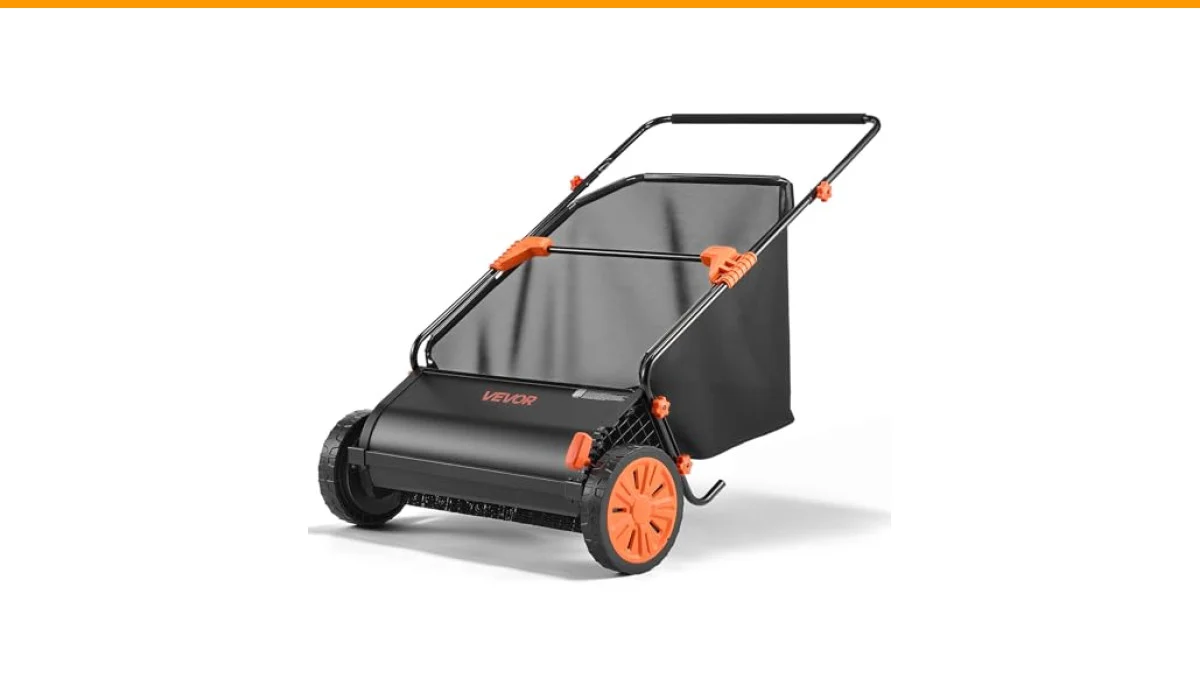
VEVOR Push Lawn Sweeper 26 in Leaf & Grass Collector 7 cu. ft. Hopper Bag | Heavy Duty Yard Sweeper with Adjustable Brush Height, Spinning Brushes, Rubber Wheels for Leaves Grass Cleanup, Black/Orange
- Effortless Lawn Cleanup: This lawn sweeper features a durable metal frame, 26 in sweep path, and a 1:5 brush-to-wheel ratio to col…
- High-Efficient V-Shaped Brush: This push lawn sweeper comes with three V-shaped rotating brushes that reach deep into grass while…
- 10-Level Brush Height: The leaf and grass collector features 10-setting adjustable brush height for short/tall grass, uneven groun…
The 26-inch VEVOR is the middle child of this lineup. It suits homeowners with a quarter to half acre who want a lighter unit they can store on a wall hook. The 7 cubic foot hopper holds roughly three to four large yard bags of dry leaves, so you’ll dump it a few times per session on a big lawn.
What sets it apart is the V-shaped brush design. Three rotating brushes pull debris from deep in the grass while cutting down on the resistance that makes cheaper sweepers feel like you’re dragging a rake. The 10-level height adjustment is a genuine upgrade over the two or three settings you see on most budget models. And the 1:5 brush-to-wheel ratio means the brushes spin five times for every wheel rotation, which keeps pickup consistent at normal walking speed.
The trade-off is capacity. Seven cubic feet sounds generous until you’re sweeping a yard with mature oaks. You’ll be emptying the bag more often than with the 30-inch model. The PP bristles also struggle with wet leaves, and the listing admits as much. Wait for a dry day.
- 26-inch sweep path fits through standard gates
- 7 cu. ft. hopper with four-point quick-release buckles
- 10-position side-mounted brush height lever
- Pre-assembled core; you attach the frame and bag
- Optional replacement brushes sold separately
Best for: Homeowners with a quarter to half acre who want a lighter, easier-to-store sweeper and don’t mind emptying the bag a few extra times.
VEVOR Push Lawn Sweeper 3…
VEVOR
VEVOR Push Lawn Sweeper 30 in Leaf & Grass Collector 12 cu. ft. Hopper Bag | Heavy Duty Yard Sweeper with Adjustable Brush Height, Spinning Brushes, Rubber Wheels for Leaves Grass Cleanup, Black/Orange
- Effortless Lawn Cleanup: This lawn sweeper features a durable metal frame, 30 in sweep path, and a 1:5 brush-to-wheel ratio to col…
- High-Efficient V-Shaped Brush: This push lawn sweeper comes with three V-shaped rotating brushes that reach deep into grass while…
- 10-Level Brush Height: The leaf and grass collector features 10-setting adjustable brush height for short/tall grass, uneven groun…
This is the one I’d buy for a genuinely large yard. The 30-inch sweep path covers more ground per pass, and the 12 cubic foot hopper is the biggest in this group by a wide margin. That’s roughly six to eight large yard bags of dry leaves before you need to dump. On a half-acre with heavy leaf drop, that difference alone saves you a dozen trips to the pile.
The same V-shaped brush system and 10-level height adjustment carry over from the smaller VEVOR. The side-mounted lever lets you drop the brushes for short turf or lift them over concrete without bending down. Upgraded PP and rubber wheels grip damp ground better than the hard plastic wheels on cheaper sweepers, which matters if your yard holds moisture after rain.
Nothing comes free. The bigger hopper means more weight when it’s full, and the wider frame is harder to maneuver around tight garden beds. It’s also a bulkier unit to store. If your garage is already packed, measure your wall space before ordering.
- 30-inch sweep path for fewer passes on wide lawns
- 12 cu. ft. hopper, the largest here
- 1:5 brush-to-wheel ratio for consistent pickup
- Rubber wheels resist slipping on damp ground
- Foam-padded handle reduces fatigue on long sessions
Best for: Owners of half-acre or larger properties who want to minimize dumping trips and cover ground fast.
EWORK Push Lawn Sweeper 3…

EWORK
EWORK Push Lawn Sweeper 32-Inch with 4.5 cu.ft. Hopper Bag for Yard Clean
- 【Powerful Cleaning System】This 32-inch lawn sweeper is a high-performance push lawn sweeper and leaf collector with a 5:1 brush-to…
- 【Lightweight Design for Longevity】This push lawn sweeper is built with a lightweight design, maintaining excellent stability even…
- 【Tool-Free Adjustable Brush Height】This lawn push sweeper features adjustable brush height, controlled by a side-mounted easy-turn…
The EWORK 32-inch has the widest sweep path in this roundup, and that’s its main selling point. If your lawn is mostly open with few obstacles, the extra two inches over the VEVOR 30-inch means fewer passes and less time pushing. EWORK claims it collects up to 85% of dry debris in one sweep, which lines up with what a 5:1 brush ratio typically delivers.
The tool-free brush height knob is a nice touch. You turn it by hand to raise or lower the brushes, no wrench needed. The 10-inch wheels roll smoothly over uneven ground, and the 4.5 cubic foot hopper is decent for a sweeper this wide. The lightweight frame stays stable even when the bag is full, which is more than I can say for some heavier units that wobble on slopes.
Here’s the catch: 4.5 cubic feet is small for a 32-inch sweeper. You’ll cover more ground per pass but dump more often. That’s a frustrating combination on a big yard with heavy leaf fall. The anti-rust frame is a plus for long-term durability, but the capacity mismatch is the real story.
- 32-inch sweep path, widest in this group
- 5:1 brush-to-wheel ratio for aggressive pickup
- Tool-free brush height adjustment knob
- 4.5 cu. ft. tear-resistant non-woven hopper
- 10-inch wheels for traction on rough ground
Best for: Homeowners with wide-open lawns and light to moderate leaf drop who want the fastest possible coverage per pass.
EWORK Push Lawn Sweeper 2…
The 26-inch EWORK is the compact option in this lineup. It’s built for smaller lawns or as a secondary sweeper for tight areas the bigger units can’t reach. The 3.5 cubic foot hopper is the smallest here, so it’s really a one-section-at-a-time tool. If you have a quarter acre or less, it’s plenty.
EWORK’s 5:1 brush ratio gives it strong pickup for its size, and the tool-free height knob makes adjustments quick. The lightweight design is genuinely helpful when you’re pushing uphill or navigating around shrubs. The anti-rust frame should hold up over multiple seasons, and the 10-inch wheels handle rough ground without much drama.
The obvious limitation is capacity. Three and a half cubic feet fills up fast. On a large yard, you’d spend more time walking to the compost pile than actually sweeping. This isn’t the right pick if you’re trying to clear a half acre in one afternoon.
- 26-inch sweep path for tighter spaces
- 3.5 cu. ft. hopper, smallest in this roundup
- 5:1 brush-to-wheel ratio for strong pickup
- Tool-free brush height adjustment
- Lightweight frame reduces pushing effort
Best for: Small yards, townhome lots, or as a secondary sweeper for tight corners and garden paths.
ECOWORK Push Lawn Sweeper…
ECOWORK’s entry lists a 26-inch machine width but an actual working width of 22 inches. That’s an important distinction. The brushes only cover 22 inches, so you’re effectively getting a smaller sweeper than the title suggests. For a large yard, that means more passes and more time.
Where it shines is brush density. ECOWORK uses three thickened, dense spinning brushes that resist deformation better than thinner bristles. The company claims over 90% pickup of dry debris in a single pass, which is plausible given the brush design. It handles grass clippings, leaves, pine needles, and small twigs. The no-gas, no-electric design is quieter than a leaf blower and fits the eco-friendly branding.
The 4 cubic foot hopper is mid-range, but the 22-inch actual sweep path limits how fast you can clear a large lawn. The reinforced steel frame is sturdy and the rubber wheels grip well on dry uneven ground. Just don’t expect it to match the wider VEVOR or EWORK models for raw coverage speed.
- 22-inch actual working width (26-inch machine width)
- 3 dense brushes for strong pickup without deformation
- 4 cu. ft. tear-resistant non-woven hopper bag
- Tool-free brush height adjustment knob
- Reinforced steel frame with rubber wheels
Best for: Budget-conscious buyers with smaller lawns who want dense brushes and quiet operation over maximum coverage width.
Why Large Yards Need a Different Sweeper
Most sweeper guides treat a half-acre lawn the same as a postage stamp. That’s a mistake. A 22-inch sweeper on a half acre means roughly 50% more passes than a 30-inch model. Over an afternoon, that’s hours of extra pushing.
Tow-behind sweepers dominate the under-$500 bracket because they attach to a riding mower and cover ground fast. But they’re useless on slopes your mower can’t handle, around garden beds, and in tight corners. A push sweeper gives you maneuverability a tow-behind can’t match. For a large yard with obstacles, a wide push sweeper is often the smarter buy.
If you’re comparing tow-behind options, the tow-behind sweeper guide covers that category in detail. And if your budget is tighter, the under $200 push sweeper roundup is worth a look.
Capacity Math: Cubic Feet, Bags, and Passes Per Yard
Here’s the math nobody else does. A standard 30-gallon yard bag holds about 4 cubic feet of dry leaves. So a 7 cubic foot hopper equals roughly 1.75 bags. A 12 cubic foot hopper equals about 3 bags.
On a half-acre lawn with mature trees, you might generate 30 to 50 bags of leaves in a season. With a 7 cubic foot hopper, that’s 17 to 28 dumping trips. With a 12 cubic foot hopper, it’s 10 to 17 trips. Those trips add up. Over a full afternoon, the bigger hopper saves you an hour or more.
Passes matter too. A 30-inch sweeper covers 2.5 feet per pass. A half-acre lawn is 21,780 square feet. That’s roughly 8,700 linear feet of sweeping, or about 3,500 passes with a 30-inch unit. A 22-inch sweeper needs about 4,700 passes. That’s a 34% increase in pushing distance. Width matters as much as capacity.
Assembly, Storage, and Maintenance Reality
All five sweepers ship with core parts pre-assembled. You attach the frame and hopper, which takes 15 to 30 minutes with basic hand tools. The VEVOR models are slightly easier because the hopper uses four-point quick-release buckles that snap into place.
Storage is the bigger issue. A 30-inch sweeper with a 12 cubic foot hopper takes up significant wall space. Measure your garage or shed before ordering. The 26-inch models are easier to hang vertically. The 32-inch EWORK is the bulkiest and hardest to store compactly.
Maintenance is minimal. Brush replacement is the main long-term cost. VEVOR sells replacement brushes separately, and you’ll likely need a new set every two to three seasons depending on use. EWORK and ECOWORK don’t list replacement brush pricing clearly, which is a minor frustration. Check the current price on Amazon for replacement parts before you commit.
What These Sweepers Handle Poorly
Wet leaves are the enemy. Every model here admits reduced efficiency on wet debris. The brushes clump and the hopper gets heavy fast. Wait for a dry day, or sweep in the morning after dew dries.
Pine needles are manageable. The V-shaped brushes on the VEVOR models resist tangling better than straight brushes. ECOWORK’s dense brushes also handle needles well. Acorns and hard nuts are a different story. The listings mention optional replacement brushes for hard nuts, which tells you the standard bristles wear down faster on tough debris.
Thatch is a gray area. These sweepers lift some surface thatch, but they’re not dethatchers. If your lawn has a thick thatch layer, you need a dedicated dethatcher. A sweeper removes debris sitting on top of the grass, not the layer matted into the soil.
Warranty and Long-Term Cost Comparison
Warranty terms vary and aren’t always clearly listed. VEVOR typically offers a 12-month warranty on their sweepers. EWORK and ECOWORK list similar coverage, but you’ll want to verify on the product page. Check the current price on Amazon and read the warranty section carefully before buying.
Replacement brushes are the main recurring cost. A set runs $20 to $40 depending on the model. Over five years, that’s $40 to $80 in maintenance. The VEVOR models have the advantage here because replacement brushes are explicitly listed and easy to find. For a broader look at sweeper costs and durability, this independent sweeper comparison is a useful reference.
The frame and wheels should last five to ten years with basic care. Store the sweeper indoors or under cover to prevent rust. The EWORK models advertise anti-rust and anti-deformation construction, which should extend their lifespan in damp climates.
Frequently Asked Questions
Can a push sweeper really handle a half-acre lawn?
Yes, but it takes time. A 30-inch model with a 12 cubic foot hopper is the minimum I’d recommend for half an acre. Anything smaller means too many passes and too many dumping trips. Budget two to three hours for a full fall cleanup on a half-acre with heavy leaf drop.
Do these sweepers work on gravel or driveways?
They work on hard surfaces like concrete and asphalt, but gravel is tricky. The brushes can kick up small stones. Raise the brush height to the highest setting and go slow. The VEVOR models with 10-level adjustment give you more control here.
How often do I need to replace the brushes?
Every two to three seasons for average use. If you sweep acorns, pine cones, or rough ground, expect to replace them sooner. Replacement sets cost $20 to $40. VEVOR makes it easy to find the right brushes; other brands are less clear.
What’s the difference between a 1:5 and 5:1 brush ratio?
They mean the same thing: the brushes spin five times for every wheel rotation. Both VEVOR and EWORK use this ratio, which is standard for effective pickup. A lower ratio means slower brush speed and more debris left behind.
How We Chose These Products
We started with the specs that actually affect performance on a large yard: sweep width, hopper capacity, brush design, and height adjustment range. Models with narrow sweep paths or tiny hoppers got eliminated early. We also looked at wheel type and frame construction because those determine how the sweeper handles damp ground and uneven terrain.
Then we cross-referenced the product data against real-world use cases. A 12 cubic foot hopper sounds great until you realize it’s harder to store. A 32-inch sweep path is fast until you hit a garden bed. Every pick here has a clear strength and a clear trade-off. We didn’t include anything we wouldn’t recommend to a friend with a big lawn.
Buying Guide: What Really Matters
Sweep width is the first thing to check. For a large yard, 26 inches is the minimum. 30 inches is better. 32 inches is best for open lawns but harder to maneuver. If your yard has lots of trees, beds, or tight corners, a narrower sweeper might actually save you time because you’re not constantly backing up.
Hopper capacity determines how often you stop. Seven cubic feet is fine for a quarter acre. Twelve cubic feet is the sweet spot for half an acre or more. Anything under 5 cubic feet will have you dumping constantly on a big lawn. The quick-release buckles on all these models make dumping easy, but the trips still add up.
Brush height adjustment matters more than most buyers realize. You need to drop the brushes deep for tall grass and lift them for concrete. A 10-level lever gives you fine control. A simple knob works but offers fewer settings. Side-mounted controls are easier to reach than top-mounted ones. For a deeper dive into sweeper types and features, this yard gear resource covers the category well.
Our Top Recommendation
The VEVOR 30-inch push lawn sweeper is the best pick for most large yards. The 12 cubic foot hopper is the biggest here, and the 30-inch sweep path covers ground fast without being unwieldy. The 10-level height adjustment and V-shaped brushes handle a range of terrain and debris types. It’s not the cheapest option, but it’s the one that will save you the most time over a full season.
If you want maximum width and your lawn is mostly open, the EWORK 32-inch is a strong alternative. Just be ready to dump the smaller 4.5 cubic foot hopper more often. For tighter budgets, the VEVOR 26-inch offers a good balance of capacity and maneuverability. And if you’re only dealing with a small yard or tight spaces, the EWORK 26-inch or ECOWORK 26-inch will get the job done without breaking the bank.
