
Best Mower for Bumpy Lawn: Top 5 Picks for Uneven Ground
Contents
You know the feeling. You push your mower across what looks like a normal yard, and suddenly the deck slams into a hummock, gouging out a patch of grass. Or you hit a dip and the whole machine bucks, leaving a strip of uncut stragglers. Bumpy lawns punish ordinary mowers, turning a simple chore into a teeth-rattling exercise in frustration.
The fix isn’t a heavier deck or more horsepower alone. It’s about wheel size, deck design, weight distribution, and how the machine handles changes in terrain. A good mower for uneven ground keeps the blade height steady, avoids scalping the high spots, and stays stable when you’re working across a slope.
I’ve broken down five very different approaches to this problem, from a nimble 13-inch electric for small lots to a burly gas self-propelled for acreage. Plus, I’ll give you the real talk on what causes scalping, why tire pressure matters more than you think, and how to maintain any mower that spends its life bouncing around. Here’s the shortlist.
Here are the key specs side by side to help you see the differences at a glance.
| Features | Casince 17-Inch | BILT HARD 21-Inch | Greenworks 16-Inch | Casince 13-Inch | LEBOSBO V3 Robot |
|---|---|---|---|---|---|
| Power Source | Cordless electric | Gas engine | Cordless electric | Cordless electric | Robotic electric |
| Deck Width | 17 inches | 21 inches | 16 inches | 13 inches | Not specified |
| Drive Type | Push (walk-behind) | Self-propelled | Push (walk-behind) | Push (walk-behind) | Self-propelled (autonomous) |
| Cutting Heights | 6 settings (1-3 in) | 8 settings (1.2-3.75 in) | 5 positions | 5 settings (1-2.6 in) | Adjustable |
| Best Use Case | Medium bumpy lots | Large, rough terrain | Small to medium lawns | Small, narrow areas | Flat, small lawns |

Casince 17-Inch Cordless
1st Pick

Casince
Cordless Lawn Mower, 17 in Walk Behind Lawn Mower for Yard & Garden
- WIDER MORE EVEN CUTTING: The 17-inch cutting deck and 6 height settings from 1 to 3 inches (25–75 mm) help this cordless lawn mowe…
- DUAL BATTERY EXTENDED RUNTIME: Powered by two 20V 4.0Ah batteries, this walk behind lawn mower runs for up to 40 minutes and cover…
- LARGE CAPACITY GRASS COLLECTION: The 50L collection bag holds more clippings between emptying cycles, while regular cleaning aroun…
This Casince model is the middle-ground workhorse for anyone with a small-to-medium yard that rolls more than it should. The 17-inch deck is wide enough to make decent progress but compact enough to stay maneuverable when you’re weaving around tree roots and old mole hills. It’s a push mower, so you control the pace, which honestly helps on bumpy ground — you can slow down for the rough patches instead of fighting a self-propelled system that wants to lurch ahead.
The dual 20V 4.0Ah batteries give it up to 40 minutes of run time, which covers roughly 5,380 square feet under test conditions. Real-world mowing on uneven turf will drain it faster because the motor works harder to keep the blade spinning at 3000 RPM. The brushless motor is the right call here; it holds its speed better than a brushed motor when the grass gets thick in the dips. At 14 kg (about 31 pounds), it’s light enough to lift over a bumpy patch or carry to a shed without throwing your back out.
Here’s the honest trade-off. A lighter mower bounces more on rough ground, and this one is no exception. You’ll feel it in your arms on a long session. The 50L collection bag is generous, but on bumpy lawns you’ll want to empty it more often — a full bag adds weight to the rear and makes the front end feel skittish on inclines. The six height settings top out at 3 inches, which is fine for most grass types but won’t let you leave the lawn as long as some gas mowers will if you’re letting it go dormant in summer heat.
- 17-inch deck with six height positions from 1 to 3 inches
- Dual 20V 4.0Ah batteries deliver up to 40 minutes of run time
- Brushless motor spins the blade at 3000 RPM for steady cutting
- 50L rear bag reduces trips to the compost pile
- One-button start with a pull-bar safety mechanism
Best for: Homeowners with a quarter-acre or less who want a lightweight electric that won’t scalp the high spots when they slow down and take their time.
BILT HARD 21-Inch Self-Propelled
2nd Pick

BILT HARD
BILT HARD 21" Self Propelled Gas Lawn Mower – 201cc 4-Cycle OHV, 3-in-1 Bagging/Mulching/Side Discharge, 8 Adjustable Cutting Heights & Smooth Easy Start
- Efficient & Versatile Mowing Solution This 21-inch self-propelled lawn mower features a durable 3-in-1 steel deck with mulching, s…
- Self-Propelled Functionality Equipped with rear-wheel drive and single-speed self-propelled technology, this mower glides smoothly…
- Reliable Performance Powered by a robust 201cc 4-stroke OHV engine delivering 9.0 ft·lb of torque, this gas-powered mower provides…
If your bumpy lawn spans a half-acre or more, pushing anything gets old fast. The BILT HARD 21-inch is the gas-powered answer for bigger properties where battery range just won’t cut it. The 201cc OHV engine makes 9.0 ft-lb of torque, which is the kind of grunt that powers through thick grass in the low spots without bogging down. This is a serious machine for serious terrain.
The self-propelled rear-wheel drive is the standout feature for uneven ground. Rear-wheel drive puts the traction where the weight is, so the drive wheels dig in and pull you over bumps instead of spinning out like a front-wheel drive unit tends to do on grass. The single-speed transmission isn’t fancy, but it’s predictable. You engage it, set a pace, and focus on steering. The foam-wrapped handle and angled design cut down on vibration fatigue during a long mow.
Nobody’s pretending this is a precision instrument, though. The 3-in-1 steel deck is tough, but it’s also heavy, and the single-speed drive means you can’t slow down to a crawl for the worst sections — you’re committed to that pace or you disengage the drive and push. The height adjustment goes from 1.2 to 3.75 inches across eight positions, giving you real flexibility to raise the deck for rough ground. The no-choke, no-primer starting is a genuine convenience that removes a common frustration with gas engines.
- 201cc 4-stroke OHV engine with 9.0 ft-lb of torque
- Rear-wheel drive self-propulsion for better traction on slopes
- 3-in-1 deck: bag, mulch, or side discharge
- Eight cutting heights from 1.2 to 3.75 inches via single lever
- Foam-wrapped handle reduces vibration transfer
Best for: Owners of large, rough lawns who need gas power and self-propelled traction to cover ground without exhausting themselves.
Greenworks 40V 16-Inch Push
3rd Pick
Greenworks
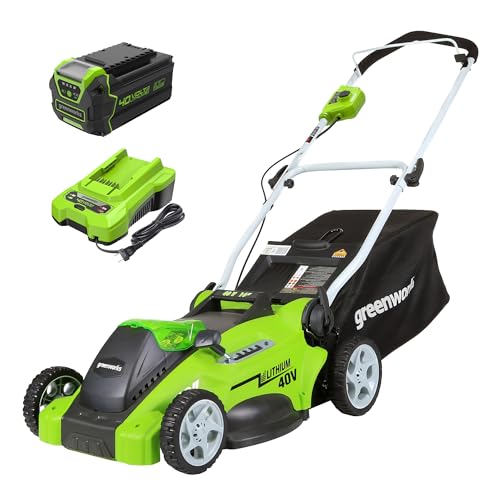
Greenworks 40V 16in Push Lawn Mower, 4.0 Ah Battery and Charger
- [16" LAWN MOWER] - This 40V lawn mower cuts up to 1/3 acre with fully charged 4.0Ah battery (varies based on grass condition and o…
- [ULTRA LIGHTWEIGHT] - 35% lighter than steel deck mowers
- [SINGLE LEVER HEIGHT ADJUST] - 5 position height adjustment
Greenworks has been making cordless outdoor tools for a long time, and this 40V 16-inch push mower shows why they’re a safe bet. It’s a simple, no-nonsense machine aimed at people with a third of an acre or less who want something that just works. The 40V 4.0Ah battery is from a mature platform, and if you already own other Greenworks 40V tools, this shares the same battery — that alone can save you a chunk of money.
The big selling point here is weight. Greenworks claims this is 35% lighter than a comparable steel deck mower, and it feels like it when you’re wrestling it around bumps and dips. A lighter mower is easier to control on uneven ground because you can lift the front end over a high spot rather than letting the deck plow into it. The single-lever height adjustment across five positions is quick to change, so you can raise the deck for a rough spring cut and lower it later in the season.
What’s the catch? The 16-inch deck is narrower than the Casince 17-inch, so you’ll make more passes. And being a push mower, you’re doing all the work — there’s no self-propelled option here. On a truly bumpy lawn, that means you’re the suspension. The 2-in-1 system handles mulching and rear bagging, but there’s no side discharge if you prefer that for very tall grass. The three-year warranty on both tool and battery is a solid safety net that many budget brands don’t offer.
- 40V 4.0Ah battery covers up to 1/3 acre per charge
- 35% lighter than steel deck equivalents for easier handling
- Single-lever height adjustment with five positions
- Mulch or rear bag with 2-in-1 system
- Works with 75+ Greenworks 40V tools
Best for: Budget-conscious buyers with small, bumpy yards who want a featherlight electric mower from a brand with a proven battery ecosystem.
Casince 13-Inch Cordless
4th Pick

Casince
Cordless Lawn Mower, 13-Inch Walk Behind Lawn Mower for Yard Care
- COMPACT CUTTING FOR SMALL LAWNS: The 13-inch cutting deck and 5 height settings from 1 to 2.6 inches (25–65 mm) help this cordless…
- BRUSHLESS POWER FOR CONSISTENCY: The 3000 RPM brushless motor delivers up to 1200W max output, helping this electric battery power…
- DUAL BATTERY LONGER RUNTIME: Powered by two 20V 4.0Ah batteries, this walk behind lawn mower runs for up to 40 minutes and covers…
Sometimes the bumpy lawn is really just a bumpy strip. Narrow side yards, oddly shaped patches around a garden, or a postage-stamp front yard with more roots than grass. For those spots, the Casince 13-inch is the right tool. It’s the smallest mower here, with a 13-inch deck that slips through gaps a 21-inch machine can’t touch. At 10 kg (about 22 pounds), it’s genuinely easy to carry to a hard-to-reach area.
Don’t let the size fool you. It still packs the same 3000 RPM brushless motor as its bigger sibling, and the dual 20V 4.0Ah batteries give it the same 40-minute runtime. The difference is coverage — you’ll get about 3,230 square feet per charge because the smaller deck means more passes. The 30L collection bag is proportionally smaller too, so you’ll be emptying it more often on any given patch of grass.
For bumpy ground, the small footprint is actually an advantage. A shorter deck follows the contours of the land better than a wide one, which means fewer instances of one corner digging in while the other side rides high. The five height settings from 1 to 2.6 inches give you less top-end range than the 17-inch model, so you can’t cut as high if you’re dealing with very uneven terrain where you want to leave more grass length for protection. It’s a niche tool, but for its niche, it’s nearly perfect.
- 13-inch deck with five height positions from 1 to 2.6 inches
- Brushless motor maintains consistent blade speed
- Dual 20V 4.0Ah batteries for up to 40 minutes of use
- 30L grass bag included
- Weighs just 10 kg for easy portability
Best for: Anyone mowing tight, bumpy spaces where a full-size mower simply won’t fit or is too heavy to manage.
LEBOSBO V3 Robot Mower
5th Pick

LEBOSBO
2026 New LEBOSBO V3 AI Vision Robotic Lawn Mower, 1600 Sq.Ft, Black
- 【AI Vision Obstacle Sensing】Equipped with intelligent AI vision technology, the LEBOSBO V3 robotic lawn mower can detect obstacles…
- 【Custom No-Go Zones with 32FT Magnetic Strip】The included 32FT magnetic strip allows flexible no-go zone setup to keep the mower a…
- 【Smartphone APP Control】Use the mobile APP to control your robot lawn mower remotely. Schedule mowing times, monitor operation, an…
Robot mowers are a different beast entirely, and the LEBOSBO V3 is aimed at a specific scenario: a small, relatively flat lawn where you’d rather not push anything at all. If your bumpy lawn is mostly smooth with a few gentle undulations, this AI vision bot can handle it. It uses cameras to map your yard and detect obstacles, so there’s no perimeter wire to bury — you set it down, connect the app, and let it work.
The AI vision system is the key differentiator here. It sees a rock or a tree root and navigates around it instead of slamming into it. For bumpy lawns, that means it can identify a particularly rough patch and either slow down or find a better line. The included 32-foot magnetic strip lets you cordon off areas you don’t want it touching, like a flower bed or a spot where the ground is too rough for safe operation.
Let’s be clear about the limitations. This is not a mower for a seriously uneven yard. A robot mower is light, and on a real bump, it can get stuck or tilt enough to lift the blade off the grass. The 1,600 square foot coverage rating is modest, and the app control, while convenient, adds a layer of complexity that some folks just don’t want. It’s quiet, which is a nice change from a gas engine, and the adjustable cutting height lets you dial in the grass length, but it’s a maintenance tool for keeping a lawn tidy between manual cuts, not a replacement for a rugged gas mower on rough terrain.
- AI vision navigation detects and avoids obstacles
- Wire-free setup with no perimeter cable installation
- 32-foot magnetic strip for custom no-go zones
- Smartphone app for scheduling and remote monitoring
- Low-noise operation for discreet mowing
Best for: Tech-savvy homeowners with small, mostly level lawns who want hands-off maintenance and are willing to work around its terrain limits.
How We Chose These Products
I looked at what actually causes problems on bumpy lawns, not just what the marketing says. Scalping happens when a mower deck tilts and the blade digs into a high spot. Bouncing happens when the mower is too light or the wheels are too small to bridge a dip. So I prioritized machines with either a wide wheelbase, a manageable weight that lets you control the deck angle, or enough power to keep blade speed up when the terrain gets rough.
Each pick here solves a different piece of the puzzle. The gas BILT HARD brings torque and self-propulsion for big slopes. The Casince and Greenworks electrics offer lightweight maneuverability for smaller spaces where you need to finesse the deck over trouble spots. The robot is the outlier, included for the specific case of a mostly flat lawn with minor undulations where hands-off convenience trumps raw capability. I excluded anything with a stamped deck so thin it would flex on impact, and I favored models with multiple height adjustments so you can raise the deck for rough conditions.
Buying Guide: What Really Matters
Deck design is the first thing to scrutinize. A deck that sits between the wheels (rather than in front) is less prone to scalping because the wheels act as stabilizers that follow the ground contour. Look for a deck that’s stiff and well-braced. A flimsy deck will flex and vibrate on bumps, leading to an uneven cut and premature wear on the blade and spindle. The material matters — steel is heavier but more rigid, while aluminum is lighter but can dent if you clip a rock.
Wheel size and tire type are critical on uneven ground. Bigger wheels roll over dips and hummocks more easily than small ones, which tend to drop into every hole. Look for 8-inch or larger rear wheels, and consider tires with a deeper tread for better traction on slopes. Semi-pneumatic tires never go flat but offer less cushioning, while pneumatic tires absorb shock and improve grip at the cost of needing occasional air checks. Lowering tire pressure slightly on pneumatic tires can dramatically improve traction and smooth out the ride on bumpy lawns.
Transmission and speed control matter more than most people realize. On a self-propelled mower, a jerky or poorly modulated drive system will lurch you forward on uneven ground, making it hard to control the deck angle. Hydrostatic transmissions offer the smoothest, most variable speed control, letting you creep along over rough patches. Manual gear transmissions have fixed speeds that can feel too fast for bumpy sections. For push mowers, your arms are the transmission, so weight and handle ergonomics become the deciding factors.
Our Top Recommendation
The BILT HARD 21-inch Self-Propelled is the top pick for most people with a genuinely bumpy lawn. The rear-wheel drive gives you the traction you need on slopes, the 201cc engine has the torque to power through thick grass in low spots, and the steel deck is durable enough to take some abuse. The eight height settings give you the range to raise the deck for rough terrain, which is the single most effective way to prevent scalping. It’s not the cheapest option, but for a large, uneven yard, it’s the one that will save your back and your grass.
If your budget is tighter or your yard is smaller, the Greenworks 16-inch push mower is the runner-up. It’s light, easy to control, and shares batteries with a wide range of other tools. For those with just a tiny, rough patch to manage, the Casince 13-inch is the nimble choice. And if you’re dealing with a yard that’s truly too large and rough for a walk-behind, you might want to look at the zero-turn mower options that are built with suspension and wider decks for exactly this problem.
Pro Tips for Mowing Bumpy Terrain
Raise the deck. It’s the simplest fix. Cutting higher leaves more grass blade, which protects the crown of the plant and reduces the chance of scalping. On a lawn with dips and rises, set the deck one or two notches higher than you would on flat ground.
Mow across the slope, not up and down it, if the grade is moderate. This is safer and gives you better traction. On steep slopes, a self-propelled or ride-on mower with a low center of gravity is essential. A push mower on a steep hill is a recipe for a strained back or worse.
Slow down. The faster you go, the more the mower bounces. A slow, steady pace lets the wheels follow the ground and keeps the blade cutting at a consistent height. This is where a variable-speed self-propelled mower shines.
Overlap your passes slightly. On bumpy ground, the mower will occasionally skip a patch where it bounces. Overlapping by a couple of inches catches those stragglers so you don’t have to go back over the whole yard.
Vary your pattern. Mowing the same direction every time will eventually compact the soil into ruts that make the bumps worse. Change your path each week to keep the ground as even as possible.
Maintenance Checklist for Rough Use
Mowing bumpy ground is hard on equipment, so maintenance is non-negotiable. Check the blade after every few uses. A blade that’s been banging into dirt and rocks will dull quickly and can develop nicks or bends. Sharpen or replace it as soon as you notice a ragged cut. An unbalanced blade will cause severe vibration, which is amplified on rough terrain and can damage the spindle.
Inspect the belt (on self-propelled models) for wear and stretching. The constant load changes from bouncing around can cause premature wear. Look for cracks, fraying, or glazing on the belt edges. Replace it at the first sign of trouble rather than waiting for it to snap mid-mow.
Keep the underside of the deck clean. Grass builds up quickly, especially when you’re cutting thick growth in the low spots. A caked-on layer of grass reduces airflow and cutting efficiency. Scrape it off after each use, and consider spraying the underside with a silicone lubricant to prevent buildup.
Check the wheel bearings and axles. On a bumpy lawn, wheels take a beating. If a wheel starts to wobble or make noise, it’s time to investigate. Keep the wheels properly secured and lubricated according to the manufacturer’s instructions.
Frequently Asked Questions
What is scalping and how do I stop it? Scalping happens when the mower deck tilts and the blade cuts into a high spot, leaving bare dirt. To prevent it, raise the deck height, slow down, and consider a mower with a deck that sits between the wheels. Larger wheels also help bridge small dips and hummocks without tilting the deck.
Is a self-propelled mower better for a bumpy lawn? Usually, yes. Self-propelled mowers take the physical effort out of pushing, which lets you focus on steering and controlling the deck angle. Rear-wheel drive models are better than front-wheel drive for slopes and rough ground because the drive wheels have more weight over them for traction.
Can I use a robot mower on uneven ground? Some can handle gentle slopes, but most are not designed for serious bumps. A robot mower is light and can get stuck or tip on rough terrain. If your lawn is mostly flat with a few soft undulations, a model with good obstacle detection like the LEBOSBO V3 might work. For genuinely bumpy yards, a walk-behind or ride-on mower is a safer bet.
How does tire pressure affect mowing on bumpy ground? It makes a big difference. Lower tire pressure creates a larger contact patch, which improves traction and helps the tires absorb small bumps instead of transmitting the shock to the deck. It also lets the tires conform to the ground slightly, reducing the chance of the deck scalping. Check your tire pressure regularly and adjust it based on the conditions.