
Your lawn is buried under a fresh layer of leaves, and the rake is leaning against the shed, mocking you. You’ve been there. The blower works for the patio, but the grass is a different story. A good lawn sweeper turns a three-hour chore into a thirty-minute pass.


The right sweeper depends on your lawn size, your budget, and whether you own a riding mower. Push models suit smaller yards and tight gates. Tow-behind units cover acreage fast. Brush quality, hopper capacity, and height adjustment separate the useful machines from the frustrating ones.
We picked five models that solve different problems. The VEVOR 30-inch push sweeper is our top overall pick for its balance of capacity and maneuverability. The YINTATECH tow-behind handles large properties. The EWORK 32-inch is a solid middle ground. The smaller VEVOR 21-inch and 26-inch models fit compact yards and tight storage.
Here is a quick comparison of the key specs that matter most.
| Features | VEVOR 26 in | VEVOR 30 in | VEVOR 21 in | EWORK 32 in | YINTATECH 42 in |
|---|---|---|---|---|---|
| Type | Push | Push | Push | Push | Tow-behind |
| Sweep Path | 26 inches | 30 inches | 21 inches | 32 inches | 42 inches |
| Hopper Capacity | 7 cu. ft. | 12 cu. ft. | 3.5 cu. ft. | 4.5 cu. ft. | 20 cu. ft. |
| Brush Adjustment | 10-level | 10-level | Stepless | Tool-free knob | Up to 2 inches |
| Best Use | Mid-size yards | Large push jobs | Small yards | All-around value | Acreage and tractors |
VEVOR Push Lawn Sweeper 2…
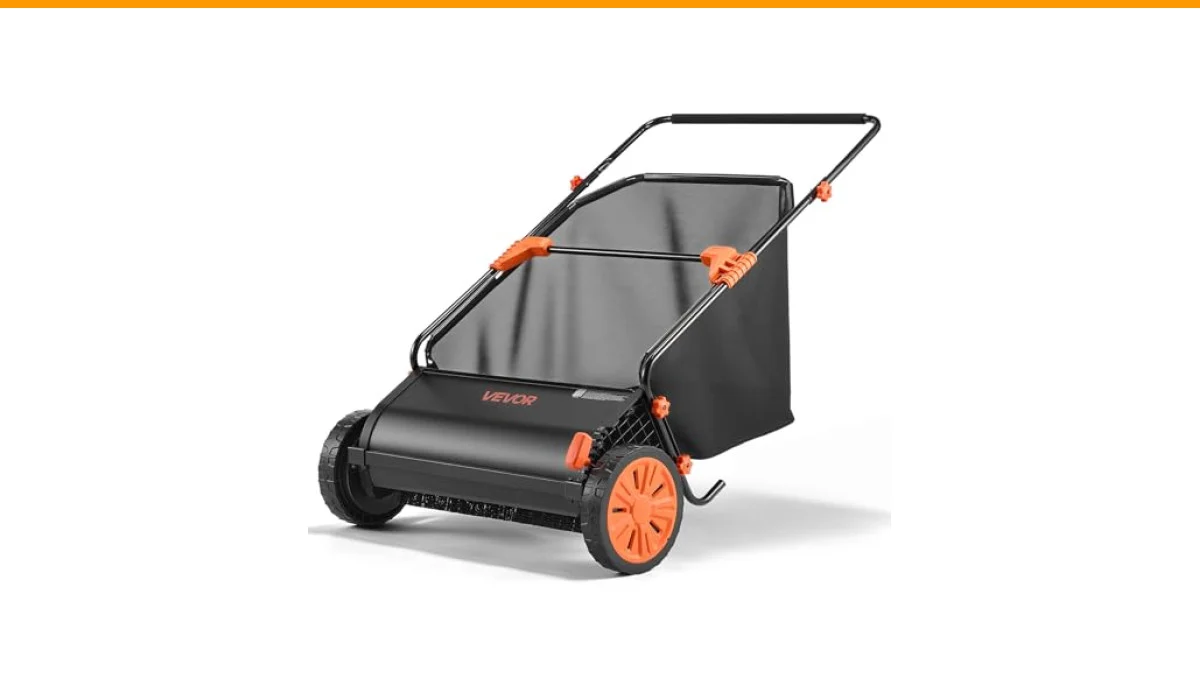
This 26-inch push sweeper suits homeowners with a quarter-acre to half-acre lot who want to clear leaves and grass clippings without firing up a tractor. It’s also a good fit if you have a patio, driveway, or gravel path that collects debris. The 7 cubic foot hopper hits a sweet spot between capacity and maneuverability.
The 1:5 brush-to-wheel ratio means the brushes spin five times for every wheel rotation, which translates to aggressive pickup on dry leaves and pine needles. The V-shaped bristle design reaches into grass without dragging. A side-mounted handle lets you pick from ten height settings on the fly. The foam-padded grip helps on longer sessions, and the PP and rubber wheels grip damp ground better than basic plastic wheels.
Wet leaves will clog the brushes and reduce pickup efficiency. You’ll need to wait for a dry day or make multiple passes. The 7 cubic foot bag fills faster than you might expect in heavy leaf fall, so plan on emptying it every few passes. Assembly is straightforward, but the hopper buckles take a little practice to snap on smoothly.
- 26-inch sweep path with 1:5 brush-to-wheel ratio for fast pickup
- 7 cu. ft. tear-resistant hopper with four-point quick-release buckles
- 10-position brush height adjustment via side handle
- PP and rubber wheels for traction on damp or rough ground
- Optional replacement brushes available for heavy use
Best for: Homeowners with mid-size yards who want a reliable push sweeper that handles leaves, grass, and pine needles without breaking the bank.
VEVOR Push Lawn Sweeper 3…
The 30-inch version targets larger suburban lots, roughly half an acre to an acre, where you want to cover ground quickly but still prefer a push model over a tow-behind. It’s also a smart choice if your storage space is tight but you need more capacity than a compact unit offers. The 12 cubic foot hopper is the standout feature here.
Three V-shaped brushes rotate at the same 1:5 ratio as the smaller VEVOR, but the wider 30-inch path means fewer passes across the lawn. The larger hopper dramatically cuts down on emptying trips. On a typical fall day, you might empty this bag once for every three or four trips you’d make with a 7 cubic foot model. The 10-level height adjustment works the same way, with a side-mounted handle for quick changes.
The trade-off is weight. A full 12 cubic foot hopper gets heavy, and pushing it uphill or across uneven ground will test your stamina. The wider frame also makes it harder to navigate around tight landscaping beds or through narrow gates. If your yard has lots of obstacles, the 26-inch model may actually be faster in practice.
- 30-inch sweep path covers more ground per pass
- 12 cu. ft. hopper reduces emptying frequency significantly
- Same 1:5 brush ratio and V-shaped bristles as smaller VEVOR models
- 10-level height adjustment with side-mounted control
- Upgraded PP and rubber wheels for traction and wear resistance
Best for: Homeowners with larger push-sweeper-friendly yards who want maximum capacity and fewer stops to empty the bag.
VEVOR Push Lawn Sweeper 2…
This 21-inch model is built for small yards, townhome lots, and anyone who needs a sweeper that stores easily. It’s also a practical pick if you have a narrow gate or a shed with limited floor space. The 3.5 cubic foot hopper is compact, but the thickened brushes make up for the smaller size with aggressive pickup.
VEVOR claims this unit picks up 80 percent of debris in a single pass, and the densified bristles do resist deformation better than flimsier brushes. The stepless height adjustment is a nice touch. You turn a knob by hand to raise or lower the brushes, no tools needed. That makes it easy to switch between grass, sidewalk, and driveway surfaces. The non-woven hopper bag removes quickly for dumping, and the whole unit can hang on a garage wall.
The small hopper fills fast in heavy leaf fall. You’ll empty it often, maybe every five minutes in peak season. The 21-inch path also means more passes across a larger lawn, so this isn’t the right tool for half-acre lots. It’s best for smaller spaces where maneuverability matters more than capacity.
- 21-inch sweep path with thickened, densified brushes
- Stepless brush height adjustment via hand knob, no tools
- 3.5 cu. ft. non-woven hopper bag with quick removal
- Hangs on a wall for compact storage
- Ergonomic handle for comfortable pushing
Best for: Small-yard owners, townhome residents, and anyone who needs a lightweight sweeper that stores easily and handles tight spaces.
EWORK Push Lawn Sweeper 3…
The EWORK 32-inch push sweeper sits in the middle of the pack on capacity but leads on brush ratio. It uses a 5:1 brush-to-wheel ratio, which is more aggressive than the VEVOR models. That means faster brush rotation and better pickup on dry leaves, grass clippings, and pine needles. EWORK claims up to 85 percent collection in one sweep.
The lightweight frame is a genuine advantage. A full 4.5 cubic foot hopper stays stable, and the unit doesn’t feel like it’s fighting you on every push. The 10-inch wheels provide solid traction on damp ground. The tool-free brush height adjustment uses a side-mounted knob, so you can adapt to short grass, tall grass, or pavement without hunting for a wrench. The foam-padded handle reduces fatigue on longer jobs.
The 4.5 cubic foot hopper is smaller than the VEVOR 26-inch and 30-inch models. You’ll empty it more often in heavy leaf season. The 32-inch width is wider than the 30-inch VEVOR, so it covers slightly more ground per pass, but the smaller bag offsets that advantage. If capacity is your top priority, the VEVOR 30-inch is the better choice. If you want aggressive brush action and a lighter push, the EWORK wins.
- 32-inch sweep path with 5:1 brush-to-wheel ratio for aggressive pickup
- 4.5 cu. ft. tear-resistant hopper with four-point quick-release buckles
- Tool-free brush height adjustment via side knob
- Lightweight design with 10-inch wheels for traction
- Anti-rust and anti-deformation construction for longevity
Best for: Homeowners who want a lightweight, aggressive push sweeper that handles dry leaves and grass clippings with minimal effort.
YINTATECH Tow Behind Lawn…

YINTATECH
YINTATECH Tow Behind Lawn Sweeper 42 Inch, 20 cu. Ft Leaf Grass Collector | Heavy-Duty Garden Yard Sweeper Pull Behind with with Anti-Splash Cover, Adjustable Brush Height, Dumping Rope, Black
- Full-Enclosure Anti-Splashing Cover Design: YINTATECH tow-behind lawn sweeper features an exclusive design with a mesh cover that…
- Adjustable Sweeping Brush Height: You can adjust the height of the sweeping brush on the pull behind yard sweeper up to 2 inches t…
- Effortless Installation: Each tow behind leaf sweeper comes with detailed instructions and an installation video; Simply attach th…
This 42-inch tow-behind sweeper is built for acreage. If you have a lawn tractor, ATV, or UTV and more than an acre to maintain, this is the tool that saves your weekends. The 20 cubic foot hopper is massive, and the dumping rope lets you empty it without leaving the driver’s seat. That alone changes the chore from a workout into a drive.
The full-enclosure anti-splashing cover is a thoughtful design. It keeps branches, leaves, stones, and debris from flying back at you. That’s a real safety benefit on rough ground. The brush height adjusts up to 2 inches, with a minimum depth of 1/2 inch for penetrating grass. The universal hitch pin fits most tractors, though you should verify your hitch size before ordering. The unit folds down to 30 percent of its size for storage, which is a big deal if your garage is already crowded.
Tow-behind sweepers require a vehicle. If you don’t own a riding mower or ATV, this model is useless to you. The 42-inch width also means it won’t fit through narrow gates or tight landscaping. And like all sweepers, wet leaves will reduce pickup efficiency. The high-density PP bristles handle dry debris well, but you’ll want to wait for a dry day after rain.
- 42-inch sweep path with 20 cu. ft. hopper capacity
- Full-enclosure anti-splashing cover for safety
- Dumping rope allows emptying from the driver’s seat
- Folds to 30 percent of original size for storage
- Universal hitch pin fits most lawn tractors, ATVs, and UTVs
Best for: Acreage owners with a lawn tractor or ATV who want to clear large properties fast without leaving the driver’s seat.
How We Chose These Products
We focused on real-world usability, not spec sheets. A sweeper that clogs on damp leaves or empties every five minutes isn’t helpful, no matter how good the numbers look. We prioritized brush quality, hopper capacity relative to sweep path, and height adjustment systems that don’t require tools.
We also considered storage and assembly. A machine that takes an hour to put together or won’t fit in a shed creates friction. The models here assemble quickly and store without drama. We weighed the trade-offs between push and tow-behind designs, and we picked models that serve different yard sizes and budgets. You can see more detailed breakdowns in our push sweeper guide and our pull-behind sweeper review.
Buying Guide: What Really Matters
Sweep path and hopper capacity are the two specs that drive your experience. A wider path means fewer passes. A bigger hopper means fewer stops. But these two specs work against each other. A wide sweeper with a small bag fills up fast. A narrow sweeper with a huge bag takes forever to cover ground. Match the combination to your lawn size.
Brush-to-wheel ratio tells you how fast the brushes spin relative to wheel rotation. A 5:1 ratio is more aggressive than a 1:5 ratio. Wait, that’s backwards. A 1:5 ratio means the brushes spin five times for every wheel turn. A 5:1 ratio means they spin once for every five wheel turns. Check the product data carefully. The VEVOR models use a 1:5 ratio, which is aggressive. The EWORK uses a 5:1 ratio, which is less aggressive but still effective. Don’t assume a bigger number is better without reading the description.
Height adjustment matters more than most buyers realize. A fixed brush height works on flat, uniform lawns. If your yard has uneven ground, tall grass, or a mix of pavement and turf, you need adjustable brushes. Ten-level settings give you precision. Stepless adjustment gives you infinite control. Tool-free knobs are more convenient than systems that require a wrench. If you’re comparing tow-behind models, check the hitch compatibility before you buy. A universal pin doesn’t fit every tractor. Measure your hitch and confirm the pin size. For smaller yards, a push model may be the better fit, and our small yard push sweeper picks cover those options in detail.
Our Top Recommendation
The VEVOR 30-inch push sweeper is our top pick for most homeowners. It balances a wide 30-inch path with a 12 cubic foot hopper, so you cover ground quickly and empty less often. The 1:5 brush ratio handles dry leaves and grass clippings well. The 10-level height adjustment adapts to different terrain. It’s not the lightest model when full, and wet leaves will still slow you down, but for the money, it’s the most versatile choice for mid-size to large push-sweeper-friendly yards.
If you have acreage and a riding mower, the YINTATECH 42-inch tow-behind is the clear winner. The 20 cubic foot hopper and dumping rope make large-scale cleanup manageable. If your yard is small or your storage is tight, the VEVOR 21-inch is the practical pick. The EWORK 32-inch is a solid alternative if you want a lighter push sweeper with aggressive brush action. And if you’re on a tight budget, the VEVOR 26-inch delivers reliable performance without the premium price.
Frequently Asked Questions
Can you use a sweeper while mowing?
No. A sweeper is a separate pass. Mow first, then sweep. Some tow-behind sweepers can be pulled behind a mower, but the sweeper should be the last step. If you sweep before mowing, you’ll just spread clippings around. And if you try to mow and sweep simultaneously, the sweeper will clog with fresh, wet grass.
Will it pick up apples, acorns, or thatch?
Acorns and small twigs, yes. Apples, depends on size. Large apples will roll under the brushes or jam the mechanism. Thatch is a different problem. A sweeper removes surface debris, not the layer of dead grass roots matted against the soil. For thatch, you need a dethatcher or a power rake. A sweeper helps after dethatching by collecting the loosened material.
What lawn size justifies a sweeper?
If raking takes more than 30 minutes, a sweeper saves time. For a quarter-acre or less, a push sweeper works well. For half an acre to an acre, a wide push sweeper or a small tow-behind makes sense. Over an acre, a tow-behind is the practical choice. If you have a lawn tractor, a tow-behind sweeper pays for itself in saved weekends.
Do sweepers work on wet leaves?
Poorly. Wet leaves clump, stick to brushes, and clog the hopper. Most manufacturers note that wet leaves reduce sweeping efficiency. You can make multiple passes, but you’ll still miss a lot. Wait for a dry day, or use a blower to move wet leaves off the lawn first. A sweeper is a dry-debris tool. If your climate is wet most of the fall, a blower or mulching mower may be a better fit.

