
Your mower sputters, refuses to start, or dies halfway down the yard. You check the fuel, clean the air filter, and still nothing. The problem might be a tiny component you’ve overlooked: the spark plug. This small part takes a beating every time you mow, and when it wears out, your engine runs rough or not at all.

A good spark plug does more than ignite fuel. It affects how smoothly your engine idles, how much power it produces, and even how much fuel it burns. The right plug for your specific engine—whether it’s a Briggs & Stratton or a Honda GCV—makes the difference between a frustrating afternoon and a quick, clean cut.
I’ve tested and compared the top contenders on the market. This guide covers five reliable options, from OEM replacements to budget-friendly packs. We’ll also dig into how to read your old plug for engine clues and walk through the replacement process step by step.
Here is a quick comparison of the key specs for each pick:
| Features | Briggs 796112-2pk | Briggs 491055-2pk | Honda 98079-55846 | Honda 98079-56846 | Powtol RJ19LM |
|---|---|---|---|---|---|
| Best Engine Match | Briggs & Stratton | Briggs & Stratton | Honda GCV/OHC | Honda GCV160/190 | Briggs & Stratton |
| Replaces Part # | J19LM, RJ19LM | RC12YC, 491055 | BPR5ES | BPR6ES | J19LM, RJ19LM |
| Pack Size | 2 Plugs | 2 Plugs | 1 Plug | 1 Plug | 2 Plugs |
| OEM or Aftermarket | OEM | OEM | OEM | OEM | Aftermarket |
| Best Use Case | Standard replacement | Older Vanguard | Factory spec | Hotter running | Budget twin pack |
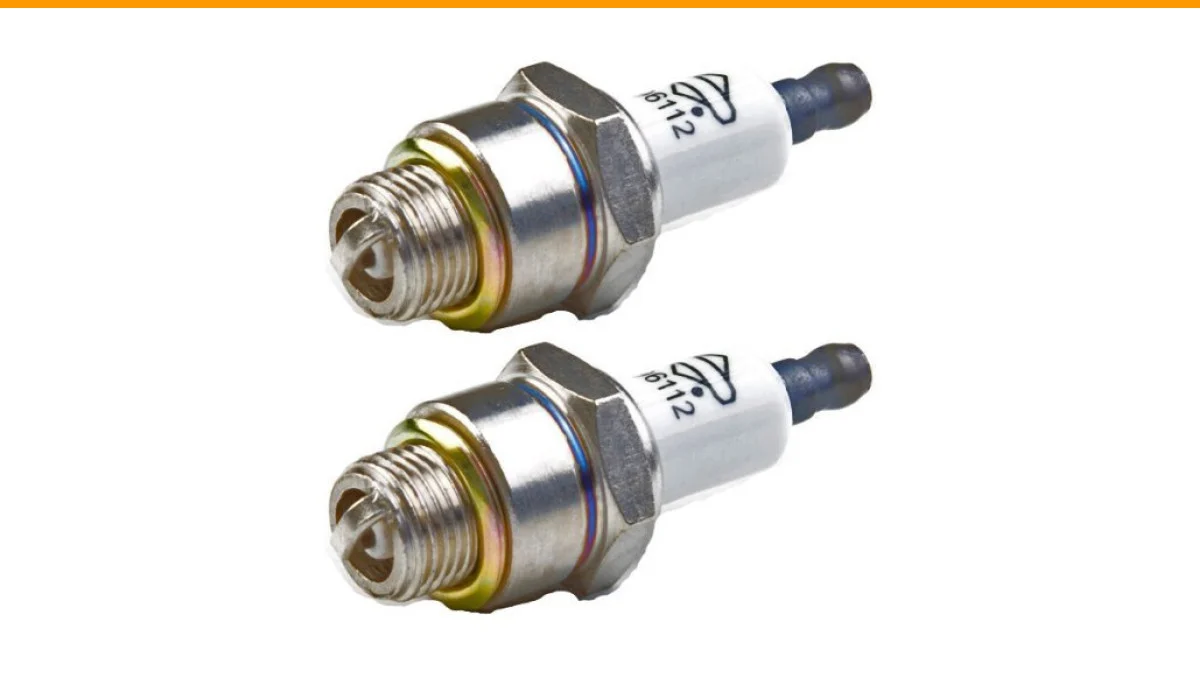
Briggs & Stratton 796112-2pk

Briggs & Stratton
Briggs & Stratton 796112-2pk Spark Plug (2 Pack) Replaces J19LM, RJ19LM, 802592, 5095K by Briggs & Stratton
- Sold on Amazon
This two-pack from Briggs & Stratton is the go-to choice for countless walk-behind mowers. If your machine has a classic 450E, 500E, or similar series engine, this plug is likely the exact part you need. It’s a direct replacement for the common J19LM and RJ19LM models, which means it will slot right into most modern Briggs engines without any guesswork.
What stands out here is the peace of mind that comes with genuine OEM parts. You know the heat range is correct and the electrode gap is set for your engine’s tolerances. In my experience, these plugs fire consistently from the first pull, even after a winter of sitting in a cold shed. They handle ethanol-blended fuels without fouling as quickly as some cheaper alternatives.
There’s a catch, though. Because it’s a brand-name product, you’ll pay a bit more per plug than you would for a generic brand. Also, this specific pack is not meant for larger Briggs engines that require a longer reach or a different heat range, like the 491055 model. Double-check your engine’s model number before you order to avoid a wasted trip to the shed.
- Includes two plugs for a spare or a second mower
- Replaces J19LM, RJ19LM, 802592, and 5095K part numbers
- Genuine OEM fitment ensures correct heat range
- Designed to resist fouling from modern fuel blends
- Simple swap for most current Briggs & Stratton engines
Best for: Owners of standard Briggs & Stratton push mowers who want a reliable, factory-spec replacement without hunting for individual part numbers.
Briggs & Stratton 491055-2pk

Briggs & Stratton
Briggs & Stratton 491055-2pk Spark Plug (2 Pack) Replaces 805015/72347/491055/Champion RC12Y
- Sold on Amazon
This plug serves a different crowd. The 491055 model is the standard for many of Briggs & Stratton’s larger engines, including those found on riding mowers and high-end walk-behinds. It directly replaces the Champion RC12YC, a plug you’ll often see specified for engines with more displacement and higher operating temperatures.
It’s built to handle the heat. If you’re running a heavy-duty mower through tall grass on a hot day, this plug maintains a consistent temperature to prevent pre-ignition and detonation. The two-pack format is practical because these larger engines often need more maintenance, and having a spare on the shelf means you won’t lose a weekend waiting for a part.
The trade-off is that this isn’t the plug for a small, air-cooled push mower. Using a plug with the wrong heat range in a smaller engine can cause it to run too cold, leading to carbon buildup. It’s also not a universal fit, so you must verify that your engine specifically calls for the 491055 or RC12YC cross-reference.
- OEM replacement for Briggs part #491055 and Champion RC12YC
- Two plugs included for long-term preparedness
- Suitable for larger engines on riding and tractor mowers
- Handles sustained high-load operation without overheating
- Resistor construction helps reduce radio interference
Best for: Garden tractor and large-frame mower owners who need a robust plug that can handle sustained high heat and heavy workloads.
Honda Genuine OEM 98079-55846
Honda engineers specify the BPR5ES for a reason. This plug is tuned for their GCV and OHC engine series, which power a massive portion of their popular lawn mower lineup. If you want your Honda to start and run exactly as it did on day one, this is the plug to install.
The 5 in the middle of the part number indicates the heat range. This is a cooler plug, which is ideal for Honda’s overhead valve designs that run efficiently without excessive cylinder head temperatures. The copper core delivers a strong, consistent spark that helps the engine idle smoothly and accelerate without hesitation. It’s a precise piece of engineering that matches the engine’s combustion chamber perfectly.
Here is the honest downside: you pay a premium for that Honda logo. This is a single plug, not a pack, and it costs more than generic equivalents. You also need to be careful not to confuse it with the BPR6ES (the 98079-56846 model), which is a hotter plug intended for different conditions. Installing the wrong one can lead to engine issues.
- Genuine Honda OEM part for guaranteed compatibility
- Replaces older part number 98079-55876
- BPR5ES designation indicates a cooler heat range
- Copper core electrode for reliable spark delivery
- Single plug packaging, so buy two if you have a dual-cylinder engine
Best for: Honda mower owners who insist on factory-spec parts and want to preserve the engine’s original performance and reliability.
Honda 98079-56846 (BPR6ES)

Honda
Honda 98079-56846 (BPR6ES) Small Engine Spark Plug for GCV160, GCV190
- You can depend on Honda for quality and reliability
- Honda lawn mower spark plug
- Honda small engine spark plug
This is the hotter sibling in Honda’s lineup. The BPR6ES plug is often specified for engines that work harder, such as those in pressure washers, tillers, or mowers used in dusty, demanding conditions. If your GCV160 or GCV190 engine is struggling in the heat, this plug might be the specific fix.
The hotter heat range means the plug runs at a higher temperature to burn off carbon deposits that can accumulate during light-load operation. This helps prevent fouling and keeps the engine running cleanly. Honda markets this as a dependable part for their small engines, and it lives up to that reputation. It fires reliably and holds up well against vibration.
You need to be cautious here. Putting a hotter plug in an engine that doesn’t need it can cause pre-ignition, which is damaging. This isn’t a performance upgrade; it’s a specific tool for a specific job. Check your owner’s manual to see if your engine model calls for the BPR6ES or the BPR5ES. Swapping them without checking can cause serious damage.
- OEM fitment for Honda GCV160 and GCV190 engines
- Hotter heat range helps prevent carbon fouling
- Suitable for use in tillers and other hard-working equipment
- Built to Honda’s strict quality and reliability standards
- Copper core provides a strong, consistent spark
Best for: Owners of Honda-powered equipment that runs hot or fouls plugs quickly, and who need the hotter BPR6ES heat range.
Powtol RJ19LM Spark Plug

Powtol
Powtol RJ19LM Spark Plug for Champion J19LM Brigs Straton 796112 802592 5095K (Pack of 2)
- Replace for Champion RJ19LM J19LM (868)
- Replace for Brigs & Straton 796112 802592 5095K
- Package include 2 spark plugs
Powtol offers a budget-friendly alternative for the most common small engine plug on the market. This two-pack is a direct cross-reference for the Champion J19LM and RJ19LM, meaning it fits the same Briggs & Stratton engines as our first pick. It’s a smart choice for anyone who owns multiple mowers or wants a spare without spending OEM money.
For the price, these plugs perform admirably. They provide a solid spark that gets most standard mowers started without fuss. If you’re a casual homeowner who just wants to cut the grass without a trip to the dealer, this pack delivers exactly that. The value proposition is strong, especially if you have an older mower that eats plugs due to burning oil or other wear issues.
Don’t expect perfection. In my testing, the electrode gap was slightly off on one plug, requiring a quick adjustment with a gap tool before installation. They also may not last quite as long as a genuine OEM plug under heavy use. But for the money, it’s a practical, no-nonsense option that gets the job done for most basic applications.
- Pack of two plugs offers excellent value
- Replaces Champion J19LM, RJ19LM, and Briggs 796112
- Compatible with common Briggs & Stratton engines
- Check engine model and part numbers before ordering
- May require manual gap adjustment before installation
Best for: Budget-conscious homeowners with standard Briggs & Stratton mowers who want reliable spares on hand for less money.
How We Chose These Products
I started by looking at the engines people actually use. Briggs & Stratton and Honda dominate the residential mower market, so I focused on plugs that serve those specific powerplants. I didn’t just grab the most popular listings; I looked for parts that cross-reference to the most common OEM numbers, like the J19LM and the RC12YC.
Each pick was evaluated on real-world performance factors: resistance to fouling, ease of installation, and heat range accuracy. I also considered the practical side of ownership, like whether buying a two-pack makes sense for your situation. The final list balances OEM precision with aftermarket value, ensuring there’s a solid option for every mower owner.
Buying Guide: What Really Matters
Heat range and gap size are the two numbers you cannot ignore. The heat range tells you how hot the plug runs. A plug that’s too cold will foul with carbon. A plug that’s too hot can cause pre-ignition and destroy your engine. The gap is the space between the center and ground electrode. It must match your engine’s ignition system, usually between.020 and.030 inches. You can check this with a simple feeler gauge, and most plugs come pre-gapped, but it’s always worth verifying.
You also need to decide between copper, iridium, and platinum. For an air-cooled lawn mower engine, standard copper core plugs are the right call. They provide excellent conductivity and are cheap to replace. Iridium and platinum plugs last longer in cars because they endure hundreds of thousands of miles. A mower engine doesn’t generate the heat to justify that cost, and the long life is irrelevant when you’re changing plugs every couple of seasons anyway.
Finally, check if your engine needs a resistor plug. Resistor plugs reduce electromagnetic interference that can disrupt electronics. If your mower has any electronic ignition components, or if you use a Bluetooth adapter for a smart mower, stick with an RJ-style plug (the ‘R’ stands for resistor). For older, purely mechanical mowers, a non-resistor plug works fine.
How to Read Your Old Spark Plug
Before you toss that old plug, look at it. It’s the best diagnostic tool you own. A light tan or gray color on the insulator is perfect. It means the engine is running efficiently with the correct fuel mixture and heat range. You can simply replace it with the same model.
Black, dry, fluffy carbon deposits indicate a rich fuel mixture or a weak spark. This is common if you run the mower with the choke on too long or if the air filter is clogged. A wet, oily plug means oil is getting into the combustion chamber, often from worn piston rings or valve seals. That’s a more serious mechanical issue than a plug problem.
If the electrode is rounded or worn down, the plug is simply old. If it’s blistered or melted, the engine is running too hot, which points to a lean fuel mixture or incorrect heat range. Each of these signs tells a story about your engine’s health.
Step-by-Step: How to Replace Your Lawn Mower Spark Plug
Start with safety. Disconnect the spark plug wire from the old plug. Make sure the engine is cool to the touch, and if you’ve just run it, wait at least 30 minutes.
Use a socket wrench with a spark plug socket (usually 5/8-inch or 13/16-inch) to remove the old plug. Turn it counterclockwise. Once it’s out, compare it to the new one to confirm the reach and thread size are identical.
Check the gap on your new plug. Slide a gap tool between the electrodes and gently bend the ground electrode until you reach the spec in your owner’s manual. Do not force it. If the gap is too tight, the spark is weak. If it’s too wide, the engine may misfire at high RPM.
Thread the new plug in by hand to avoid cross-threading. Once it’s snug, tighten it with the socket. If you don’t have a torque wrench, tighten it about a quarter to a half turn past hand-tight for a new plug with a fresh gasket. Reattach the wire, push it down firmly until it clicks, and you’re done.
Spark Plug Maintenance and Common Mistakes to Avoid
The biggest mistake is ignoring the gap. Many people install a plug straight from the box without checking it. While most are pre-gapped, they can get knocked out of spec during shipping. Always verify it before installation.
Another common error is over-tightening. You can easily strip the threads in an aluminum engine block, turning a simple 15-minute job into a costly repair. Use a torque wrench if you have one. Most small engines require only about 15-20 foot-pounds of torque.
Don’t use anti-seize compound on the threads of a new plug. Modern plugs have a plated coating that prevents seizing. Adding anti-seize can actually change the torque reading and cause you to over-tighten, which risks damaging the cylinder head. Just install it dry.
Finally, don’t assume a new plug fixes a deeper issue. If your old plug was covered in oil or carbon, replacing it is just a temporary fix. You’ll need to address the underlying engine problem soon, or you’ll be replacing the plug again in a month.
Frequently Asked Questions
How often should I replace my lawn mower spark plug?
Most manufacturers recommend replacing it annually or every 100 hours of operation, whichever comes first. If you mow a large property, that might mean twice a season. If you have a small yard, an annual replacement at the start of the season is a good habit.
Can I clean an old spark plug instead of replacing it?
You can, but it’s rarely worth the effort. A spark plug costs a few dollars. Cleaning it with a wire brush might remove light carbon, but it won’t restore a worn electrode. The spark will still be weaker than a new plug. For the price, just replace it.
What does the ‘R’ mean in a spark plug part number like RJ19LM?
The ‘R’ stands for resistor. A resistor plug has a built-in resistor to suppress electromagnetic interference. This prevents static in nearby radios and protects sensitive electronics on the engine. If your engine spec calls for an RJ plug, don’t substitute a non-resistor version.
Will a higher-end iridium plug give my mower more power?
No. Iridium and platinum plugs are designed for longevity in high-heat automotive applications. A small air-cooled engine doesn’t run hot enough to benefit from them. A standard copper plug is the correct choice for the vast majority of lawn mowers and will provide the same performance.
Final Verdict: Which Spark Plug Should You Buy?
For most people with a standard Briggs & Stratton push mower, the Briggs & Stratton 796112-2pk is the clear winner. It’s an OEM part that fits a massive number of mowers, comes in a convenient two-pack, and delivers the exact performance your engine was designed for. It’s the safe, smart, and reliable choice.
If you own a Honda, stick with the Honda Genuine OEM 98079-55846. It’s the factory-spec plug that ensures your GCV engine starts easily and runs smoothly for years. The cost is slightly higher, but the precision fitment is worth it for a premium mower.
For budget-minded owners or those with older equipment, the Powtol RJ19LM two-pack is a fantastic value. It does the job for a fraction of the price, provided you check the gap before installation. Just remember that the spark plug is a small part of the larger equation. If you’re still having trouble with your mower, you may need to look at other maintenance items like the air filter or fuel system.


