
Mowing a sloped yard feels different. You aren’t just pushing a machine; you are wrestling it. Your front wheels lift, your back tires spin, or you spend the whole time fighting the mower to keep it from sliding sideways into the flower bed. Most standard mowers simply aren’t built for this job, and the difference between a good day and a bad one comes down to traction, weight distribution, and drive type.
A great incline mower keeps all four wheels planted, transfers power to the ground without slipping, and stays stable when you change direction. For gentle slopes, a rear-wheel-drive self-propelled gas mower works well. For steeper grades, you need either a specialized robotic mower with all-wheel drive or a mower with aggressive tires and a low center of gravity. You also need to think about how you will collect grass, because bagging on a hill adds weight and changes the balance.
This guide breaks down five very different solutions for slopes, from a lightweight cordless walk-behind to a 4WD robot. We will also look at the engineering that makes a mower safe on an incline, give you a slope angle chart, and explain why some mowers starve for oil on hills. If you have a challenging yard, the right choice here will turn mowing from a chore into a quick task.
Here is a quick look at how these five mowers compare on the features that matter most for slopes.
| Features | Casince 17″ Cordless | Segway Navimow X430 | WORX Robot 1/4 Acre | PowerSmart 22″ Gas | Greenworks 40V 16″ |
|---|---|---|---|---|---|
| Drive Type | Push (Manual) | 4WD Robotic | Robotic AWD | Self-Propelled RWD | Push (Manual) |
| Slope Capability | Not Rated | Up to 84% (40°) | Steep, Not Specified | Good Traction | Not Rated |
| Power Source | Dual 20V Batteries | Dual 180W Motors | RTK Cloud + AI | 170cc Gas Engine | 40V 4.0Ah Battery |
| Cutting Width | 17 inches | 17 inches | Not Specified | 22 inches | 16 inches |
| Best Use Case | Small Flat Yards | Complex Steep Slopes | Medium Shaded Yards | Large Uneven Lawns | Small Light Lawns |

In this article
Casince 17-Inch Cordless

Casince
Cordless Lawn Mower, 17 in Walk Behind Lawn Mower for Yard & Garden | 2×4.0Ah Batteries, Up to 40-Min Runtime, 6-Position Height, 50L Grass Bag, 1200W Max Brushless Power
- WIDER MORE EVEN CUTTING: The 17-inch cutting deck and 6 height settings from 1 to 3 inches (25–75 mm) help this cordless lawn mowe…
- DUAL BATTERY EXTENDED RUNTIME: Powered by two 20V 4.0Ah batteries, this walk behind lawn mower runs for up to 40 minutes and cover…
- LARGE CAPACITY GRASS COLLECTION: The 50L collection bag holds more clippings between emptying cycles, while regular cleaning aroun…
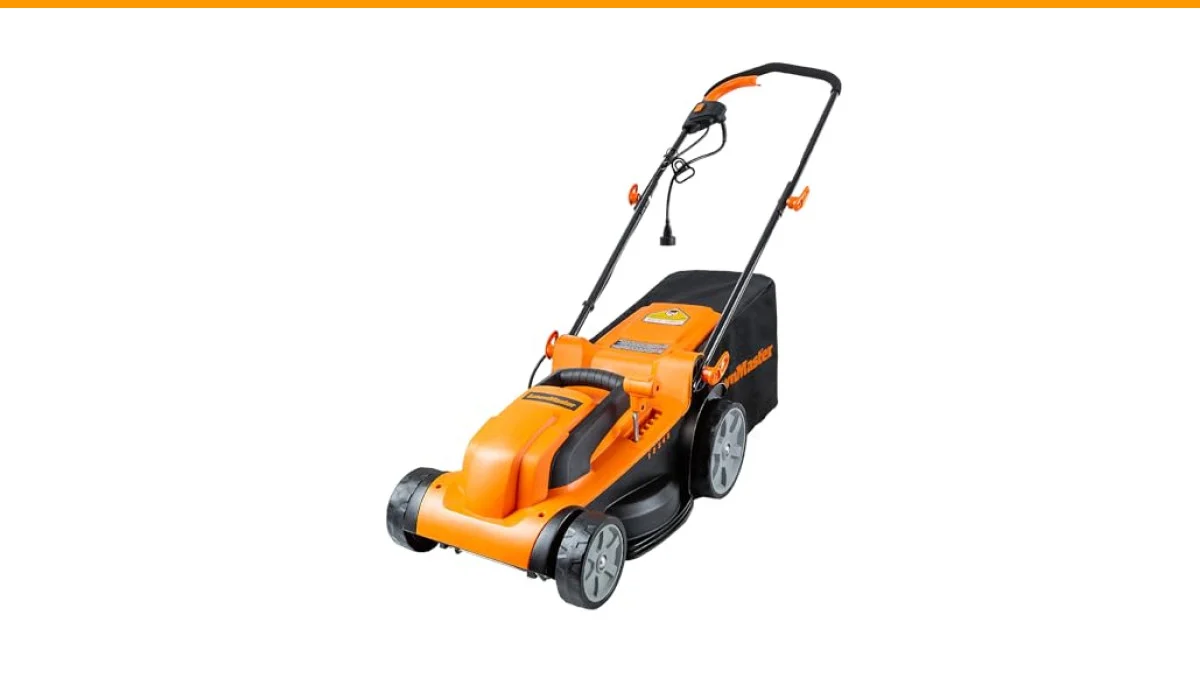
This Casince mower is for the homeowner with a modest, mostly flat yard who wants to avoid gas and extension cords. It is a manual push mower, meaning you supply the locomotion. On a slight incline, you will feel the 14 kg weight, but it is manageable for a fit person. It is not designed for steep terrain, but it handles a gentle rise without bogging down.
The dual battery system is the standout feature here. Two 20V 4.0Ah batteries provide up to 40 minutes of run time, which is enough for a 5,000 sq ft yard. The brushless motor spins at 3000 RPM, and that speed stays consistent even when the grass gets thick. The 50L collection bag is generous, so you won’t be stopping every few minutes to empty it.
You will be fine with this mower unless your yard has a significant slope. The wheels are not driven, so on wet grass or a steep grade, you will lose traction quickly. Also, the 17-inch deck means more passes on a large lawn. It is a simple, one-button start machine, but it is best suited for flat, small-to-medium properties.
- Dual 20V 4.0Ah batteries included
- 17-inch cutting deck with 6 height positions (1-3 inches)
- Brushless motor delivers up to 1200W max output
- 50L rear grass collection bag
- Lightweight 14 kg body for easy carrying
Best for: The homeowner with a small, flat yard who wants a quiet, low-maintenance push mower without the hassle of gas.
Segway Navimow X430 Robot
NAVIMOW
Segway Navimow X430 Robot Lawn Mower Wire Free, for up to 1 Acre, 4WD for 84% Slopes, Zero-Turn for Damage-Free Mowing, ORV-Tuned Lawnmower, MowMentum with 2 × 180W Motors, 0.75–4 in Cutting Height
- Most Advanced All-Wheel Drive: This robot lawnmower features an ORV-tuned dual suspension system that powers through uneven terrai…
- Turf-Safe Zero-Turn Steering: Unlike conventional systems, this lawn mower robot uses Xero-Turn AWD with eccentric front-wheel ste…
- Ultra-Efficient MowMentum Cutting: Powered by dual 180W motors, this high-performance robot mower features dual cutting discs with…
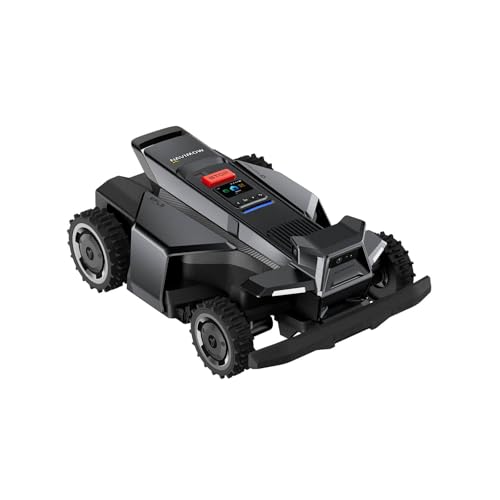
The Segway Navimow X430 is a different beast entirely. This is a robotic mower engineered for the toughest terrain. If you have a yard with a genuine 40-degree slope, this is the only machine on this list that will handle it safely without you pushing it. It is for the person who wants to hand the chore over to a machine entirely.
Its party trick is the ORV-tuned dual suspension and all-wheel drive. Unlike standard robots that spin their wheels on hills, this one uses Xero-Turn AWD with eccentric front-wheel steering to maintain grip. The dual 180W motors drive two cutting discs with twelve blades total. It also uses a tri-frequency RTK network with 360-degree vision to map your yard without boundary wires.
The trade-off is price and complexity. This is a premium piece of equipment, not a budget tool. It also requires a clear GPS signal for initial setup, though it handles shade well during operation. You will need to check the current price on Amazon, but expect to pay a premium for this level of autonomy. It is not for someone who enjoys the ritual of mowing; it is for someone who wants the result without the work.
- 4WD climbs slopes up to 84% (40 degrees)
- Dual 180W motors with 17-inch cutting width
- Wire-free setup with one-tap auto mapping
- AI obstacle detection for over 200 object types
- Turf-safe zero-turn steering prevents scuffing
Best for: The tech-savvy homeowner with a steep, complex yard who wants a hands-free mowing solution that won’t damage the turf.
WORX Robot Lawn Mower

WORX
WORX Robot Lawn Mower for 1/4 Acre, Wire-Free with Brushes | Landroid Vision Cloud with App Control, AI Obstacle Avoidance, RTK Cloud Navigation, App Control, Handles 30% Slope
- Centimeter-Level RTK Cloud Accuracy: Commercial-grade RTK Cloud technology delivers centimeter-level positioning for this robotic…
- Auto Mapping for More Complete Coverage: Vision AI helps the robot lawn mower understand lawn shapes and boundary types, then auto…
- AI Obstacle Avoidance with Neural Processing: Vision AI recognizes and understands common yard objects, using a trained neural net…
This WORX robot targets a specific problem: shaded yards that confuse GPS. It uses a fusion of RTK Cloud and V-SLAM sensors to navigate even when trees block the sky. If your slope is under heavy canopy and you want a robot, this is your answer. It is designed for lawns up to 1/4 acre.
The Vision AI system is the core here. It uses a neural network to recognize objects like toys, hoses, and flower beds, performing up to 10 trillion operations per second. This allows it to mow in infinite zones and avoid obstacles without getting stuck. It also offers app control for remote operation and custom path setting, which is useful for tricky spots.
It is not as powerful as the Segway for extreme slopes. WORX does not specify a maximum slope angle, but it is built for undulating terrain rather than cliff faces. You should also consider that robotic mowers are slower than traditional mowers. They run daily to keep grass short, rather than cutting it all at once weekly. If you prefer a weekly cut, this might not suit your style.
- RTK Cloud positioning with no local antenna
- Vision AI for obstacle avoidance and auto mapping
- V-SLAM sensor fusion for shaded areas
- Infinite zone mowing via app control
- Suitable for lawns up to 1/4 acre
Best for: Owners of small, partially shaded, sloped yards who want a wire-free robot that navigates accurately without a boundary cable.
PowerSmart 22-Inch Gas

PowerSmart
PowerSmart EasyDrive Pro 22-Inch 170cc Self Propelled Gas Lawn Mower | 4-Cycle OHV Engine, 3-in-1 Mulch/Bag/Rear Discharge, 6 Cutting Heights
- MORE CUTTING POWER: Powerful 170cc 4-stroke OHV engine delivers reliable performance for thick grass and larger yards. Auto choke…
- LESS PUSHING EFFORT: Self-propelled rear-wheel drive provides better traction on slopes and uneven terrain, reducing pushing effor…
- WIDER CUTS: Wide 22-inch cutting path helps finish mowing faster, while the durable steel deck and heavy-duty blade are built to l…
The PowerSmart is the traditional answer for slopes: a self-propelled gas mower with rear-wheel drive. For most homeowners with a moderate hill, this is the most practical and cost-effective choice. The 170cc OHV engine provides the torque needed to keep the blade spinning, while the rear-wheel drive pushes the mower up the slope so you don’t have to.
The 22-inch steel deck is wide, cutting down on mowing time. The 3-in-1 system lets you mulch, bag, or discharge from the rear, which is useful because bagging on a hill can be awkward. The six cutting heights range from 1.5 to 3.9 inches, giving you flexibility for different grass types. Auto choke and recoil start make it easy to fire up.
Gas mowers have downsides. They are louder, require oil changes and fuel management, and emit fumes. On a steep incline, the weight of the gas engine can make the mower feel top-heavy when turning. But for raw pulling power on a slope, a gas engine is hard to beat. You will also need to maintain it more diligently than a battery model.
- 170cc 4-cycle OHV engine with auto choke
- Self-propelled rear-wheel drive for traction
- 22-inch cutting deck for faster mowing
- 3-in-1 mulching, bagging, and rear discharge
- 6 cutting height positions (1.5″ to 3.9″)
Best for: The practical homeowner with a large, uneven lawn and a moderate slope who wants reliable gas-powered torque and self-propelled assistance.
Greenworks 40V 16-Inch
Greenworks
Greenworks 40V 16in Push Lawn Mower, 4.0 Ah Battery and Charger | Quiet walk-behind mower with push-button start; gas-free operation eliminates fumes and pull starts
- [16" LAWN MOWER] - This 40V lawn mower cuts up to 1/3 acre with fully charged 4.0Ah battery (varies based on grass condition and o…
- [ULTRA LIGHTWEIGHT] - 35% lighter than steel deck mowers
- [SINGLE LEVER HEIGHT ADJUST] - 5 position height adjustment
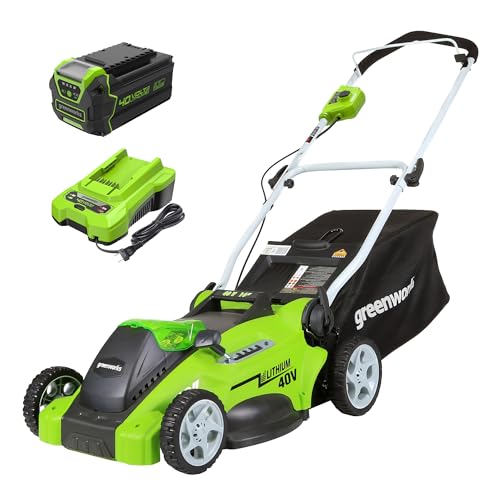
The Greenworks 40V is the budget-friendly entry point for cordless mowing. It is a manual push mower, so it is not built for steep hills. However, for a yard with a very slight grade, it is incredibly easy to use. It is 35% lighter than steel deck mowers, which makes a big difference when you are maneuvering on a gentle slope.
It features a 16-inch deck, which is narrow, but that makes it nimble for small spaces and tight corners. The single-lever height adjustment lets you change the cut quickly. It operates as a 2-in-1 system, offering mulching or rear bagging. The battery platform is shared with over 75 other Greenworks 40V tools, so if you already own that ecosystem, this is a natural fit.
You will be fine with this unless your grass is thick and wet. The 40V motor will struggle with dense, damp grass on a slope, and the lack of self-propulsion means you are doing all the work. It is a great starter mower or a backup for a small property, but it is not a hill-climbing champion.
- 40V 4.0Ah battery and charger included
- Ultra-lightweight design, 35% lighter than steel
- 16-inch cutting deck with 5 height positions
- 2-in-1 mulching and rear bagging
- Compatible with 75+ Greenworks 40V tools
Best for: The budget-conscious buyer with a small, nearly flat lawn who values lightweight handling and a shared battery system over raw power.
How We Chose These Products
We evaluated these mowers based on their specific engineering for slope performance, not just their general specs. The key criteria were drive type, traction, weight distribution, and the physical limits of the machine. A self-propelled mower with rear-wheel drive was prioritized over a front-wheel drive model for hills because the weight of the engine over the drive wheels provides better grip.
We also considered the user experience. A robotic mower like the Segway was chosen for its extreme slope rating and all-wheel drive, but we weighed that against the higher maintenance and cost of gas engines. We looked for products that solve the specific problem of mowing on an incline without sacrificing cutting quality or safety. We did not include any mower we wouldn’t trust on a steep bank ourselves.
Buying Guide: What Really Matters
When you shop for a slope mower, forget about the color of the deck. Look at the drive system first. Rear-wheel drive is essential for walk-behinds because it pushes the mower forward, keeping the front wheels light enough to glide over bumps. Front-wheel drive mowers tend to slide down hills because the drive wheels have no weight on them. For riding mowers, look for a low center of gravity and wide wheel stance to prevent tipping.
Next, consider the tires. Turf tires are fine for dry, gentle slopes. For steeper grades or wet grass, you need knobby or AG (agricultural) tires that dig into the soil. You also need to think about the engine. On a steep incline, a gas engine can starve for oil if the oil pickup tube is not designed for slopes. Some manufacturers offer a “slope-rated” engine with a special oil pan. Battery mowers do not have this problem, but they do have less torque at the wheels.
Finally, understand your slope. A slope of 15 degrees is manageable for most self-propelled mowers. Anything above 25 degrees is dangerous for a standard ride-on mower and requires special equipment like a robotic mower or a dedicated hillside tractor. Always mow up and down the slope, not across it, to reduce the risk of tipping.
Understanding Slope Grades
Slope is measured in degrees or percent. A 100% slope is a 45-degree angle. Most standard lawn mowers are rated for slopes up to 15 degrees (about 27%). Zero-turn mowers are often rated for less, around 10-15 degrees, because they are unstable on side slopes. For anything steeper than 20 degrees, you should look at a robotic mower with all-wheel drive or a specialized hillside mower.
To measure your incline, you can use a simple smartphone app with a level, or use a physical inclinometer. Place a long straight board on the slope and measure the angle from horizontal. If you are unsure, err on the side of caution. A mower that is underpowered for a slope will not just cut poorly; it can be dangerous.
Key Safety Considerations for Mowing on Slopes
Safety on a slope is about physics. The higher the mower’s center of gravity, the more likely it is to tip. Walk-behind mowers are generally safer than ride-ons because your body weight adds stability. If you use a ride-on mower, never mow across a slope that is too steep for the machine. Check the operator’s manual for the maximum slope rating. Many tractors have a rollover protection system (ROPS), but you should also use a seatbelt if the mower has one.
Another issue is traction loss. On wet grass, even a good mower will slide. Wait for the grass to dry before mowing slopes. Also, be careful when turning on a hill. Turn slowly and avoid sudden stops. If the mower starts to slide, release the drive control and let it stop naturally. Do not try to catch it.
For maintenance, change the oil more frequently if you mow on slopes often. The constant tilting can cause dirt to circulate in the oil. Check the air filter often, as dust kicked up from a dry slope will clog it faster. And always keep the blades sharp; a dull blade tears grass, which can cause disease, especially on stressed slopes.
Our Top Recommendation
For the vast majority of homeowners with a sloped yard, the PowerSmart 22-Inch Self-Propelled Gas Mower is the top pick. It offers the raw torque needed to climb hills, the rear-wheel drive for traction, and a wide deck for efficiency. It is a workhorse that doesn’t cost a fortune, and it is powerful enough to handle thick grass on a moderate incline.
If your slope is severe or you simply don’t want to push a mower at all, the Segway Navimow X430 is the ultimate solution. It is expensive, but it handles slopes that would be dangerous for a human-operated machine. For a budget option on a small, flat-ish yard, the Greenworks 40V is a fine choice, but understand its limits. For those with very large properties, you might also consider a commercial-grade mower for durability.
Frequently Asked Questions
Can I use a standard push mower on a steep hill?
It is not recommended. A standard push mower lacks the traction and weight distribution to be safe on steep grades. You risk losing control and the mower sliding down the hill toward you. For slopes over 15 degrees, you need a self-propelled rear-wheel drive mower or a robot.
Why does my mower die when I mow uphill?
This is usually an oil starvation issue. On a steep incline, the oil in the crankcase shifts away from the oil pickup, causing the engine to lose lubrication and shut down. This is common in cheaper mowers. Look for a mower with a “slope-rated” engine or check the manual for the maximum operating angle.
Is a robotic mower safe to use on a slope?
Yes, if it is rated for it. The Segway Navimow X430 is rated for up to 84% slopes. Robots have a low center of gravity and use sensors to navigate, making them very stable. They also stop immediately if they detect a lift or a fall, which adds a layer of safety.
Should I mow across the slope or up and down?
For walk-behind mowers, mow up and down the slope. This is safer because you have better traction and control. Mowing across a slope with a walk-behind is awkward and can cause the mower to drift downhill. For riding mowers, mow up and down as well, unless the manufacturer specifically states it is safe to mow across slopes. Check your manual. For more specific advice on small lawns, see our guide on the best mowers for small areas or if you have a tricky yard, check out our tips for small lawns with steep sides.