Most houseplants die from kindness, not neglect. Overwatering kills more indoor plants than any other single cause, and the plant you pick matters as much as how you care for it. A fiddle leaf fig in a dark hallway is a losing battle. A snake plant in the same spot thrives.
The best indoor plant to have depends on three things: the light your room actually gets, how much attention you’ll realistically give it, and whether you have pets or small kids. Get those three right and almost any plant works. Get them wrong and you’ll replace plants every few months.
This guide covers five products that solve the real problems beginners face, from a starter set of easy plants to a moisture meter that ends the guesswork. We’ll also break down light conditions by window direction, flag which plants are toxic to cats and dogs, and explain the fixes for yellow leaves and root rot.
Here’s a quick side-by-side of the five products we recommend, based on the features that actually drive the buying decision.
| Features | Houseplants 12-Pack | How Not to Kill Book | XLUX Moisture Meter | Live Pothos 4-Pack | Miracle-Gro Plant Food |
|---|---|---|---|---|---|
| Product Type | Live plant assortment | Reference book | Soil testing tool | Live trailing plants | Liquid fertilizer |
| Quantity Included | 12 plants in 2-inch pots | Single hardcover guide | One battery-free meter | 4 plants, 8-10 inches tall | Two 8 fl. oz. bottles |
| Main Strength | Variety for decor and gifts | Beginner troubleshooting | Accurate root-zone reading | Resilient, low-light tolerant | Instant feeding for all plants |
| Best Use Case | Grouped planters, party favors | Learning plant care basics | Ending overwatering guesswork | Shelves, hanging baskets | Biweekly feeding routine |
| Skill Level | Beginner to intermediate | Complete beginner | Any level | Beginner friendly | Any level |
Easy to Grow Houseplants 12-Pack

Plants for Pets
Easy to Grow Houseplants (12 Pack) Live House Plants in Plant Containers, Growers Choice Plant Set in Planters with Potting Soil Mix, Home Décor Planting Kit or Outdoor Garden Gifts by Plants for Pets
- LIVE INDOOR HOUSEPLANTS: Includes a rotating assortment of 12 popular indoor plants in 2 in. grower pots, approximately 4-5 in. Ta…
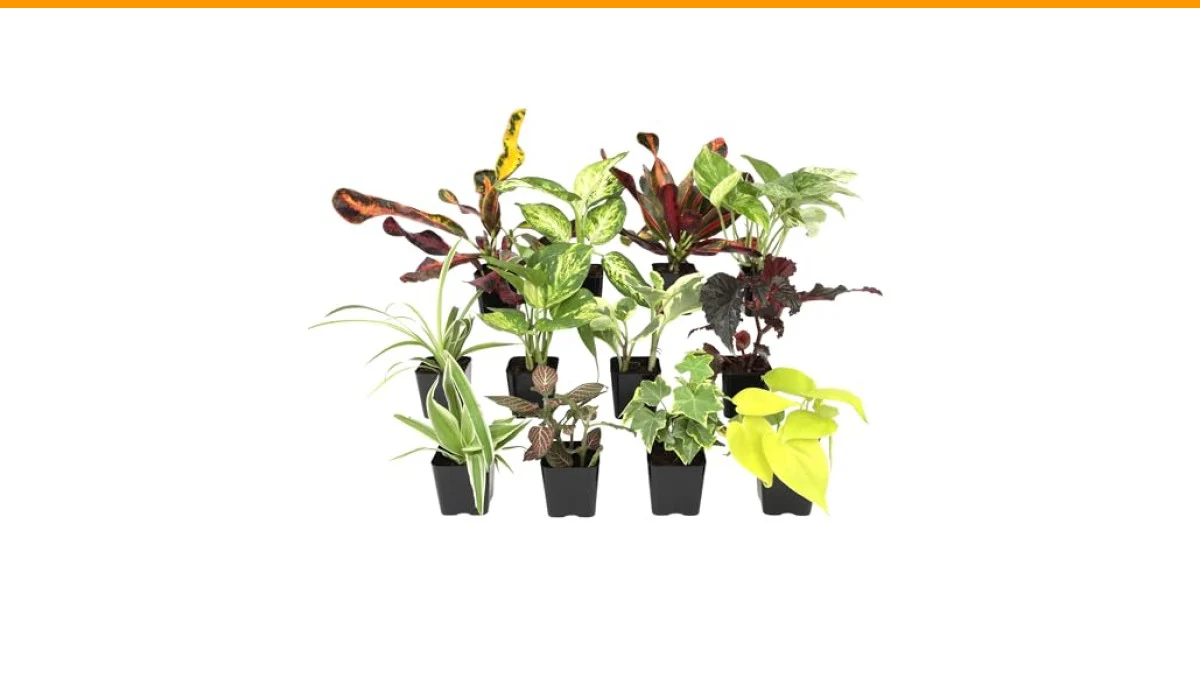
- WHAT'S IN THE BOX: Features Pothos, Peperomia, Spider Plants, Croton, Ficus, Syngonium, Begonia, and more
- COMPACT SIZE, BIG IMPACT: Grown in small pots but striking nonetheless, this pack is perfect for event decor, grouped planters, an…
This is a rotating assortment of twelve live indoor plants in two-inch grower pots, roughly four to five inches tall. It’s aimed at people who want variety fast: event decorators, gift-givers, and anyone filling a shelf or windowsill with greenery in one order.
The variety is the real draw. You’ll get a mix pulled from pothos, peperomia, spider plants, croton, ficus, syngonium, and begonia. That range means you can experiment with placement, see which plants respond to your home’s conditions, and keep the ones that thrive. The small pot size also makes them easy to group into a single planter for a fuller look.
Here’s the trade-off: two-inch pots dry out quickly, often within a few days. These plants need more frequent watering than a mature houseplant would. The assortment rotates monthly, so you can’t request specific varieties, and some picks (croton, begonia) are fussier than the pothos or spider plants in the same box. If you want predictable, easy plants only, a dedicated pothos pack is the safer call.
- Twelve plants, each in a 2-inch grower pot
- Rotating mix of popular indoor varieties
- Small footprint suits grouped planters and DIY projects
- Doubles as party favors or starter gifts
- Requires frequent watering due to small pot size
Best for: Anyone who wants a broad mix of starter plants to test in different rooms before committing to larger specimens.
How Not to Kill Your Houseplant Book

DK’s updated survival guide targets the horticulturally challenged, and that’s a real audience. If you’ve killed a plant and don’t know why, this book walks through the most common failure points in plain language with photos.
What sets it apart is the format. It’s organized around problems, not just plant profiles, so you can look up a symptom (drooping, yellowing, brown tips) and find the likely cause. That’s more useful than a generic care encyclopedia when something’s already going wrong. The plant-by-plant profiles also flag light and water needs clearly, which helps you match a plant to your space before you buy it. Pair it with a quality soil mix and you’ve covered the two most common beginner mistakes.
The limitation is obvious: it’s a book, not a plant. It won’t fix a problem you can’t identify, and it doesn’t replace hands-on experience. Some readers find the plant selection US-centric and wish it covered more tropical varieties. It’s also not a substitute for a moisture meter if your main issue is watering timing.
- Problem-based troubleshooting format
- Photo-heavy plant profiles with care specs
- Written for complete beginners
- Updated edition with expanded content
- Reference tool only, not a live plant
Best for: New plant owners who want a diagnostic reference before they buy anything else.
XLUX Plant Soil Moisture Meter

XLUX
XLUX Plant Soil Moisture Meter, for Indoor and Outdoor use, Battery-Free | Since 2015, instant read, anti-rust 304 SST probe, Clear & Easy-to-Read Display, Single-Probe, less hurts to roots
- Trusted Since 2015: Become one of the many plant lovers who rely on the proven accuracy of XLUX. Established in 2015, our soil moi…
- Take the guesswork out of watering: While your eyes and fingers can only determine the moisture level of the soil surface, the XLU…
- Clear & Easy-to-Read Display: Perfect for beginners and expert gardeners alike. The large, color-coded dial features 10 distinct s…
This is a battery-free soil moisture meter with a single slim probe. It’s for anyone who’s ever watered a plant, watched it die anyway, and suspected the problem was timing. The XLUX has been sold since 2026 and carries a large base of verified ratings, which matters for a tool this simple.
The single-probe design is the standout feature. Most cheap meters use two thick prongs that tear through root systems, especially in dense soil. This one slides in with minimal displacement, so you can test without stressing the plant. The dial has ten color-coded scales from dry to wet, and it reads the root zone rather than just the surface, which is where the real moisture story lives. No batteries, no charging, no app.
The catch is that it only measures moisture. It won’t tell you pH, light levels, or nutrient content, and it’s soil-only, so don’t dunk it in water. The instructions call for inserting, reading, and removing within five minutes, then wiping the probe clean. Leave it in the soil permanently and you’ll shorten its life. It’s a simple tool that rewards simple use.
- Battery-free operation, no charging needed
- Slim single probe protects delicate roots
- Ten-scale color-coded dial for quick reads
- 304 stainless steel probe with protective sleeve
- Soil use only, remove after each reading
Best for: Overwaterers who need an objective second opinion before picking up the watering can.
Live Pothos Plants 4-Pack

Plants for Pets
Live Pothos Plants (4PK) Indoor Plants Live Houseplants, Pothos Live Plant House Plants, Money Plant Indoor Pothos Plant Decor, Devils Ivy Trailing Plants Live by Plants for Pets,Black
- LIVE INDOOR PLANTS: Includes 4 easy to grow pothos plants, approximately 8-10 in. tall measured from bottom of pot
- GROWER'S CHOICE VARIETIES: Rotating assortment features marble queen pothos, silver satin Scindapsus, golden pothos, neon, and Haw…
- EASY PLANT CARE: Pothos are popular plants due to their resilient nature and ability to survive even when neglected
Four live pothos plants, each roughly eight to ten inches tall measured from the bottom of the pot. Pothos is the plant most often recommended to beginners, and for good reason: it tolerates low light, forgives missed waterings, and grows fast enough to show visible progress.
The assortment rotates through marble queen, silver satin scindapsus, golden, neon, and Hawaiian varieties, so you get visual variety without buying five separate plants. Pothos also works as a trailing plant, which makes it ideal for shelves, bookcases, and hanging baskets where the vines can spill over the edge. If you’re setting up a display, a sturdy plant shelf gives trailing varieties room to drape. The plants tolerate a wide range of conditions, from low light to bright indirect light.
One honest caveat: pothos is toxic to cats and dogs if chewed. The calcium oxalate crystals cause mouth irritation and vomiting. If you have pets that nibble, keep these on a high shelf or skip them entirely. The other limitation is that you can’t choose your varieties; the grower picks based on what’s ready to ship.
- Four plants, 8-10 inches tall from pot bottom
- Rotating mix of marble, silver, golden, neon, Hawaiian
- Thrives in low light to bright indirect light
- Trailing habit suits shelves and hanging planters
- Toxic to pets if ingested
Best for: Beginners who want a forgiving, fast-growing trailing plant for a low-light spot, and who don’t have plant-chewing pets.
Miracle-Gro Indoor Plant Food

Miracle-Gro
Miracle-Gro Indoor Plant Food for All Plants, 8 fl. oz. (2-Pack) | Liquid Plant Food for Indoor Plants, Houseplants, Flowers, Vegetables, Herbs and More
- INDOOR HOUSEPLANT FOOD: Miracle-Gro Indoor Plant Food All Plants contains nutrients for healthier, stronger plants (vs unfed when…
- NUTRIENTS FOR HEALTHY HOUSEPLANTS: This liquid plant food for indoor plants feeds instantly to help grow healthy houseplants
- FOR INDOOR POTTED PLANTS: Use house plant food with all indoor container plants, including houseplants, flowers, vegetables, herbs…
A two-pack of liquid indoor plant food, eight fluid ounces per bottle. This is the maintenance product in the lineup, the one you buy after your plants are alive and you want them to actually grow rather than just survive.
Application is flexible: squirt directly onto the soil and water, or mix into a quart of water and feed while you water. Either way, it feeds instantly, and you reapply every two weeks. It works on all indoor container plants, including houseplants, flowers, vegetables, and herbs, so you don’t need separate fertilizers for different pots. Two bottles go a long way at biweekly intervals.
Don’t overdo it. More fertilizer isn’t better, and overfeeding causes salt buildup and burned leaf tips. Stick to the two-week schedule and skip feeding in winter when most houseplants are dormant. The other thing to know: this is a general-purpose feed, not a specialized formula for flowering plants or acid-loving varieties like gardenias.
- Two 8 fl. oz. bottles per pack
- Feeds instantly, applied directly or mixed in water
- Safe for houseplants, herbs, vegetables, flowers
- Reapply every two weeks
- General-purpose formula, not plant-specific
Best for: Plant owners who’ve mastered watering and want steady growth without buying multiple specialty fertilizers.
How We Chose These Products
We evaluated each product against the problems beginners actually face: picking the right plant, watering correctly, diagnosing problems, and feeding for growth. Products that solved a specific, common failure point ranked higher than generic accessories.
We also weighed honesty about limitations. A product that claims to do everything usually does nothing well. The moisture meter, for example, only measures moisture, and that focus is a strength. The plant packs offer variety but not control over selection, and we flagged that rather than glossing over it.
Buying Guide: What Really Matters
Read your light before you buy anything. A south-facing window gets strong direct sun for most of the day and suits succulents, cacti, and crotons. East and west windows get a few hours of gentler sun and work for most houseplants. North windows get indirect light all day and limit you to low-light champions: snake plants, ZZ plants, and pothos.
Check pet toxicity before you bring a plant home. Pothos, peace lily, monstera, and fiddle leaf fig are all toxic to cats and dogs. Spider plants, calatheas, and most peperomias are considered pet-safe. The ASPCA maintains a searchable database if you’re unsure about a specific variety.
Match your watering style to the plant’s needs. If you tend to water on a schedule regardless of soil conditions, buy a moisture meter or choose drought-tolerant plants like snake plants and ZZ plants. If you’re attentive and consistent, ferns and calatheas will reward you. For more inspiration on matching plants to your space, this gallery of indoor plant options is worth a look.
Our Top Recommendation
The XLUX Plant Soil Moisture Meter is the single most useful purchase for most plant owners. Overwatering is the top killer of indoor plants, and this tool removes the guesswork for a modest cost. It won’t grow the plant for you, but it stops the most common mistake.
If you don’t own a plant yet, start with the Live Pothos 4-Pack. Pothos forgives low light, missed waterings, and general neglect, which makes it the best indoor plant to have for beginners. Add the moisture meter and the Miracle-Gro food, and you’ve covered watering, feeding, and the plant itself.
For households with pets, skip the pothos and look for spider plants or calatheas instead. The 12-pack works if you want variety, but expect to lose a few fussier varieties along the way.
Frequently Asked Questions
Why do my plant’s leaves turn yellow?
Yellow leaves usually mean overwatering. The roots sit in soggy soil, can’t absorb oxygen, and start to rot. Check the soil with a moisture meter before watering again. If the soil is wet and the leaves are yellow and soft, stop watering for a week or two and let it dry out. If the soil is bone dry and leaves are crispy yellow, you’ve underwatered.
How do I know if my room has enough light for a plant?
Hold your hand about a foot above the spot where the plant will sit. If it casts a sharp, defined shadow, you have bright light. A soft, blurry shadow means medium light. No visible shadow means low light. North-facing rooms almost always fall into the low-light category, which limits you to snake plants, ZZ plants, and pothos.
Can I keep plants in a bathroom with no window?
Only if you add a grow light. No window means no natural light, and even low-light plants need some. A small LED grow bulb on a timer for 10-12 hours a day will support pothos, snake plants, and spider plants. The bathroom humidity helps, but light is non-negotiable.
What causes root rot and how do I fix it?
Root rot comes from soil that stays wet too long, usually from a pot with no drainage hole or a watering schedule that ignores soil conditions. Symptoms include yellowing leaves, a soft mushy stem base, and a sour smell from the soil. Remove the plant, trim away brown mushy roots with clean scissors, repot in fresh dry soil, and water sparingly until new growth appears.
Final Verdict: Which Plant Is Right for You?
Pick your plant based on the light you actually have, not the light you wish you had. Low-light rooms get pothos or snake plants. Bright rooms open up the options to crotons, succulents, and flowering varieties. If you have pets, check toxicity first and choose spider plants or calatheas.
Buy the moisture meter regardless of which plant you choose. It’s the cheapest insurance against the most common mistake. Feed with Miracle-Gro every two weeks during the growing season, and skip feeding in winter. That’s the whole system, and it works.