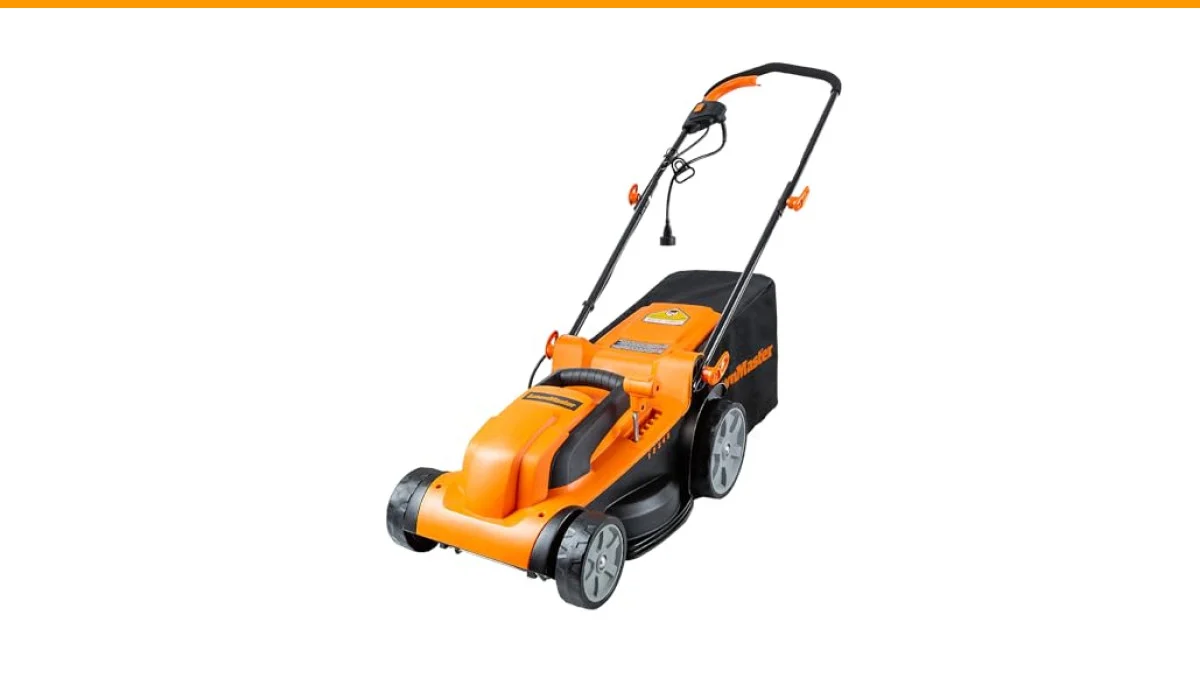
You’ve just finished mowing, and the grass looks ragged instead of clean. The culprit is a dull blade that tears grass rather than cutting it. Sharpening a mower blade with a bench grinder takes time and risks overheating the thin edge. A flap disc on an angle grinder offers a faster, more controlled approach that keeps the blade cool and removes metal evenly.
Flap discs work because overlapping abrasive flaps wear down to expose fresh grit, giving a consistent cut throughout the disc’s life. For mower blades, zirconia abrasive stands out as the right material—it handles the heat and pressure of grinding hardened steel without breaking down quickly. The key variables come down to grit size, disc shape (Type 27 vs. Type 29), and how many discs you need for the season.
I tested five flap disc options that cover different needs: a bulk pack for heavy users, a single high-quality disc for occasional sharpening, and a few mid-range choices that balance cost and performance. Each one gets the job done, but the right pick depends on how many blades you sharpen per year and what condition they are in. Below, you’ll find a comparison table and detailed reviews to guide your purchase.
Here is a quick look at how the key specs stack up across the five products.
| Features | Sali 10-Pack | DEWALT DW8311 | ROZZLOOM 2-Pack | OSTTE 5-Pack | PRVEW 5-Pack |
|---|---|---|---|---|---|
| Grit Options | 60 Grit | 36 Grit | 80 Grit | 60 Grit | 40/60/80/120 |
| Disc Type | Type 29 Bevel | Flat (Type 27) | Type 27 | Type 29 Conical | Type 29 Bevel |
| Pack Size | 10 Discs | 1 Disc | 2 Discs | 5 Discs | 5 Discs |
| Abrasive Material | Zirconia Alumina | Zirconia | Zirconium Corundum | Zirconia | Zirconia |
| Best Use Case | High Volume | Aggressive Cut | Smooth Finish | Balanced Grind | Multi-Grit Jobs |

In this article
- Sali 10-Pack Flap Discs
- DEWALT DW8311 Flap Disc
- ROZZLOOM Zirconia Flap Discs
- OSTTE 4-1/2 Flap Discs
- PRVEW Flap Discs 4 1/2
- How We Chose These Products
- Flap Disc Grit Guide: Choosing the Right Grit
- How to Sharpen a Lawn Mower Blade with a Flap Disc
- Common Mistakes That Ruin Your Blade
- Flap Disc vs. Bench Grinder vs. File
- Frequently Asked Questions
- Final Verdict
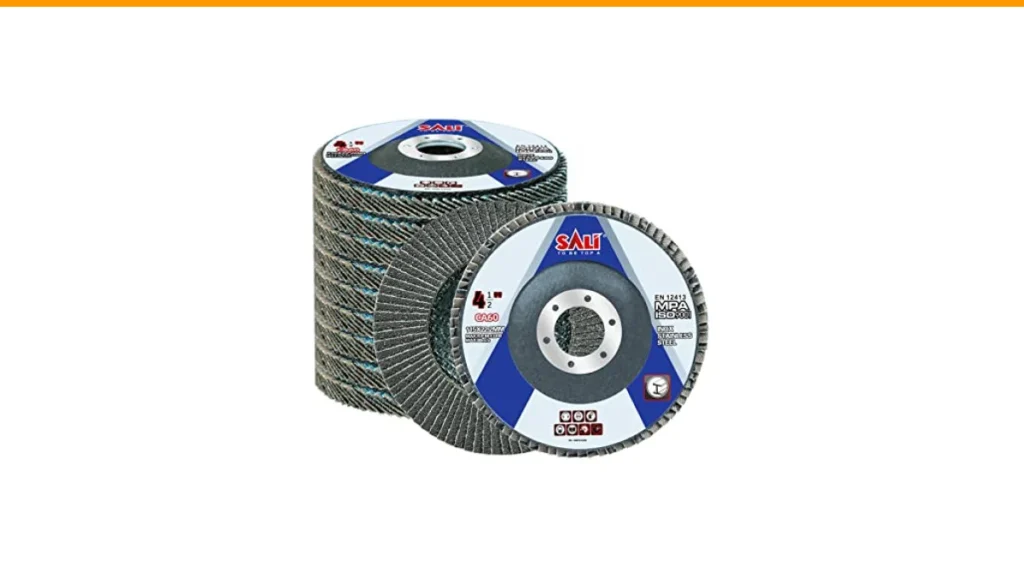
Sali 10-Pack Flap Discs

SALI
Sali 10 Pack Flap Disc 60 Grit 4.5" x 7/8-Inch Sanding Disc Bevel Type #29 Premium and Industrial Angle Grinder Grinding Wheel High Performance Edge Grinding
- Premium quality : These flap discs are constructed with industrial grade premium zirconia abrasive for strength, durability, and e…
- Stock removal : Each disc is made with coarse grit 60 zirconia alumina making this abrasive flap disc ideal for aggressive grindin…
- Bevel : These bevel type 29 discs are angled to be more effective for contours, edge and weld blending, and radius grinding
The one you buy when you sharpen blades for the whole neighborhood.
The Sali 10-pack gives you enough discs to handle a full season of blade maintenance without restocking. At 60 grit, this disc hits the sweet spot for mower blades—it removes nicks and dull edges quickly while leaving a surface that’s ready for light honing. The Type 29 bevel shape lets you work at a 15- to 25-degree angle, which matches the factory bevel found on most rotary mower blades.
Zirconia alumina abrasive is the right call here. It runs cooler than aluminum oxide and holds up better against the hardened steel used in most mower blades. The fiberglass backing plate adds stiffness, so you won’t get the disc fluttering when you press it against the blade’s edge. At 13,300 RPM max speed, it works with virtually every 4.5-inch angle grinder on the market.
The trade-off is that 60 grit is a compromise. On badly damaged blades with deep nicks, you’ll spend more time grinding than you would with a 40-grit disc. And while the price per disc is attractive, you’re committing to 10 discs of the same grit—there’s no variety for finishing work. If you prefer a 120-grit pass to polish the edge, you’ll need a second product.
- 10 discs per pack, 4.5-inch diameter with 7/8-inch arbor
- Type 29 bevel design for edge and contour work
- Zirconia alumina abrasive resists heat buildup
- Fiberglass backing reduces vibration during grinding
- Rated for up to 13,300 RPM
Best for: Homeowners who sharpen multiple mower blades each spring and want a dependable supply of 60-grit discs without paying premium per-disc prices.
DEWALT DW8311 Flap Disc

DEWALT
DEWALT DW8311 4-1/2-Inch by 5/8-Inch-11 36 Grit Zirconia Angle Grinder Flap Disc
- High performance, contaminant free
- Product is manufactured in Turkey
- This product meets customer requirement
The one you grab when you need a single disc that just works.
DEWALT’s DW8311 is a straightforward, no-frills 36-grit disc with a 5/8-inch-11 hub. That hub size is worth noting because it fits grinders with a threaded spindle directly—no adapter ring required. The 36-grit zirconia cuts aggressively, making it the fastest option in this lineup for removing material from a badly dulled blade.
This disc is flat (Type 27), which means you hold the grinder at a lower angle, around 5 to 10 degrees, to make contact. It’s a different feel than the beveled Type 29 discs. For mower blades, flat discs work fine on the straight sections of the blade but require more care near the curved ends. The zirconia abrasive is contaminant-free, so you won’t get any unwanted particles embedded in the blade surface.
Availability can be spotty, and you’re getting one disc, not a pack. At 36 grit, it leaves a rougher finish than the 60-grit options. Plan to follow up with a finer grit or a sharpening stone to hone the edge after you’ve removed the bulk of the dull metal. The coarse grit also generates more heat, so keep the disc moving and avoid lingering in one spot.
- Single 4.5-inch disc with 5/8-inch-11 threaded hub
- 36 grit zirconia for fast stock removal
- Flat Type 27 profile for low-angle grinding
- Contaminant-free construction for clean results
- Manufactured in Turkey
Best for: Users who want a single, high-quality aggressive disc for restoring a severely neglected blade and don’t mind finishing with a hand file.
ROZZLOOM Zirconia Flap Discs

ROZZLOOM
ROZZLOOM Zirconia 4 1/2 Flap Discs for Angle Grinder - 80 Grit Flap Disc 4.5'' x 7/8'' Grinding Wheel, Sanding Disc - Flap Wheel Disc for Cleaning Wood,Metal,Stainless Steel-2pcs
- 👍【80 Grit Fast Grinding】:The type 27 and 80 grain zirconium corundum particles adhere firmly to the flap disc surface, allowing yo…
- 👍【Wear Resistant Zirconia】:Professional resin and Zirconia abrasive materials make the discs more durable and efficient for high p…
- 👍【Excellence Performance】:Professional flap discs are what you need for good abrasion resistance, anti-static and anti-clogging as…
The one that leaves the smoothest edge right out of the pack.
ROZZLOOM’s 80-grit discs are the finishing specialists in this group. While other picks focus on fast metal removal, this pair is designed for the final pass that leaves a clean, sharp edge. The Type 27 flat profile works well for light grinding and blending, and the 80-grit zirconium corundum abrasive gives you a fine cut that reduces the need for secondary honing.
The anti-clogging properties matter when you’re working on blades that have picked up sap, grass residue, or light rust. A clogged disc stops cutting and starts burning the metal. ROZZLOOM’s resin bond resists loading, so the disc keeps cutting even on less-than-pristine blades. The anti-static feature also means less dust clinging to your work area.
Two discs don’t go far if you’re sharpening several blades or doing heavy reshaping. And at 80 grit, you shouldn’t use this disc to grind out deep nicks—you’ll wear through the flaps before the nick is gone. It’s a dedicated finishing tool, not an all-in-one solution. For a complete sharpening job, you’ll want a coarser disc first, then switch to this one for the final edge.
- 2 discs per pack, 80 grit, 4.5-inch with 7/8-inch arbor
- Type 27 flat profile for surface work
- Anti-static and anti-clogging resin bond
- Zirconium corundum abrasive for durability
- Suitable for wood, metal, and stainless steel
Best for: The second step in a two-step sharpening process—use a 40 or 60-grit disc first, then finish with these 80-grit discs for a polished cutting edge.
OSTTE 4-1/2 Flap Discs
OSTTE
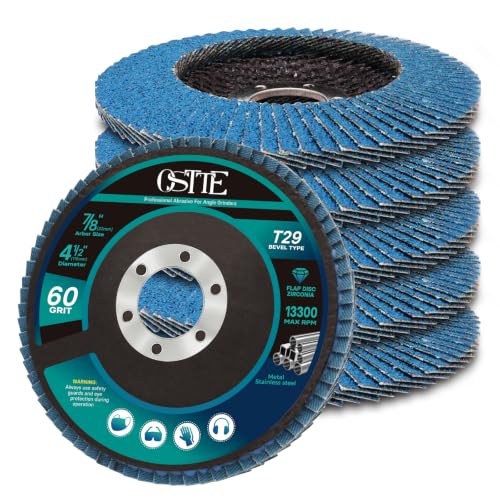
OSTTE 4-1/2" 60 Grit Flap Discs, 7/8" Arbor, 5 Pack
- 4.5-Inch Flap Discs for Angle Grinder:OSTTE 5-pack of quality flap discs features 60 grit and a Type 29 conical design with a 7/8-…
- Type 29 Conical Design for Better Surface Contact:The conical face of the disc allows it to fit well against edges and contours. T…
- Zirconia Abrasive for Effective Cutting:Made with quality zirconia abrasive, these discs aim to provide faster cutting speed and m…
The balanced performer that handles most blade conditions without drama.
OSTTE’s 5-pack at 60 grit is the closest thing to a universal recommendation for mower blade sharpening. The Type 29 conical design gives you the angled working surface that matches blade bevels naturally, so you spend less time adjusting your grinder position. The 60-grit zirconia abrasive removes dull metal efficiently while leaving a surface that’s nearly ready to cut.
The conical face also helps with vibration. When you’re grinding a curved blade, a flat disc can chatter or grab. The Type 29 profile distributes pressure more evenly, which translates to smoother operation and less fatigue in your hands. OSTTE rates these for 13,300 RPM, so they’re safe on standard 4.5-inch angle grinders.
Five discs is a reasonable quantity for a homeowner who sharpens one or two blades per year—you might make this pack last several seasons. The 60-grit limitation applies here too; it’s not aggressive enough for blades with serious damage, and not fine enough for a mirror finish. But for routine annual sharpening, it’s hard to beat the balance.
- 5 discs per pack, 60 grit, 4.5-inch with 7/8-inch arbor
- Type 29 conical design for better edge contact
- Zirconia abrasive for faster cutting speed
- Cushioned flap structure reduces vibration
- Max speed 13,300 RPM
Best for: Homeowners who want a straightforward, reliable pack for annual blade sharpening without overthinking grit selection or disc geometry.
PRVEW Flap Discs 4 1/2

PRVEW
PRVEW Flap Discs 4 1/2 Inch 5-Pack,4.5" x 7/8" Premium Zirconia Grinding Wheels Abrasive Flap Discs
- [Various Grit Flap Discs]: Including 4-1 2 inch Flap discs with 40/60/80/120 4 different grits. This angle grinder flap disc set c…
- [Premium Raw Material]: These flap discs are constructed with premium zirconia abrasive for strength, durability, and extended lif…
- [Fast & Efficient Grinding]: Bevel Type 29 angle design makes the edge and corner grinding much more convenient, great for surface…
The variety pack that covers every stage of blade restoration.
PRVEW’s 5-pack includes four different grits: two 40-grit discs, one 60, one 80, and one 120. That variety makes this the most versatile option for anyone who wants to handle the complete blade maintenance workflow with a single purchase. Start with 40 grit to grind out nicks, move to 60 or 80 for the main bevel, and finish with 120 for a sharp edge.
The Type 29 bevel design is consistent across all grits, so you don’t have to change your grinding angle when you switch discs. The zirconia abrasive holds up to high temperatures, which is critical when you’re working on a blade that’s been heat-hardened. Having multiple grits also lets you experiment to find the finish you prefer for your specific mower.
The downside is quantity per grit. You get only one 120-grit disc, which will wear out fastest if you use it for final honing on multiple blades. And the 40-grit discs are aggressive—if you’re not careful, you can remove too much metal and throw the blade out of balance. Start with light pressure and let the disc do the work.
- 5 discs per pack: 2x 40 grit, 1x 60 grit, 1x 80 grit, 1x 120 grit
- Type 29 bevel for edge and contour grinding
- Zirconia abrasive resists heat and pressure
- Working angle of 5 to 15 degrees recommended
- 4.5-inch diameter with 7/8-inch arbor
Best for: Beginners who want to learn the correct grit progression and users who sharpen multiple blades with varying levels of damage in one sitting.
How We Chose These Products
Selection started with a simple question: what does a flap disc need to do well on a lawn mower blade? The answer narrowed the field to zirconia abrasive discs, since aluminum oxide runs too hot and wears out too fast on hardened blade steel. I also prioritized discs with Type 29 bevel geometry because it matches the angle of most mower blade edges better than flat Type 27 discs.
From there, I looked at grit coverage across the lineup. A single grit recommendation ignores the reality that blades come in different conditions. Some need aggressive 40-grit restoration; others just need a quick 80-grit refreshing. The final five picks represent a range of grits and pack sizes, so there’s a sensible option whether you sharpen one blade a year or run a small mowing business. I also checked arbor sizes and RPM ratings to ensure compatibility with standard 4.5-inch angle grinders.
Flap Disc Grit Guide: Choosing the Right Grit
Matching grit to blade condition prevents wasted effort and damaged edges. A blade with visible nicks, rolled edges, or heavy rust needs a 40-grit disc. This coarse grit removes material fast, reshaping the edge in minutes. Start with light pressure and check your progress frequently—40 grit can remove metal quicker than you expect.
For routine sharpening where the blade is dull but not damaged, 60 grit is the most efficient choice. It cuts well enough to refresh the edge in a few passes while leaving a surface that’s reasonably smooth. Most of the picks in this article center on 60 grit for this reason.
Use 80 or 120 grit only for the final honing pass. These finer grits don’t remove much metal, but they refine the edge and remove the burr left by coarser discs. A blade sharpened to 120 grit will cut grass noticeably cleaner than one stopped at 40 grit. The trade-off is time—finer grits require more passes to achieve the same material removal.
How to Sharpen a Lawn Mower Blade with a Flap Disc
Sharpening with a flap disc takes about ten minutes per blade once you have the right setup. The process breaks down into four steps that protect both you and the blade.
Step 1: Remove and clean the blade. Disconnect the spark plug wire before tipping the mower. Remove the blade and clean off grass buildup and sap with a wire brush or solvent. A clean blade gives you a clear view of the cutting edge and prevents clogging the disc.
Step 2: Secure the blade for grinding. Clamp the blade firmly to a workbench with the cutting edge facing up. Use a C-clamp or a bench vise. Never hold the blade in one hand and the grinder in the other—kickback from the disc can cause serious injury. Wear safety glasses and heavy gloves.
Step 3: Grind with the correct motion and pressure. Hold the grinder so the disc contacts the blade at the existing bevel angle, typically 30 to 45 degrees. Move the grinder in one direction along the edge, from the base toward the tip. Apply light pressure—let the disc do the cutting. Keep the disc moving to avoid heat buildup. If the blade starts to turn blue, you’re grinding too hard; the temper (hardness) is being ruined. Stop and let it cool.
Step 4: Check for balance. After sharpening, hang the blade on a nail or use a blade balancer. The heavy side will drop. Grind a bit more material from the heavy end until the blade hangs level. An unbalanced blade causes vibration and damages the mower spindle over time.
Common Mistakes That Ruin Your Blade
Overheating is the most common mistake. Grinding generates friction, and friction generates heat. When the edge turns blue, the steel has lost its hardness and will dull quickly. Keep the disc moving and take breaks if the blade gets hot to the touch.
Grinding the wrong angle is a close second. The factory bevel on most mower blades is around 30 to 45 degrees. If you grind a steeper angle, the edge becomes weaker and chips. If you grind too shallow, the blade won’t cut effectively. Match the existing bevel as closely as possible.
Ignoring the balance check is a quieter failure. A blade that’s sharp but unbalanced will vibrate, stress the engine, and produce an uneven cut. Always check balance after sharpening, even if you only removed a small amount of metal.
Skipping the burr removal is another oversight. Grinding pushes a thin burr of metal to the back side of the edge. If you don’t remove it with a fine stone or a pass with a 120-grit disc, the burr will roll over during the first mow and leave the blade dull again.
Flap Disc vs. Bench Grinder vs. File
Each sharpening method has a place, but they’re not equal for mower blade work. A bench grinder removes metal fast but generates heat quickly, making it easy to ruin the blade’s temper. It also requires removing the blade and holding it at the right angle against a spinning wheel—a skill that takes practice.
A file is the safest option but the slowest. It generates no heat and gives you total control. For a blade that’s only slightly dull, ten minutes with a mill file can restore the edge. The downside is arm fatigue and the time required for badly damaged blades.
A flap disc on an angle grinder sits between these two. It removes metal faster than a file but with more control than a bench grinder. The flexible flaps conform to the blade’s shape, and the zirconia abrasive cuts cool enough to avoid ruining the temper—provided you keep the disc moving. For most homeowners, a flap disc offers the best balance of speed, control, and cost.
Frequently Asked Questions
Can I sharpen a mower blade without removing it from the mower? You can, but it’s not recommended. Sharpening in place risks damaging the mower deck and makes it difficult to maintain a consistent angle. Removing the blade takes five minutes and gives you a safe, controlled setup. The risk of injury or uneven sharpening outweighs the time saved.
How often should I sharpen my mower blade? A typical rule is every 20 to 25 hours of mowing, or about twice per season. If you mow frequently or cut thick grass, check the blade monthly. A dull blade tears grass, leaving a brown, ragged appearance. If the grass looks frayed after mowing, it’s time to sharpen.
What’s the difference between Type 27 and Type 29 flap discs for blade sharpening? Type 27 discs are flat and require a lower grinding angle, around 5 to 10 degrees. Type 29 discs have a conical, angled profile that lets you work at a higher angle, around 15 to 25 degrees. For mower blades, Type 29 discs match the bevel shape more naturally and reduce the need to tilt the grinder.
Will a flap disc work on a mulching blade with a curved cutting edge? Yes, but the curved sections require more care. The flexible flaps conform to the curve better than a rigid grinding wheel. Work slowly around the curve and maintain the existing bevel angle. A Type 29 disc is preferable for curved blades because the angled flaps reach into the contour more easily than a flat Type 27 disc.
Final Verdict
The Sali 10-pack at 60 grit is the top recommendation for most homeowners. The per-disc cost is low enough that you won’t hesitate to replace a worn disc, and 60 grit handles the full range of routine sharpening tasks. For a single high-quality disc that cuts aggressively, the DEWALT DW8311 is the pick. If you want to learn the proper grit progression from one purchase, the PRVEW 5-pack with assorted grits is the best starting point.
Whichever you choose, pair the disc with a solid clamping setup and a blade balancer. The disc does the cutting, but your technique determines whether the blade ends up sharp, balanced, and ready for the next mow. Taking the extra few minutes to check your work will keep your mower running smoothly and your lawn looking clean.