Your back hurts. The wheelbarrow tips over on the slope by the shed. And you still have six more loads of mulch to move before lunch. A motorized garden cart solves most of that, but only if you pick one built for your actual terrain and loads.
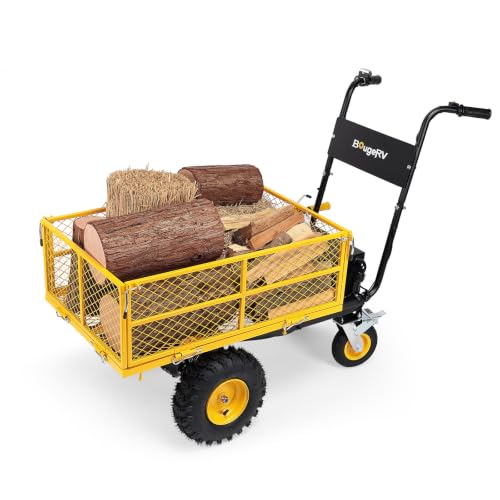


A great electric utility cart needs real hauling capacity, wheels that don’t sink into mud, and a battery that lasts longer than your patience. The motor should assist, not fight you. And the frame has to survive a season of gravel, roots, and wet grass without rattling apart.
We looked at five models that cover everything from light backyard chores to full landscaping jobs. The BougeRV takes top honors for raw power and hill control. The Landworks is the reliable all-rounder. The VEVOR wins on battery watt hours, while the SEESII and Litheli serve campers and small-space owners who need a foldable design. Here’s how they compare.
Key specs side by side, so you can find your match fast.
| Features | BougeRV Electric | Landworks Utility | VEVOR Power Wagon | SEESII Wagon Cart | Litheli Utility Wagon |
|---|---|---|---|---|---|
| Load Capacity | 660 lbs | 500 lbs | 660 lbs | 330 lbs | 450 lbs |
| Battery System | 48V 7.5Ah SLA | 48V 7Ah SLA | 36V 12A 432Wh | 2 x 20V 4.0Ah | 20,000mAh removable |
| Wheel Setup | 14 in front, 8 in rear | 13 in pneumatic | 4-wheel steel | Widened heavy-duty | SUV-style all-terrain |
| Top Speed | 3.11 mph | 3.1 mph forward | Not specified | Stepless variable | 0.6 to 1.3 m/s |
| Best Use Case | Slopes and heavy loads | Garage and yard | Farm and construction | Camping and garden | Travel and storage |
BougeRV Electric Utility Cart
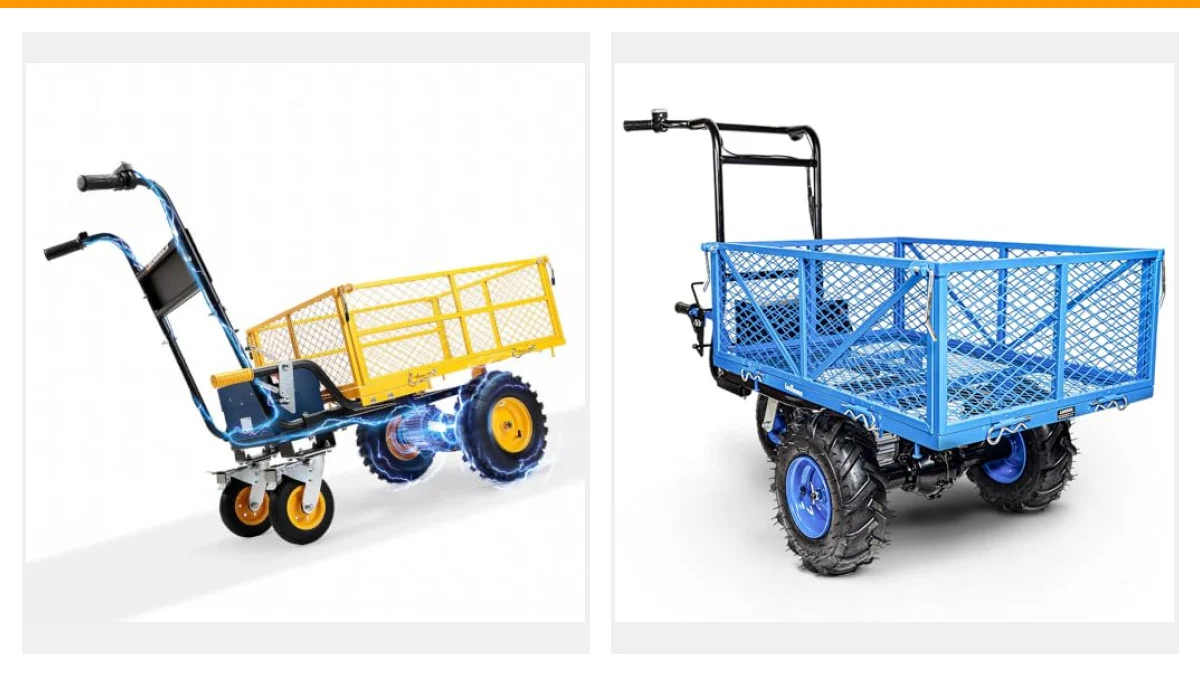
The BougeRV is the one you buy when your property has a hill and you’re tired of fighting it. With a 660 lbs load capacity and 1000 lbs towing weight, this electric wheelbarrow handles firewood, soil, and construction debris without bogging down. It’s aimed at homeowners with sloped yards, small farms, and anyone who moves heavy material weekly.
What sets it apart is the hill-hold function. Release the control handle on an incline and the cart locks in place instead of rolling back. That single feature changes how you work on grades up to 15 degrees. The 14-inch inflatable front tires bite into grass and gravel, while the flat-free 8-inch rear swivel wheels handle tighter turns. Cold weather doesn’t kill it either, thanks to the sealed lead-acid battery pack.
The trade-off is weight. This is a heavy machine, and the 48V SLA battery takes hours to charge fully. It’s not a cart you’ll toss in the trunk for a camping trip. And the 3.11 mph top speed feels deliberate rather than quick, which is fine for hauling but slow if you’re crossing a large property empty.
- 660 lbs load capacity and 1000 lbs towing weight
- Automatic hill-hold on slopes up to 15 degrees
- Foldable and detachable side panels convert to flatbed mode
- 14-inch inflatable front tires with deep tread
- Operates in cold-weather conditions
Best for: Homeowners with sloped or uneven property who move heavy loads regularly and need the cart to stay put when they let go.
Landworks Electric Utility Cart

Landworks
Landworks Electric Utility Cart, 500 lb Load | 48V Lead-Acid Power Wagon Uses a 500W Motor to Tow 1000 lb Through Garages, Warehouses and Outdoor Areas
- Powerful 500W Motor & High Capacity: Equipped with a 500W lead-acid battery-powered motor and a 48V brushless motor system, the La…
- Reliable Dual Power System: Powered by four 12V 7Ah rechargeable deep cycle sealed lead acid batteries, this utility cart ensures…
- All-Terrain Mobility with Heavy-Duty Wheels: Navigate effortlessly across various surfaces with large 13-inch heavy-duty pneumatic…
Landworks built this cart for people who want quiet, consistent power without a lot of fuss. The 500W brushless motor and 48V system deliver 500 lbs of hauling capacity and 1000 lbs towing. It suits garage work, warehouse tasks, and residential yard projects where noise matters.
The dual power system uses four 12V 7Ah deep-cycle sealed lead-acid batteries. They charge faster than some lithium setups and hold up in cold conditions. The 13-inch pneumatic wheels run at 30 to 31 PSI and roll smoothly over rough ground. Variable speed tops out at 3.1 mph forward and 2.2 mph reverse, which feels natural when you’re walking behind it.
Here’s the honest part. The 6 cubic feet cargo bed is smaller than the BougeRV’s, and the lead-acid batteries add noticeable weight. You won’t want to lift this into a truck bed alone. The brushless motor is efficient, but the 500 lbs limit means you’ll need to make more trips if you’re moving serious volume.
- 500W brushless motor with 48V system
- 500 lbs load capacity and 1000 lbs towing
- 6 cubic feet modular cargo bed converts to flatbed
- 13-inch pneumatic wheels at 30/31 PSI
- Quiet operation suitable for residential areas
Best for: Garage owners, warehouse workers, and homeowners who want a quiet, dependable cart for moderate loads on mixed terrain.
VEVOR Electric Utility Cart
VEVOR’s power wagon targets the long-job crowd. The 36V 12A, 432 Wh battery delivers more watt hours than most competitors here, which means longer run time between charges. That matters when you’re hauling soil or lumber across a farm or construction site all afternoon.
Steel mesh side rails stand 15.75 inches high and keep loads contained. The four-wheel structure adds stability that three-wheel designs can’t match, and the electronic brake system prevents rolling on slopes. You also get adjustable handle height and a soft-start controller, which makes the cart feel less jerky when you engage the motor.
The catch is speed and agility. VEVOR doesn’t publish a top speed, and the four-wheel design turns wider than a two-wheel wheelbarrow. It’s also heavy and not foldable in the way the SEESII or Litheli are. If you need portability, look elsewhere. If you need to work all day without a charge break, this is your cart.
- 36V 12A, 432 Wh battery for extended run time
- 660 lbs load capacity with reinforced steel mesh
- Electronic braking system for slope control
- Four-wheel structure for stability
- Adjustable handle height and soft-start controller
Best for: Farmers, landscapers, and construction workers who need maximum run time and a stable platform for heavy, bulky loads.
SEESII Electric Wagon Cart
SEESII takes a different approach. This is a foldable electric wagon for campers, gardeners, and families who need power assist without a permanent piece of equipment taking up garage space. The 330 lbs capacity and 150L interior handle tents, coolers, and garden tools in one trip.
Two 20V 4.0Ah batteries ship with the cart, giving you over 30 minutes of continuous use per charge. You can swap them mid-job for uninterrupted power. The stepless variable speed system lets you match your walking pace exactly, whether you’re strolling a campsite or moving quickly across a job site. Widened wheels with anti-slip and shock-absorbing features handle mud, gravel, and grass without getting stuck.
It’s not a heavy-duty hauler. The 330 lbs limit is the lowest here, and the Oxford fabric liner won’t survive the same abuse as a steel bed. The frame is reinforced, but this cart is built for lighter, more varied tasks rather than daily construction work.
- Two 20V 4.0Ah batteries included for extended runtime
- 330 lbs load capacity and 150L interior space
- Stepless variable speed control
- Reinforced steel frame with tear-resistant Oxford fabric
- Widened anti-slip wheels for multi-terrain use
Best for: Campers, festival-goers, and home gardeners who want a foldable, battery-powered cart they can store easily and take anywhere.
Litheli Electric Utility Wagon
Litheli’s wagon is the space-saver of the group. It folds down to a 1:4 ratio, which means it fits in a car trunk or hallway closet without a fight. The 450W motor and 450 lbs capacity make it more capable than its compact size suggests. Families, beach-goers, and seniors who need help moving groceries or garden supplies will find it useful.
A 20,000mAh removable battery powers the cart for 30 to 50 minutes under a 132 lbs load. Variable speed ranges from 0.6 to 1.3 m/s, matching a natural walking pace. The 600D waterproof Oxford liner is removable and washable, which matters when you’re hauling wet gear or muddy tools. Oversized SUV-style wheels with anti-slip tread handle sand, gravel, and forest trails.
Safety features stand out here. Soft start, collision-guarded front wheels, and a power lock make it safer for kids or older adults to use. The trade-off is capacity. At 450 lbs, it sits between the SEESII and the heavier-duty models. And the fabric liner, while washable, won’t hold up to sharp debris like a steel bed would.
- 450W motor with 450 lbs load capacity
- 150L capacity with reinforced tailgate
- 20,000mAh removable battery for 30 to 50 minutes of use
- 1:4 fold ratio for compact storage
- Triple safety system with soft start and power lock
Best for: Families and seniors who need a foldable, safe, easy-to-store electric wagon for errands, beach trips, and light garden work.
How We Chose These Products
We started by filtering out carts with vague specs or unrealistic claims. Every model here publishes its load capacity, battery type, and wheel configuration. That transparency matters because a 660 lbs rating means nothing if the tires sink into mud or the motor stalls on a slope.
We weighed real-world usability over marketing language. Hill-hold, brake systems, and variable speed controls got extra attention because they solve actual problems. Battery chemistry, charge time, and run time under load separated the contenders from the pretenders. Foldability and storage footprint mattered for buyers without a dedicated shed. And we considered who each cart actually serves, from farmers to campers to seniors.
Buying Guide: What Really Matters
Load capacity is the first number people check, and it’s also the most misleading. A cart rated for 660 lbs might handle that on flat pavement but struggle on a 10-degree slope with wet grass. Look for hill-climbing specs and tire tread depth alongside the payload rating. If you regularly haul on grades, prioritize carts with brake systems or hill-hold features.
Battery type shapes your entire ownership experience. Sealed lead-acid batteries are heavy and slow to charge but handle cold weather well and cost less upfront. Lithium batteries are lighter, charge faster, and hold steady power as they drain, but they cost more and can struggle in freezing temperatures. Watt hours tell you the real energy storage, so compare that number rather than amp hours alone.
Wheel design decides where the cart works. Pneumatic tires absorb bumps and grip loose surfaces, but they can go flat. Flat-free wheels never need air but ride rougher. Four-wheel carts are more stable on slopes. Two-wheel designs turn tighter. Match the wheel setup to your terrain, not the product photo.
Battery Life and Charging: What Riders Get Wrong
Most buyers assume run time scales linearly with load. It doesn’t. A cart that runs 50 minutes empty might last 20 minutes with 400 lbs aboard and a headwind. The Litheli, for example, rates 30 to 50 minutes under a 132 lbs load, which is far below its 450 lbs maximum. Plan for shorter run times as your payload grows.
Charge time is the other surprise. Lead-acid packs often need 6 to 8 hours for a full charge. Lithium packs charge faster but may require a proprietary charger. If you work in shifts, a spare battery is worth the investment. The SEESII ships with two batteries for exactly this reason.
Weight Capacity vs Real-World Payload
A 660 lbs rating assumes ideal conditions. Add a slope, soft ground, or a worn tire, and effective capacity drops. The BougeRV and VEVOR both claim 660 lbs, but the BougeRV’s hill-hold and inflatable front tires give it an edge on uneven ground. The VEVOR’s four-wheel design and electronic brake help on grades but add rolling resistance.
Think about what you actually haul. A cubic foot of wet topsoil weighs about 80 lbs. Six cubic feet hits 480 lbs before you add the cart’s own weight. If your typical load exceeds 400 lbs, choose a cart with a steel frame and a proven brake system. Fabric-sided wagons like the SEESII and Litheli work best under 300 lbs.
Electric vs Manual Carts: When the Motor Pays Off
A manual garden cart costs a fraction of an electric model and never needs a charge. So when does the motor earn its keep? Three situations: slopes, heavy repetitive loads, and users with back or joint issues. Pushing 500 lbs up a 10-degree grade by hand is miserable. An electric assist mode turns that into a manageable walk.
For flat, light-duty work, a manual cart is simpler and cheaper. But if you’re moving firewood, soil, or construction material weekly, the motor pays for itself in saved time and avoided strain. Seniors and anyone recovering from injury should seriously consider electric assist for safety alone.
Common Problems With Electric Garden Carts and How to Avoid Them
Battery drain tops the list. Cold weather cuts lead-acid capacity by 20 to 30 percent. Store batteries indoors and charge them fully before winter use. Tire pressure is another culprit. Pneumatic tires lose air over time, and underinflated tires increase rolling resistance and drain the battery faster.
Motor controllers can overheat on long, steep climbs. Give the cart a break every 15 to 20 minutes on sustained grades. And check the wiring harness where it connects to the handle. Vibration loosens connectors over time. A zip tie and a quick inspection prevent most mid-job failures.
Best Budget Electric Garden Cart Under $300
The SEESII and Litheli both land in budget territory while offering real electric assist. The SEESII gives you two batteries and a 330 lbs capacity for lighter tasks. The Litheli adds a foldable design and a washable liner. Neither matches the heavy-duty models on raw power, but for camping, small gardens, and errands, they deliver solid value. Check the current price on Amazon before you commit, since sales shift often.
Best Heavy-Duty Electric Cart for Slopes and Mud
The BougeRV wins this category. Hill-hold, 14-inch inflatable front tires, and a 660 lbs capacity make it the most capable cart here on grades and soft ground. The VEVOR runs a close second with its electronic brake and 432 Wh battery, but the BougeRV’s automatic hill-hold is the feature you’ll appreciate most when you’re halfway up a wet slope with a full load.
Maintenance, Storage, and Winter Care
Wash the cart after muddy jobs, especially around the wheels and undercarriage. Mud adds weight and clogs the motor housing. Check tire pressure monthly on pneumatic models. Lubricate the axle and handle joints every few months with a light grease.
For winter storage, remove the battery and keep it indoors. Charge lead-acid packs to full before storing, then top them off every 60 days. Lithium batteries prefer a 50 to 80 percent charge for long storage. Cover the cart or park it in a shed to protect the frame and electronics from moisture.
Electric Cart Safety for Seniors and DIYers
Electric carts reduce physical strain, but they introduce new risks. Always engage the brake or hill-hold before loading or unloading. Keep hands and feet clear of the wheels when the motor is on. On slopes, walk beside the cart rather than behind it, so you can step away if it slips.
The Litheli’s soft start and power lock make it a strong choice for older adults. The BougeRV’s hill-hold prevents rollback, which is a common cause of falls. If you’re buying for a senior, look for variable speed control and a low engagement force on the handle. Avoid carts with abrupt start-stop behavior.
Our Top Recommendation
The BougeRV Electric Utility Cart takes the top spot. It combines 660 lbs hauling capacity, automatic hill-hold, and aggressive all-terrain tires in a package built for real work. The cold-weather battery operation is a bonus for northern buyers. If your property has any slope at all, this is the cart that keeps you safe and productive.
For a tighter budget, the Landworks delivers 500 lbs and a quiet brushless motor at a lower cost. The VEVOR is the pick for all-day run time on farms and job sites. Campers and small-space owners should look at the SEESII or Litheli for their foldable designs and lighter weight. Every cart here earns its place, but the BougeRV earns it first.
Frequently Asked Questions
How long does the battery last on an electric garden cart?
Run time depends on load, terrain, and temperature. The Litheli offers 30 to 50 minutes under a 132 lbs load. The SEESII provides over 30 minutes per battery with two included. Heavier loads and hills cut that time significantly, so plan for shorter runs when hauling maximum weight.
Can an electric garden cart handle hills and slopes?
Yes, within limits. The BougeRV climbs inclines up to 15 degrees with automatic hill-hold. The VEVOR’s electronic brake prevents rolling on grades. Steep, wet slopes still demand caution. Walk beside the cart and keep the load balanced.
What weight can an electric garden cart actually haul?
Published capacities range from 330 lbs to 660 lbs. Real-world payload is lower on slopes, mud, or soft grass. For loads above 400 lbs, choose a steel-framed cart with a brake system and inflatable tires. Fabric-sided wagons work best under 300 lbs.
Are electric garden carts worth the money?
They are if you haul heavy loads regularly or deal with slopes. The motor saves time and reduces strain on your back and joints. For light, flat-ground tasks, a manual cart costs less and needs no charging. Match the tool to your actual workload before you buy.
Do electric garden carts come with spare batteries?
Most ship with one battery. The SEESII includes two 20V 4.0Ah batteries for extended runtime. If you work long shifts, buying a spare battery is worth it. Just confirm the battery type and voltage match your cart before ordering.
Can you use an electric garden cart on grass and gravel?
Yes, with the right wheels. Pneumatic tires with deep tread handle grass and gravel well. The BougeRV’s 14-inch front tires and the Litheli’s SUV-style wheels are built for these surfaces. Avoid smooth, hard plastic wheels on loose ground.
How fast does an electric garden cart go?
Most models top out around 3 mph, which matches a slow walking pace. The Landworks runs 3.1 mph forward and 2.2 mph reverse. The Litheli ranges from 0.6 to 1.3 m/s. Speed isn’t the point with these carts. Control and stability matter more.
Are electric garden carts safe for older adults?
They can be safer than manual carts when they include soft start, variable speed, and brake systems. The Litheli’s triple safety system and the BougeRV’s hill-hold are good examples. Avoid carts with abrupt start-stop behavior or high handle engagement force.
What maintenance does an electric garden cart need?
Wash it after muddy jobs, check tire pressure monthly, and lubricate axle and handle joints every few months. Remove the battery for winter storage and keep it charged. Inspect the wiring harness for loose connections. These steps prevent most common failures.