A worn trimmer head ruins an otherwise good afternoon. The bump knob stops feeding line, the spool cracks, or the whole thing wobbles until you give up and grab the hand shears. If you run an Echo straight-shaft trimmer, the fix is usually a cheap replacement head, not a new machine.
Picking the right one takes about five minutes of homework. You need to match the arbor size, confirm your shaft type, and decide between a bump-feed or fixed-line design. Get those three things right and the head bolts on in under ten minutes.
This guide covers the aftermarket 3-pack that fits most Echo straight-shaft models, then walks through compatibility, installation, and the mistakes that cause wobble and line jams.
Here is the quick spec comparison before the full breakdown.
| Features | VIABRICO 3-Pack Head |
|---|---|
| Material & Build | Reinforced composite, crack-resistant |
| Arbor / Bolt Size | M10 x 1.25 mm, 10 mm female hole |
| Head Diameter | 3-3/4 inches |
| Max Rotation Speed | 10,000 RPM |
| Best Use Case | Straight-shaft Echo and Shindaiwa trimmers |
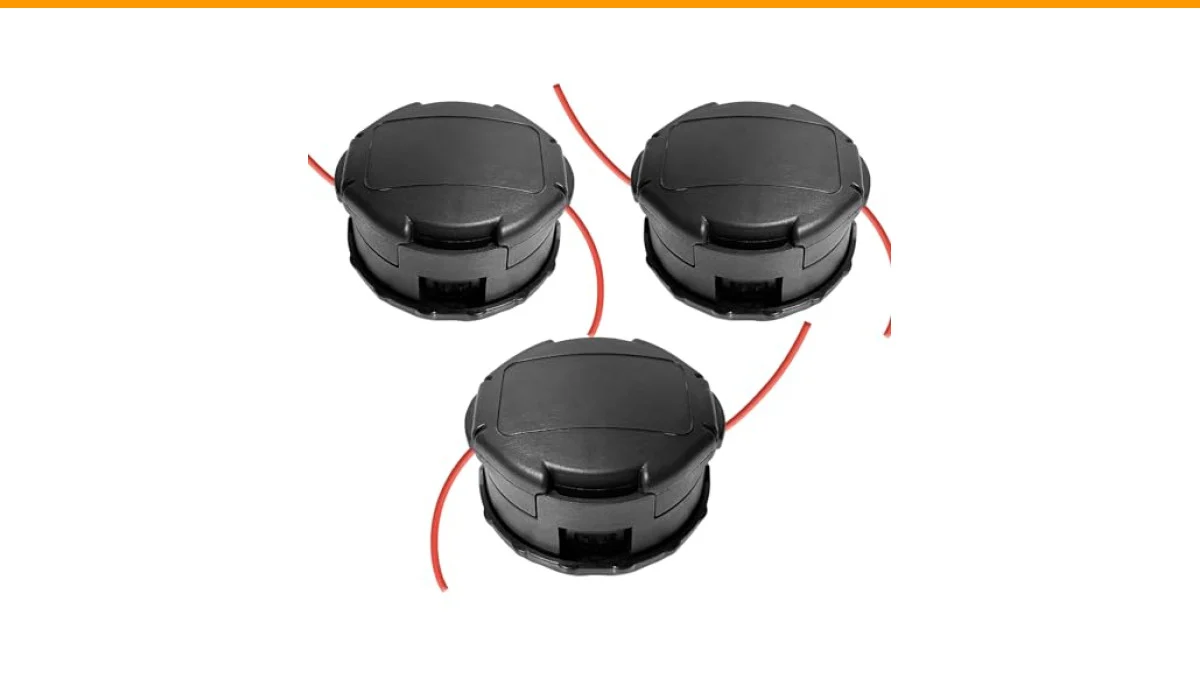
VIABRICO 3-Pack Trimmer Head

VIABRICO
3 Pack String Trimmer Head compatible for Echo Speed Feed 400 SRM-230 SRM225 SRM-210 SRM2100 Echo Weed Eater PAS210 PAS211 PAS225 PAS230 PAS260 Shindaiwa T195S T220 T222 T230 T231 Straight Shaft
- Universal Weed Eater Head - We used a much stronger material for the string trimmer head, which promises great durability while re…
- Upgraded Line Storage Capacity - The female hole is 10mm/0.39'', make sure the size fits your string trimmer before purchasing. Th…
- Our weed eater bump head is compatible with Echo Speed Feed 400 SRM-225 SRM-210 SRM-2100 SRM-200 SRM-230 SRM-250 SRM-265 SRM-266 S…
This is a three-pack of bump-feed replacement heads built for straight-shaft Echo and Shindaiwa trimmers. It suits homeowners and light-commercial users who run the same trimmer across a season and want spares on the shelf instead of ordering one at a time. If your trimmer gets heavy use, having two backups in the garage beats waiting on shipping mid-job.
The standout feature is the reinforced composite body. Cheaper heads crack at the spool housing after a few months of hitting fence posts and rocks. This one holds up better and the 10,000 RPM ceiling keeps it stable at full throttle. Line capacity is generous too — it swallows 0.080, 0.095, 0.105, and 0.130 inch line, so you can run whatever gauge your trimming conditions call for. A 6.56-foot length of line comes in the box.
The real limitation is fitment. This head does not come with adapters and it will not work on curved-shaft trimmers. The 10 mm female hole and M10 x 1.25 bolt thread are specific. Measure your shaft before ordering, because a curved-shaft Echo owner will end up with three useless heads. Check the current price on Amazon against a single OEM head and the math usually favors this pack.
- Three heads per pack — practical for multi-season use
- Fits 0.080 to 0.130 inch trimmer line
- M10 x 1.25 mm bolt, 10 mm female hole, 3-3/4 inch diameter
- Compatible with Echo SRM, GT, and PAS straight-shaft models plus Shindaiwa T-series
- No adapters included — straight shaft only
Best for: Echo straight-shaft owners who want a durable bump-feed head and two spares without paying OEM prices.
What Is an Echo Weed Eater Replacement Head?
It is the spinning assembly at the bottom of your trimmer that holds the line and feeds it out as you work. Echo sells several designs, and they are not interchangeable across every model. The head threads onto the gearbox output shaft, which is why arbor size and shaft type matter more than brand loyalty.
Replacement heads exist because spools wear out. The bump knob strips, the spring weakens, or the housing cracks after enough contact with concrete. A new head costs a fraction of a new trimmer and takes minutes to install. This is one of the cheapest repairs in outdoor power equipment.
Echo Replacement Head Types Explained
Echo’s lineup splits into three families. Knowing which one you have tells you what will bolt on.
Rapid Loader Head
The Rapid Loader lets you reload line without disassembling the head. You feed the line through the eyelets and twist the knob. It saves time on long jobs, but the mechanism has more moving parts and tends to wear faster than simpler designs. Popular on newer SRM and PAS models.
Speed-Feed 400 and 450
The Speed-Feed 400 is the workhorse head on SRM-225, SRM-230, and similar straight-shaft trimmers. The 450 handles larger line and heavier cutting. The VIABRICO pack above is built as a Speed-Feed 400 replacement. If your trimmer came with a Speed-Feed 400, this is the direct swap.
Fixed-Line and Bump-Feed Heads
Fixed-line heads use pre-cut line segments you insert by hand. No bumping, no spool. They suit brushcutters and heavy clearing where line breaks constantly. Bump-feed heads, like the VIABRICO, let you tap the head on the ground to advance line while you work. Most homeowners want bump-feed.
Echo Trimmer Head Compatibility Chart
Fitment is where most buyers go wrong. The head either threads on or it does not — there is no middle ground.
GT, SRM, and PAS Series Fitment
The VIABRICO head fits Echo SRM-225, SRM-210, SRM-2100, SRM-200, SRM-230, SRM-250, SRM-265, SRM-266, SRM-280, and GT225 straight-shaft models. It also fits the PAS-210 through PAS-280 attachment series and PAS-2100, PAS-2400, and PAS-2601 power sources. On the Shindaiwa side, it covers T195S, T220, T222, T230, T231, T242, T2510, C230, C242, and C2510.
Curved vs Straight Shaft Models
Curved-shaft trimmers use a different head design and a smaller arbor. This head will not fit them. The shaft type is the single most important thing to check before ordering. If your trimmer has a curved shaft, look for a curved-shaft-specific head instead.
How to Identify Your Trimmer’s Shaft and Arbor Size
Look at the trimmer from the side. A straight shaft runs in a direct line from the engine to the head. A curved shaft bends near the middle. That visual check settles the biggest compatibility question.
For arbor size, check the model plate on the engine housing. Echo model numbers usually start with SRM, GT, or PAS. Cross-reference the number against the fitment list above. If you cannot find the plate, measure the threaded stud on the gearbox with calipers. An M10 x 1.25 thread measures roughly 10 mm across the threads.
Step-by-Step Installation and Removal
The job takes about ten minutes with basic hand tools.
Tools You Need
A socket wrench or a screwdriver to lock the gearbox, plus a rag. Some Echo models ship with a locking tool that slots into the gearbox holes. If yours is missing, a screwdriver through the holes works fine.
Removing the Old Head
Disconnect the spark plug boot or remove the battery first. Lock the gearbox with your tool, then turn the head clockwise to loosen it. Echo heads thread opposite to normal bolts — righty-loosey, lefty-tighty. It catches people off guard the first time.
Installing the New Head
Thread the new head counterclockwise onto the shaft by hand until it seats. Lock the gearbox and snug it down. Do not overtighten — the plastic housing can crack. Spin it by hand once to confirm it turns freely before you start the engine.
OEM vs Aftermarket Replacement Heads
Echo OEM heads are reliable and carry the brand’s backing. They also cost more per unit, and you buy one at a time. Aftermarket packs like the VIABRICO three-pack bring the per-head cost down sharply. The trade-off is no manufacturer warranty and slightly looser quality control.
For a homeowner trimming a quarter acre, aftermarket makes sense. For commercial crews running trimmers daily, OEM durability and warranty support may justify the premium. The VIABRICO head’s reinforced body narrows that gap, but it is still a copy of the Speed-Feed design, not the original.
Best Trimmer Line for Each Head
Line diameter affects cut quality and engine load. The VIABRICO head accepts 0.080, 0.095, 0.105, and 0.130 inch line. Use 0.080 for light grass and edging. Step up to 0.095 for general trimming, which is the sweet spot for most Echo straight-shaft models.
Go to 0.105 or 0.130 for thick weeds and brush. Heavier line puts more drag on the engine, so drop your RPM expectations on smaller displacement trimmers. Pre-cut line lengths work in fixed-line heads, while bump-feed heads take bulk line wound onto the spool.
Troubleshooting Common Replacement Head Problems
A wobbling head usually means it is not seated fully on the shaft or the threads are cross-threaded. Remove it and reinstall by hand first. Line jams happen when the spool is overwound or the line is too thick for the eyelets. Rewind with even tension and match the line gauge to the head’s rating.
If the head will not thread on at all, you have the wrong arbor size or a curved-shaft model. No adapter will fix a mismatched thread pitch. Return it and order the correct fit. A head that bumps but does not advance line often has a worn spring or a spool loaded in the wrong direction.
How We Chose These Products
We evaluated replacement heads on fitment accuracy, material durability, line capacity, and value per head. Fitment came first. A head that does not thread onto your trimmer is worthless regardless of build quality, so we prioritized models with clearly documented Echo and Shindaiwa compatibility.
Durability and line range came next. We looked at whether the housing resists cracking and how many line gauges the head accepts. Multi-packs earned extra weight because most trimmer owners eventually need a second head. Price matters, but only after fit and build quality are confirmed.
Buying Guide: What Really Matters
Confirm your shaft type before anything else. Straight-shaft Echo trimmers use one head family, curved-shaft models use another. This single check prevents most returns. Next, verify the arbor size — an M10 x 1.25 thread is standard on the models listed above, but measuring takes thirty seconds and saves a headache.
Line capacity decides how often you reload. A head that accepts 0.080 through 0.130 inch line gives you flexibility as your trimming needs change. Match the head’s max RPM to your trimmer’s operating speed. The VIABRICO head handles 10,000 RPM, which covers most Echo straight-shaft models.
Finally, think about how many heads you need. A three-pack costs less per unit than buying singles and keeps you working when one wears out. For casual use, one head is plenty. For regular trimming, spares pay off.
Our Top Recommendation
The VIABRICO 3-Pack String Trimmer Head is the clear pick for Echo straight-shaft owners. It fits the most common SRM, GT, and PAS models, accepts four line gauges, and the reinforced housing resists the cracking that kills cheap heads. Three heads per pack means you are covered for multiple seasons.
If you own a curved-shaft trimmer, this head will not work — look for a curved-shaft-specific replacement instead. If you prefer OEM reliability and warranty coverage, an Echo Speed-Feed 400 from a dealer is the alternative, though you will pay more per head. For everyone else running a straight-shaft Echo, this pack delivers the best balance of fit, durability, and cost.
Frequently Asked Questions
Will this head fit my Echo SRM-225?
Yes, if your SRM-225 is a straight-shaft model. It is listed as compatible with the SRM-225 and shares the M10 x 1.25 thread used across the SRM straight-shaft lineup. Curved-shaft versions of similar models are not supported.
Do I need adapters to install this head?
No adapters are included or required for the listed models. The head threads directly onto the gearbox shaft. If it does not thread on by hand, you have a fitment mismatch, not a missing part.
What size trimmer line should I use?
Start with 0.095 inch for general trimming. It balances cut performance and engine load on most Echo straight-shaft models. Switch to 0.105 or 0.130 inch for thick weeds, or 0.080 inch for light edging work.
Why does my new head wobble?
A wobble almost always means the head is not fully seated. Remove it, check the threads for debris or cross-threading, and reinstall by hand until it seats. Lock the gearbox and snug it — do not overtighten, or the plastic housing can crack.