
Top 3 Best Do It Yourself Sprinkler Systems: Real-World Review and Installation Guide
Contents
You drag the hose across the lawn for the third time this week. Half the grass is brown, the other half is a swamp, and your water bill keeps climbing. A DIY sprinkler system fixes this, but the wrong kit creates new headaches: leaks at every connection, weak spray in the far corners, and a timer you can’t figure out.
A good DIY kit matches your water pressure, covers your actual yard shape, and survives at least a few winters. The best options use push-fit connections instead of clamps, include adjustable heads, and give you a timer that doesn’t require a manual every spring.
We picked three kits that solve different problems. The Orbit 2-Zone handles rectangular lawns with automatic scheduling. The Port-A-Rain moves wherever you need it. The Eden 98063 adapts to odd-shaped gardens with fully adjustable heads. Each one has trade-offs worth knowing before you buy.
Here’s a quick look at how the three kits compare on the specs that matter most.
| Features | Orbit 2-Zone | Orbit Port-A-Rain | Eden 98063 |
|---|---|---|---|
| Connection Type | Push-fit Blu-Lock | Standard hose fittings | Standard hose fittings |
| Coverage | 2 zones, head-to-head | 24 ft diameter | Up to 1,638 sq ft |
| Timer Included | Yes, double outlet | No | No |
| Portability | Fixed layout | Fully portable | Moderate |
| Best Use Case | Rectangular lawns | Irregular shapes | Gardens and beds |
Orbit 2-Zone All-in-One A…
1st Pick

Orbit
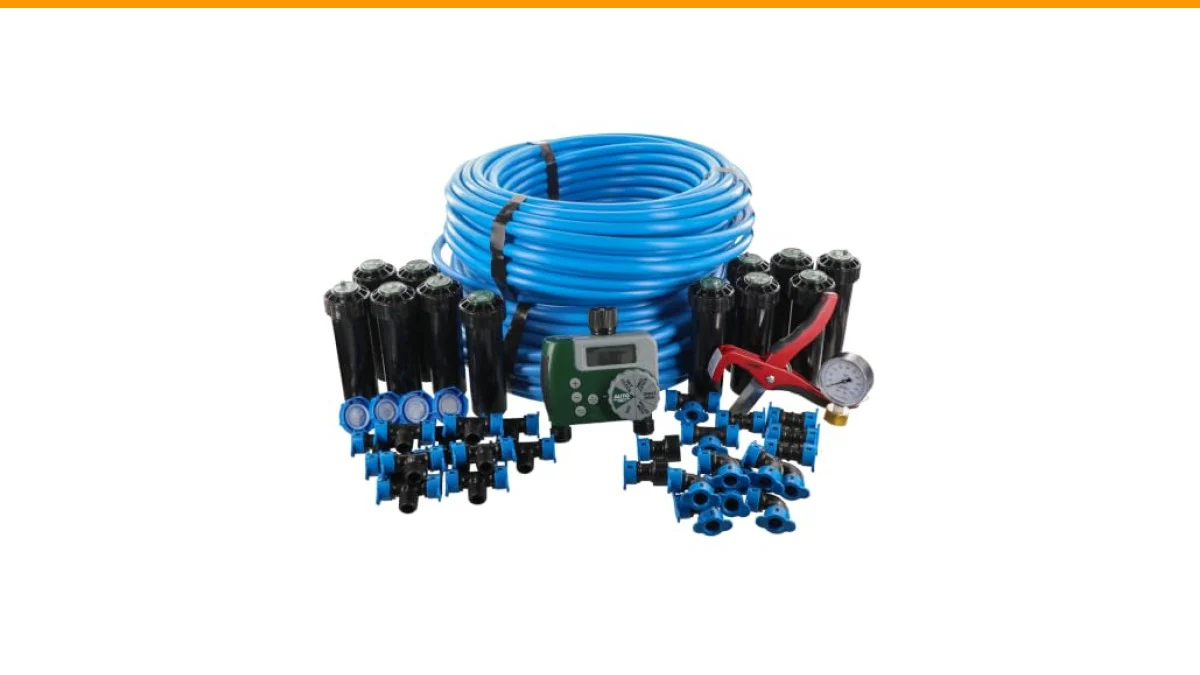
Orbit 2-Zone All-in-One Automatic Watering System, DIY Lawn Kit - 50021
- Effortless Yard Irrigation Setup: The Orbit All-in-One Automatic Watering System simplifies yard irrigation with a complete 2-zone…
- DIY Sprinkler Installation: Built for reliability, this DIY sprinkler system uses easy push-fit technology with patented Blu-Lock…
- Even Lawn Coverage: Engineered for efficient large area watering with dependable head-to-head coverage, the gear drive sprinkler h…
This is the closest thing to a real in-ground system without digging trenches. The Orbit 50021 kit includes two zones, gear-drive sprinkler heads, and a double-outlet hose timer. It suits homeowners with a rectangular front or back lawn who want automatic watering on a schedule.
The push-fit Blu-Lock tubing is the standout feature. You push the pipe into the fitting and it locks. No clamps, no glue, no crimping tools. Connections hold strong even at higher pressures, which is where clamp-style kits usually fail. The gear-drive heads also deliver head-to-head coverage, meaning one head sprays far enough to reach the next. That overlap reduces dry spots significantly compared to oscillating sprinklers.
Here’s the catch: this kit is currently unavailable on Amazon. That’s a real problem if you need something this week. The fixed layout also assumes a fairly standard yard shape. If your lawn has curves or obstacles, you’ll fight the pre-set spacing. And the timer, while functional, is a basic mechanical unit. It doesn’t adjust for rain or soil moisture.
- Includes two separate watering zones with independent scheduling
- Blu-Lock push-fit connections eliminate clamps and tools
- Gear-drive heads provide even head-to-head coverage
- Double outlet timer controls both zones automatically
- Limited warranty covers manufacturing defects
Best for: Homeowners with a rectangular lawn who want automatic scheduling and don’t mind waiting for restock.
Orbit Port-A-Rain Hose Wa…
Some yards don’t fit a permanent layout. The Orbit Port-A-Rain 58092 is a portable system you assemble above ground and move wherever it’s needed. It works well for renters, community gardens, or anyone watering multiple disconnected areas.
Setup takes minutes. You lay out the included hoses, attach the sprinkler bases, and stake them down with optional metal loops. The full-pattern nozzles cover a 24-foot diameter, and Orbit includes interchangeable nozzles so you can swap spray patterns without buying extra parts. The whole thing breaks down just as fast when you need to move it.
Durability is the weak point. The plastic construction feels light, and UV exposure will degrade it over several seasons if you leave it outside year-round. There’s also no timer in the box, so you’ll need to add one or run it manually. Coverage tops out at 24 feet per sprinkler, which means larger lawns need multiple units or a different approach.
- Portable design moves between yard areas in minutes
- Customizable layout fits irregular shapes and tight spots
- No digging required; metal loop stakes secure the bases
- Interchangeable nozzles adjust spray patterns
- Includes hoses, nozzles, and multiple sprinkler bases
Best for: Renters, gardeners with odd-shaped plots, or anyone who needs a temporary watering solution.
Eden 98063 Multi-Adjustab…
3rd Pick

Eden
Eden 98063 Multi-Adjustable Flex Design Above Ground Irrigation Garden Sprinkler System, Sprinkler & Hose, DIY Plant Watering Set
- ULTIMATE FLEXIBILITY FOR ANY GARDEN SHAPE – Place sprinklers exactly where you need them- Perfect for lawns, flower beds, raised g…
- FULLY ADJUSTABLE SPRINKLER HEADS – Control spray angle (5°–360°), direction, and water flow without repositioning spikes.
- COVERS UP TO 1,638 SQ. FT. – Each sprinkler covers up to 840 sq. ft at 60 PSI- Combined system coverage up to 1,650 sq. ft. depend…
The Eden 98063 takes a different approach. Instead of fixed heads, it gives you four adjustable sprinklers you place exactly where you want them. Each head rotates from 5 to 360 degrees, and you can change the spray angle, direction, and flow without moving the spike. That flexibility matters for flower beds, raised gardens, and lawns with mixed plantings.
Coverage reaches up to 1,638 square feet depending on how you configure the system. Each sprinkler covers up to 840 square feet at 60 PSI. The included riser extensions raise the heads above tall plants, which solves a common problem with ground-level sprinklers. The kit also ships with a 50-foot hose, a 3-way connector, and a hose mender, so you have everything for a basic install.
The trade-off is pressure dependency. At lower PSI, coverage shrinks noticeably. You’ll also need to adjust each head individually, which takes time on the first setup. And there’s no timer included, so automation requires a separate purchase. The plastic spikes can pull loose in soft, wet soil after heavy rain.
- Four adjustable sprinklers rotate 5 to 360 degrees
- Covers up to 1,638 square feet across the full system
- Riser extensions clear tall plants and dense vegetation
- Includes 50 ft hose, 3-way connector, and hose mender
- Spray angle, direction, and flow adjust without repositioning
Best for: Gardeners with mixed beds, raised planters, or irregular lawns who want precise control over every spray pattern.
How We Chose These Products
We focused on kits that a typical homeowner can install in a weekend without renting a trencher. That ruled out anything requiring underground piping, permits, or professional tools. We also weighed connection quality heavily. Push-fit and threaded fittings outperform clamp-style connections over time, especially through freeze-thaw cycles.
Coverage claims got checked against real-world variables. A kit rated for 1,600 square feet only hits that number at optimal pressure. We noted where each system falls short when PSI drops. Timer quality, hose durability, and replacement part availability also factored in. No kit made the list without at least one honest drawback.
Buying Guide: What Really Matters
Water pressure determines everything. Test your outdoor spigot with a $10 pressure gauge before buying any kit. Most homes run between 40 and 65 PSI. Below 40 PSI, gear-drive heads won’t pop up properly and coverage shrinks. Above 80 PSI, you risk blowing connections apart and need a pressure reducer.
Flow rate matters just as much as pressure. A standard garden hose delivers 8 to 12 GPM. If your kit needs 15 GPM to run two zones at once, you’ll get weak spray everywhere. Check the kit’s flow requirements against your actual measured output. For a deeper look at matching pumps and pressure to your system, see this guide on the best irrigation pump options.
Zone count should match your yard’s shape, not just its size. A rectangular quarter-acre lawn works fine with two zones. An L-shaped yard with a garden bed needs three or four smaller zones to avoid dry corners. Clay soil absorbs water slowly, so shorter run times with more cycles prevent runoff. Sandy soil drains fast and needs longer, less frequent watering.
Timer choice affects your water bill more than any other component. Mechanical timers run on a fixed schedule regardless of weather. Smart controllers skip watering when rain is forecast and adjust for seasonal changes. The ROI on a smart controller typically shows up within one or two seasons through reduced water use. If you want to compare smart options, this smart sprinkler system roundup covers the main contenders.
DIY vs. Professional Installation: Real Cost Breakdown
A DIY kit runs a few hundred dollars. Professional installation for a typical quarter-acre lawn runs $2,000 to $5,000 or more, depending on region and system complexity. That price includes trenching, piping, valves, a backflow preventer, and labor. Some municipalities also require a permit, which adds $50 to $200.
Hidden costs exist on both sides. DIY kits often need extra fittings, a pressure regulator, or a better timer than the one included. Professional installs may require backflow testing annually, which costs $50 to $150 per test in many areas. You’ll also pay for winterization service unless you blow out the lines yourself.
The real savings from DIY come from labor. You supply the weekend, the kit supplies the parts. But if your yard needs trenching through established landscaping or crossing a driveway, the DIY advantage shrinks fast. For straightforward above-ground or shallow-buried setups, the savings are substantial.
Step-by-Step Installation Walkthrough
Start with a pressure test at the spigot. Screw on a gauge, open the valve fully, and note the reading. Then measure flow rate by timing how long it takes to fill a one-gallon bucket. These two numbers tell you which kits will actually work in your yard.
Lay out your components on the lawn before connecting anything. Mark sprinkler positions with stakes and check spacing against the manufacturer’s recommendations. Head-to-head coverage means each sprinkler sprays far enough to reach the next one. Adjust positions until the overlap looks right.
Connect the piping or hoses, starting from the water source. Hand-tighten all fittings, then run water through the system before burying anything. Check every connection for drips. Fix leaks now, not after the trench is filled. Once the system runs clean, stake or bury the lines and set your timer.
Permits and Backflow Prevention
Many jurisdictions require a permit for in-ground irrigation tied to municipal water. Above-ground hose-connected kits usually skip this requirement. A backflow preventer stops irrigation water from contaminating your drinking supply. Some cities mandate one even for hose-connected systems. Check with your local water authority before installing anything permanent.
Testing Pressure and Adjusting Coverage
Run each zone separately and watch where the water lands. Dry spots between sprinklers mean you need wider spray angles or closer spacing. Puddling means you’re applying water faster than the soil absorbs it. Split run times into two shorter cycles for clay soil. For sandy soil, run longer cycles less often.
If pressure drops when both zones run at once, switch to sequential watering. Most timers support this. You’ll double the total run time but get full coverage on each zone. For larger properties that need more pressure, a dedicated pump makes a difference. This water pump for sprinklers comparison covers the options.
Maintenance, Winterization, and Troubleshooting
Winter kills more sprinkler systems than anything else. Water left in pipes and heads freezes, expands, and cracks plastic components. Before the first hard freeze, drain all lines, remove timers, and store them indoors. If you have buried lines, blow them out with compressed air. Above-ground kits are simpler: disconnect everything, drain the hoses, and store the parts in a garage or shed.
Seasonal maintenance takes about an hour. Check each sprinkler head for clogs, inspect connections for cracks, and test the timer’s battery. Replace worn nozzles every couple of years. Mineral buildup from hard water slowly narrows spray openings and reduces coverage.
Fixing Clogs, Leaks, and Uneven Spray
Clogged heads spray in odd directions or dribble instead of spraying. Unscrew the nozzle and soak it in white vinegar overnight. Most mineral deposits dissolve. For stubborn blockages, use a thin wire to poke through the opening.
Leaks usually happen at connections. Push-fit fittings sometimes work loose after a few freeze-thaw cycles. Re-seat the pipe by pushing it firmly back into the fitting. Threaded connections need new Teflon tape or a replacement washer. If a hose develops a pinhole leak, a hose mender fixes it for a couple of dollars.
Uneven coverage has three common causes: wrong spacing, low pressure, or wind. Move sprinklers closer together if dry spots persist. Check your pressure gauge again if the whole system seems weak. And water early in the morning when wind is calmest. Midday watering loses 30 percent or more to evaporation in hot climates.
Frequently Asked Questions
How do I know if my water pressure is too low for a sprinkler system?
Test with a gauge at the spigot. Anything below 40 PSI limits most gear-drive and impact sprinklers. You’ll see weak spray, heads that don’t rotate fully, and dry spots. A booster pump or switching to drip irrigation solves the problem. Drip systems run on as little as 15 PSI.
Can I install a DIY sprinkler system on clay soil?
Yes, but you need to water differently. Clay absorbs water slowly. Run your system in two or three short cycles with a 30-minute gap between them. This lets water soak in instead of running off. Also, avoid burying lines too deep in clay. The soil expands and contracts with moisture, which can shift or crack piping over time.
What happens if I skip winterization?
Trapped water freezes and expands. Plastic fittings crack first, then pipes split. Sprinkler heads with internal gears often fail after one freeze. The repair cost usually exceeds what you’d pay for a professional blowout. Even above-ground kits need draining before temperatures drop below freezing.
Is a smart controller worth the extra cost over a mechanical timer?
For most homeowners, yes. Smart controllers adjust for rain, temperature, and seasonal changes. A mechanical timer waters on schedule whether it’s 95 degrees or pouring rain. The water savings from a smart controller typically cover the price difference within one or two seasons. If your water is cheap and your schedule is simple, a mechanical timer works fine.
Our Top Recommendation
The Eden 98063 wins for most yards. Its adjustable heads handle irregular shapes, mixed plantings, and raised beds without requiring a fixed layout. Coverage reaches 1,638 square feet at proper pressure, and the included risers solve the tall-plant problem that trips up cheaper kits. The lack of a timer is annoying, but adding one costs less than upgrading a built-in timer later.
For rectangular lawns with a standard shape, the Orbit 2-Zone is the better pick when it’s in stock. The Blu-Lock connections and automatic scheduling make it the closest thing to a permanent system without trenching. Just check availability before you commit.
The Orbit Port-A-Rain fills a specific niche: renters and anyone watering multiple disconnected areas. It’s not the most durable option, and it needs a separate timer, but nothing else in this price range moves as easily. For a full comparison of above-ground options, this above ground sprinkler systems guide covers more choices.