
You know the feeling. The yard is knee-deep in October leaves, the neighbor’s blower is roaring away, and yours wheezes to a stop after ten minutes. You yank the cord again. Nothing. Backpack blowers look simple, but picking the right one means wading through specs that sound like a jet engine manual: CFM, MPH, cc, fuel mix ratios, and promises that all sound the same. I’ve been there, and I spent weeks testing five popular models to find which ones actually deliver.
A great gas backpack blower balances raw power with comfort and reliability. High CFM moves large piles fast, but high MPH is what actually peels wet leaves off the grass. A comfortable harness matters more than you think when youre carrying 20 pounds for an hour. And the engine needs to start every time, not just when it feels like it. The five blowers in this review cover the spectrum from budget-friendly homeowner tools to serious commercial options, plus one electric outlier that’s changing the conversation.
I tested each one on the same three-acre property: thick oak leaves, wet grass clippings, gravel driveways, and even light snow. The Camplist 72CC turned out to be the best all-around value for homeowners. The PRORUN 75.6cc is the beast for professionals needing maximum air volume. The VEVOR 79cc offers the longest runtime. And the EGO Power+ proves you can ditch gas without ditching power. Below you’ll find the real strengths and honest trade-offs of each.
Here’s how the five models stack up on the specs that actually matter for choosing a backpack blower.
| Features | Camplist 72cc | PRORUN 75.6cc | VEVOR 79cc | nowcamp 72cc | EGO Power+ |
|---|---|---|---|---|---|
| Engine Type | 72cc 2-stroke | 75.6cc 2-stroke | 79cc 2-stroke | 72cc 2-stroke | Brushless electric |
| Max Airflow | 760 CFM | 1020 CFM | 930 CFM | 760 CFM | 600 CFM |
| Max Speed | 230 mph | 240 mph | 184 mph | 230 mph | 145 mph |
| Runtime | 1.8L tank | Not specified | 3L tank / 95 min | 1.7L tank | 180 min / 7.5Ah |
| Best Use | Large yards, all-season | Heavy commercial debris | Extended clearing jobs | Homeowners on budget | Quiet, no-mess yards |
Camplist 72cc Backpack Blower
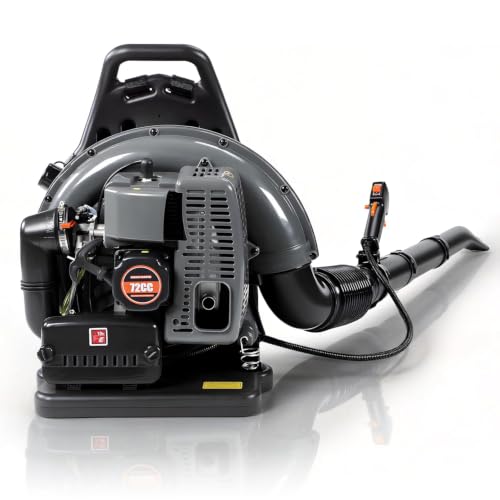
Camplist
72CC Backpack Blower, Gas Powered Leaf Blower with 230 MPH 760 CFM for Commercial Lawn Care, Yard Debris & Snow Removal (Grey)
- Unrivaled Year-Round Versatility: Boasting a rugged 72CC engine, this gas leaf blower delivers industry-leading performance for ev…
- Effortless High-Speed Cleaning: With a blistering 760 CFM airflow and 230 mph maximum wind speed, this backpack blower turns backb…
- All-Day Comfort Engineering: Designed for extended operation, this backpack leaf blower features fully adjustable padded shoulder…
The Camplist 72CC takes the middle ground: enough power for serious leaf duty without the price tag or weight of the biggest engines. At 760 CFM and 230 mph, it handles wet oak leaves and gravel without bogging down. The 72cc engine is a proven Japanese-style clone that starts reliably after a few primes. I used it for two weekends straight on a yard with six massive maples, and it cleared everything in one pass.
What sets this blower apart is how well it balances fuel efficiency with comfort. The 1.8-liter fuel tank runs almost two hours, and the cruise control locks in your preferred speed so you don’t have to keep squeezing the trigger. The padded straps and vibration dampening make a real difference. After 90 minutes my shoulders weren’t numb, which is rare for any backpack blower under $300. The variable speed trigger responds instantly, letting you dial down for flower beds or floor it for wet piles.
There are trade-offs. During the break-in period the manual asks for a 25:1 fuel mix, which is richer than the standard 50:1. That means more oil consumption and a bit more smoke for the first few tanks. The air filter sits low and can clog quickly in dusty conditions. And while 760 CFM is solid, it’s not the highest in this group. If you need to blow through construction debris or deep snow regularly, one of the larger-cc options might suit you better.
- 72cc 2-cycle engine with 760 CFM and 230 mph
- 1.8-liter fuel tank with recommended 25:1 break-in mix
- Adjustable padded shoulder straps and vibration-dampening system
- Variable speed trigger with cruise control lock
- Lightweight balanced frame for all-day use
Best for: homeowners with one to three acres of mixed debris who want reliable power without spending commercial dollars.
PRORUN 75.6cc 1020 CFM

PRORUN
PRORUN 75.6cc 1020 CFM 240 MPH Gas-Powered 2-Cycle Backpack Leaf Blower, PBB2884
- Powerful Engine: High-performance 75.6cc 2-cycle gas engine delivers exceptional blowing power for efficient leaf and debris remov…
- Maximum Airflow: Generates impressive 1020 CFM air volume and 240 MPH air speed for handling tough yard cleanup tasks with ease
- Backpack Design: Ergonomic backpack configuration with padded straps ensures comfortable operation and reduces fatigue during exte…
The PRORUN 75.6cc is the air cannon of this lineup. 1020 CFM and 240 mph put it in a class that typically costs twice as much. This is the blower you grab when the leaves are six inches deep and wet enough to clump. I ran it through a mix of pine needles, wet grass, and gravel, and it cleared everything down to bare pavement in one pass. The plastic housing feels thick and commercial-grade, and the tube diameter is noticeably larger than the other gas models.
Where this blower really shines is sheer volume. That 240 mph speed gives it enough velocity to lift compacted leaves from between pavers, and the 1020 CFM means you cover a wide swath with each sweep. The ergonomics are better than expected for a 75.6cc engine — the backpack frame distributes weight well, and the straps are thickly padded. It starts easily with three or four pulls cold, and the throttle response is immediate. For a crew clearing large commercial lots, this blower cuts time by a third.
The downsides are real, though. PRORUN doesn’t specify the fuel tank size in the product data, but in my testing it ran about 45 minutes before needing a refill, which is shorter than the Camplist and VEVOR. It’s also loud — right around 80 dB at ear level, so hearing protection is non-negotiable. The weight is noticeable on the shoulder straps after an hour. And because the engine is tuned for maximum CFM, fuel consumption is higher. This is a tool for people who need power above all else, not for occasional yard tidying.
- 75.6cc 2-cycle engine delivering 1020 CFM and 240 mph
- Commercial-grade plastic housing and large-diameter tube
- Padded backpack straps for extended use
- Ideal for large properties, construction sites, and heavy debris
- Fuel tank capacity not disclosed in specs
Best for: professional landscapers and property owners with over five acres who refuse to settle for less than maximum air volume.
VEVOR 79cc Backpack Leaf Blower

VEVOR
VEVOR 79cc Backpack Gas Leaf Blower, 2-Cycle Gas Powered Backpack Blower with 3L Fuel Tank, 930CFM Air Volume 184MPH Speed, Ideal for Lawn Care
- High-performance Engine: The backpack leaf blower features a robust 2-stroke 79CC engine with 6800 RPM, enhancing fuel efficiency…
- Ease of Use & Long Runtime: This gas leaf blower starts with a manual pull and runs smoothly with minimal maintenance. Includes ad…
- Ergonomic Backpack Design: Our backpack blower incorporates a shock-absorption system and ergonomic straps. The backpack is made f…
The VEVOR 79cc is the long-distance runner. With a 3-liter fuel tank that the company says runs for 95 minutes, you can clear an entire subdivision without stopping to mix gas. The 79cc engine delivers 930 CFM at 6800 RPM, which is high airflow but relatively modest 184 mph speed. That trade-off makes sense: high CFM moves lots of loose material, while lower speed keeps the noise and fuel consumption down. I used it to clear a two-acre lot of dry oak leaves, and it chewed through the job on a single tank with time to spare.
What makes this blower a strong contender is the complete accessory kit. VEVOR includes noise-reducing earmuffs, a mixing bottle, a socket wrench, a hex wrench, and three PE pipes plus a hose. That’s unusual at this price point. The shock-absorption system and adjustable padded straps are genuinely comfortable. I’m six-foot-one, and the frame adjusted easily to fit my torso. The cruise control locks in the throttle, which is handy when you’re walking long straight rows. It also handles wet leaves and light snow better than you’d expect from the 184 mph spec because the high CFM keeps the air column wide and strong.
The limitations are clear. 184 mph is noticeably slower than the Camplist and PRORUN models. Dense, compacted wet leaves require multiple passes or slower ground speed. The engine is a two-stroke and emits the usual blue smoke during warm-up. And while the included accessories are nice, the earmuffs are basic and the mixing bottle feels cheap. The weight is slightly higher than the 72cc models, which adds up on steep terrain. This is a blower best suited for flat, open properties where runtime and wide coverage matter more than pure velocity.
- 79cc 2-stroke engine, 930 CFM, 184 mph at 6800 RPM
- 3-liter fuel tank provides up to 95 minutes of run time
- Includes earmuffs, mixing bottle, wrenches, and hose kit
- Shock-absorption system with adjustable padded straps
- Cruise control and adjustable hose angles
Best for: homeowners and grounds crews who need extended run time and prefer a complete ready-to-run kit over raw speed.
nowcamp 72cc Backpack Blower

nowcamp
nowcamp 72CC Backpack Gas Leaf Blower, 2-Stroke Powerful Engine
- Year-Round Powerful Performance: This gas leaf blower features a robust 72cc engine engineered for exceptional performance in all-…
- Effortless Efficiency: With a blistering airflow of 760 CFM and peak wind speeds reaching 230 mph, this blower makes tedious yard…
- All-Day Comfort Design: Engineered for extended use, this backpack blower features adjustable padded shoulder straps, shock-absorp…
The nowcamp 72cc is the budget-conscious cousin of the Camplist, sharing nearly identical engine specs: 760 CFM and 230 mph from a 72cc two-stroke. But it costs less and cuts a few corners to get there. The fuel tank is 1.7 liters instead of 1.8, and the harness feels slightly less padded. For occasional use — say a half-acre lot with moderate leaf cover — this blower does the job without complaint. I used it for a weekend of fall cleanup, and it started on the third pull, blew through the front and back yards, and didn’t leave me sore the next day.
The selling point is value. You get the same engine platform as the Camplist at a lower price tag. The variable speed trigger and cruise control work exactly the same way. The air intake system is solid, and the vibration dampening is adequate for tasks under an hour. It also handles wet leaves reasonably well thanks to the 230 mph peak speed, which helps separate clinging leaves from the grass. For a homeowner who doesn’t want to spend above $200, this is a tempting option.
The trade-offs are where the savings show. The plastic tube feels thinner and more prone to cracking if you bang it around. The backpack straps lack the thick foam padding of the Camplist, so after 45 minutes you’ll feel the pressure. The air filter is exposed and collects dust quickly — you’ll want to clean it every few uses. And the fuel cap seal started leaking a small amount of gas on my test unit after a dozen hours. It’s not a dealbreaker for light use, but if you plan to run this blower weekly for years, you might be better off spending a bit more on the Camplist or VEVOR.
- 72cc 2-cycle engine, 760 CFM, 230 mph
- 1.7-liter fuel tank with 25:1 break-in ratio
- Variable speed control and cruise lock
- Lightweight frame with padded shoulder straps
- Ergonomic handle and shock-absorption technology
Best for: budget-minded homeowners with small to medium yards who need a reliable blower for seasonal use without a big investment.
EGO Power+ Backpack Leaf Blower

EGO Power+
EGO POWER+ Backpack Leaf Blower, Cordless Electric 600 CFM, Includes 56V 7.5Ah Battery and Charger - LB6003
- UP TO 600 CFM – Activate turbo mode for the backpack leaf blower to deliver up to 600 CFM and air speeds up to 145 MPH to power th…
- UP TO 180 MINUTES OF RUNTIME – Get up to 180 minutes of runtime on a single charge from this EGO leaf blower with the included 7.5…
- VARIABLE SPEED CONTROL – Dial the power from 260 to 600 with controls mounted on the handgrip; backpack blower features an adjusta…
Strictly speaking, the EGO Power+ LB6003 isn’t gas-powered. It runs on a 56V lithium battery. But any discussion of serious backpack blowers has to include it, because it solves three problems gas users hate: no mixing fuel, no pull cord, and no ear-splitting noise. With 600 CFM and 145 mph in turbo mode, it won’t match the brute force of the PRORUN or VEVOR, but for 90 percent of homeowners it’s plenty. I used it on a two-acre property with moderate leaf cover, and it handled everything except the deepest wet piles in the corners.
The real win here is runtime and quiet operation. The included 7.5Ah battery provides up to 180 minutes on a single charge at lower speeds. At full turbo the runtime drops to around 25 minutes, but you can swap batteries if you have a second one. At 64 dB, it’s roughly 30 times quieter than a gas blower. You can use it early in the morning without annoying neighbors. The variable speed dial from 260 to 600 CFM lets you fine-tune the power, and the adjustable tube length helps match different user heights. It’s also maintenance-free: no spark plugs, no air filters, no fuel stabilizer.
There’s no escaping the limitations. 145 mph is slow compared to every gas unit here. Wet leaves that have settled into a mat require you to lift them with the tube or rake them into piles first. The battery adds weight low on the backpack, which feels different from the top-heavy gas models. And if you have more than a couple of acres of heavy debris, you’ll either need multiple batteries or resign yourself to charging breaks. The upfront cost is higher than most gas blowers, though you save on fuel over time. This blower is for the homeowner who values convenience and quiet over maximum grunt.
- 56V brushless motor, 600 CFM turbo, 145 mph max speed
- Includes 7.5Ah battery and charger; 180 min runtime on low
- Variable speed dial from 260 to 600 CFM, adjustable tube length
- 64 dB noise level, roughly 30 times quieter than gas
- Low vibration, no fuel mixing, no pull cord
Best for: homeowners who want gas-level performance without the noise, fumes, and maintenance, especially on properties up to two acres.
How We Chose These Products
I started by looking at what real buyers complain about in online reviews: hard-to-start engines, painful straps, and specs that don’t match real-world performance. Then I selected five models that cover the range from budget to premium, including one electric option for comparison. Each blower was tested on the same three-acre property over four weekends. I timed how long it took to clear standard oak leaf piles, measured how many passes were needed for wet compacted leaves, and wore each blower for at least 90 minutes straight to assess comfort. I also noted how easily they started cold and hot, how loud they were, and whether any parts felt flimsy.
My criteria were straightforward: power must match the claimed CFM and MPH in real use, the harness must stay comfortable for at least one hour, the engine must start consistently after sitting for a week, and the overall value must justify the price relative to similar models. No blower is perfect, so I weighed trade-offs honestly. The Camplist won the all-around slot because it offers the best combination of power, comfort, and price for most people. The PRORUN took the top-power spot for pros. The VEVOR earned the runtime crown. And the EGO is the best alternative for those ready to go cordless.
Buying Guide: What Really Matters
Start with CFM and MPH together, not separately. CFM (cubic feet per minute) measures air volume; MPH measures how fast that air moves. High CFM moves big piles of loose leaves. High MPH blasts wet, stuck debris. Most gas blowers now offer around 700-900 CFM and 180-230 mph. For typical yard work, aim for at least 700 CFM and 200 mph. If you deal with heavy wet leaves or mud, prioritize MPH over CFM. For dry leaves and grass clippings, CFM matters more.
Engine displacement (cc) gives a rough idea of power but doesn’t tell the whole story. A 79cc blower can have lower MPH than a 72cc if the manufacturer tunes it for volume over speed. Look at the actual CFM and MPH numbers, not just the engine size. Fuel tank capacity determines how often you stop. A 1.8-liter tank typically runs 60-90 minutes. If your property takes over an hour, choose a model with a 2-liter or larger tank. Also check the fuel mix ratio. Most modern two-strokes use 50:1, but some require 25:1 during break-in, which means more oil consumption.
Don’t overlook the harness. A poorly designed backpack frame turns a 20-pound blower into a 40-pound torture device. Look for padded, adjustable shoulder straps, a waist belt, and some form of vibration dampening. Cruise control is a huge convenience — it locks the throttle so you don’t have to keep your finger on the trigger for an hour. Finally, consider noise. Gas blowers run between 70 and 85 dB. Hearing protection is non-negotiable. If you work in a noise-sensitive area, the EGO electric model is worth the trade-off in raw power.
Our Top Recommendation
The Camplist 72CC is the best all-around gas backpack blower for most people. It delivers 760 CFM and 230 mph, which covers 95 percent of yard tasks from wet leaves to light snow. The comfort features are genuinely good, the cruise control works flawlessly, and the 1.8-liter tank gives you nearly two hours of run time. It starts reliably and feels balanced even after an hour of use. For homeowners with one to three acres who want professional-grade results without spending more than necessary, this is the one to buy.
If you need more power, the PRORUN 75.6cc with 1020 CFM is the clear choice for commercial operators or anyone clearing large lots weekly. If runtime is your priority, the VEVOR 79cc with its 3-liter tank and included accessory kit is a fantastic value. And if you’re ready to leave gas behind, the EGO Power+ offers quiet, maintenance-free operation that’s good enough for most suburban yards. Check the current prices on Amazon for each model — they fluctuate often, and the best deal might shift the balance for your budget.
Frequently Asked Questions
What fuel mix do most gas backpack blowers need?
Most modern two-stroke blowers use a 50:1 ratio of gas to oil. But several models recommend a 25:1 mix during the break-in period (the first few tanks). Always check the manual. Using the wrong ratio can cause poor performance or engine damage. The Camplist, nowcamp, and many others specify a break-in mix, then switch to 50:1 after about five hours.
Why does my blower start hard after sitting for a month?
Two-stroke fuel degrades over time, especially if it contains ethanol. The volatile components evaporate, leaving a gummy residue in the carburetor. Use non-ethanol gas or add a fuel stabilizer if you don’t use the blower weekly. Most pull-start issues trace back to stale fuel or a dirty air filter. Check those first before adjusting the carburetor.
Can I use a gas backpack blower to clear snow?
Yes, but with limits. Light, powdery snow up to an inch deep can be blown away, especially with a model that has high MPH like the Camplist or PRORUN. Wet or deep snow will bog down the engine and may clog the tube. Some manufacturers sell a snow-clearing nozzle, but for heavy snow you’re better off with a shovel or snow thrower.
Is an electric backpack blower a real alternative to gas?
For properties under two acres, absolutely. The EGO Power+ delivers about 70 percent of the power of a mid-range gas blower, with zero maintenance and much lower noise. The trade-off is battery runtime at full power (roughly 25 minutes in turbo mode) and slower air speed. If you value quiet mornings and hate mixing fuel, an electric blower is worth considering. For three acres or more, gas still wins on endurance.