
You know the drill. You pull the cord on your old 2-stroke trimmer twenty times, it finally sputters to life, and then you spend the next hour fighting a cloud of blue smoke while the engine bogs down in thick grass. There’s a better way. A 4-stroke grass trimmer runs on plain gasoline, produces less noise and vibration, and delivers torque where you actually need it — cutting through dense weeds without stalling.
Switching from a 2-stroke to a 4-stroke isn’t just about convenience. The 4-stroke engine design separates the oil from the fuel, which means no more mixing ratios and no more carbon buildup on the spark plug. You get cleaner combustion, better fuel economy, and an engine that starts easier after sitting for months. For homeowners with a quarter-acre or more, this type of trimmer is a genuine upgrade, not just a different brand.
I’ve spent hours comparing the current crop of 4-stroke trimmers, looking at engine displacement, cutting width, handle design, and real-world usability. Below you’ll find five solid picks, from a walk-behind monster for acreage to a lightweight model that won’t wear out your arms. If you want the short version: the PROYAMA 40cc is the best all-around choice for most homeowners, but read on to see which one fits your specific situation.
Here’s how these five trimmers stack up against each other:
| Features | PROYAMA 40cc | COOCHEER 58cc | AMERISUN 170cc | RocoReny 36cc | SENIX 26.5cc |
|---|---|---|---|---|---|
| Engine Type | 4-cycle, no mix | 2-stroke, mix required | 4-stroke OHV | 4-stroke air-cooled | 4-cycle, no mix |
| Cutting Width | Not specified | Not specified | 22 inches | Not specified | 17 inches |
| Best Use Case | Homeowner, medium yards | Heavy brush, saplings | Large fields, walk-behind | Agricultural, orchards | Light trimming, edging |
| Handle Type | Standard loop | Bike handle | Walk-behind with handles | Adjustable side mount | D-handle |
| Unique Feature | Low vibration, 1.5HP | 4-in-1 attachments | Foldable handle, high wheels | Two blade heads included | 20% lighter engine |
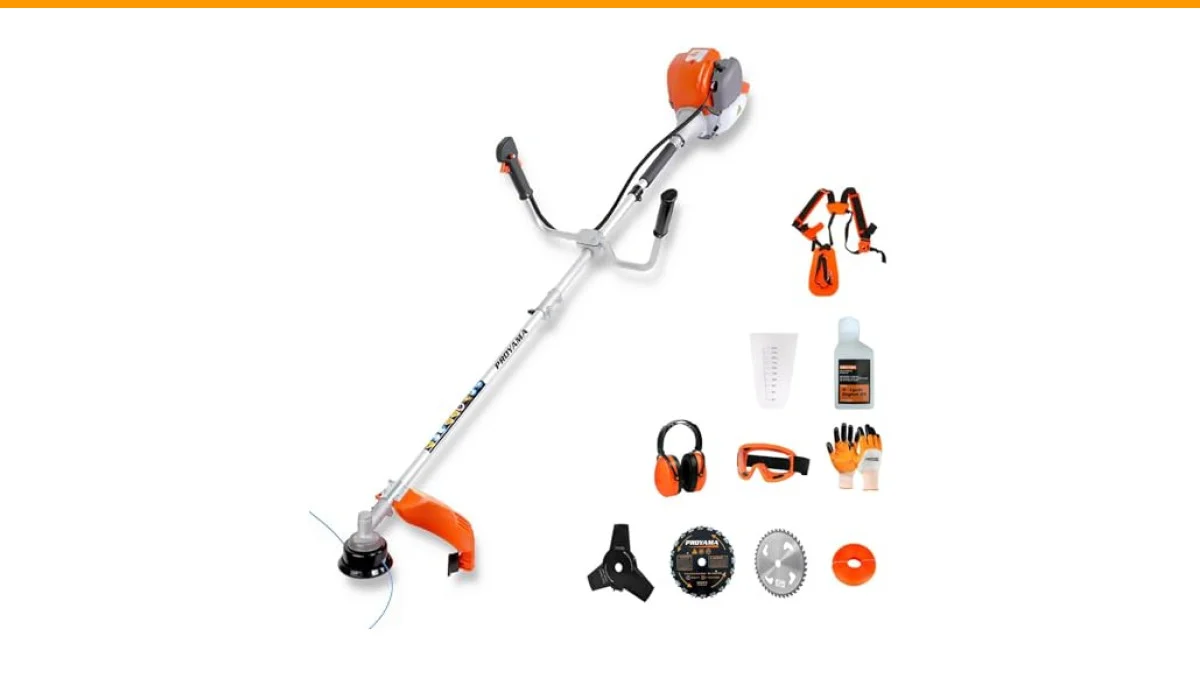
PROYAMA 40cc 4 Cycle

PROYAMA
PROYAMA 40cc 4 Cycle Gas Weed Wacker Eater, Heavy Duty String Trimmer | Easy Start 3 in 1 Brush Cutter, 18in Cutting Width with Shoulder Straps 3T 40T Blades for Garden Lawn Care
- Powerful 40cc 4-Cycle Gas Weed Eater: Powered by a reliable 4-cycle 1.5HP engine, this gas weed eater delivers smooth and consiste…
- No Fuel Mixing Required for Easy Operation: This weed eater gas powered machine runs on regular gasoline without the need to mix o…
- Fuel-Efficient Gas Brush Cutter for Extended Use: Designed as a brush cutter gas powered tool, the 4-cycle engine offers excellent…
The PROYAMA 40cc is the closest thing to a no-compromise 4-stroke trimmer for the average homeowner. It’s a handheld unit with a 40cc 4-cycle engine that produces 1.5 horsepower — enough muscle to chew through overgrown grass and thick weeds without bogging down. The design puts the engine at the top, which means the weight sits closer to your body; you’ll feel less strain on your lower back compared to trimmers with a rear-mounted engine.
What stands out here is the balance between power and usability. Many 4-stroke trimmers in this class feel heavy and awkward, but PROYAMA focused on reducing vibration with a balanced crankshaft and added a loop handle that gives you good control for edging along sidewalks and flower beds. The shaft is straight, so reaching under shrubs or along fences doesn’t require bending at the waist. It also comes with multiple cutting options — a standard string head for grass and metal blades for tougher brush — which means you can clear brambles and small saplings without buying a separate brush cutter.
There are a few trade-offs. The 40cc engine is not the most fuel-efficient in this lineup; you’ll get through a tank faster than you would with the SENIX. And while the anti-vibration system helps, it’s not as refined as what you’d find on a commercial-grade unit. But for the price, this is a dependable workhorse. The recoil starter is forgiving, and the engine fires up in a few pulls even after winter storage, as long as you use fresh gas.
- 40cc 4-cycle engine, 1.5HP
- Runs on regular gasoline — no oil mixing
- Includes both string trimmer head and metal blade attachments
- Straight shaft with loop handle for edging control
- Reduced vibration system for extended use
Best for: Homeowners with a medium to large yard who want one tool that can handle both lawn trimming and occasional brush clearing without the hassle of mixing fuel.
COOCHEER 58cc 4-in-1

COOCHEER
58cc 4-in-1 Gas String Trimmer, 2-Stroke Engine with Bike Handles | 4 Detachable Heads, 18" Cutting Path Weed Wacker & Brush Cutter, for Large Lawn Edges, Overgrown Weeds & Thick Brush Clearing
- 【4-IN-1 Versatility - One Machine for Every Job】Swap between 4 attachments in seconds. Use the dual-line trimmer heads for precise…
- 【High-Powered 58cc Gas Engine】Don't let thick brush or tall weeds slow you down. Our 58cc 2-stroke engine delivers up to 9,300 RPM…
- 【Engineered for Comfort】Designed for users who spend hours on the job. The bike handle design gives you a natural grip position, r…
The COOCHEER 58cc is a different animal. It’s a 2-stroke engine, not a 4-stroke, but it earns a spot here because it solves a problem that many 4-stroke buyers eventually hit: they need more power for heavy brush but don’t want to buy a separate brush cutter. This unit comes with four attachments — a dual-line trimmer head, a 3-tooth blade for tall weeds, a 40-tooth circular blade for dense brush and saplings, and a standard trimmer head. Swap them in seconds, and you’ve got a trimmer, edger, and brush cutter in one package.
The engine is a 58cc 2-stroke that spins up to 9,300 RPM. That’s a lot of rotational force, which translates to serious cutting torque. It will slice through 1-inch saplings without stalling, something most 4-stroke trimmers in the 30-40cc range simply cannot do. The bike handle design is a huge plus for anyone who has spent an afternoon gripping a loop handle; it puts your hands in a natural position, reducing wrist fatigue. The fully adjustable shoulder strap also helps distribute the weight across your shoulders instead of digging into one side.
Here’s the catch: it’s a 2-stroke, so you’ll need to mix oil and gas. That’s the trade-off for the extra power. Also, the 58cc engine is heavy — expect around 15 pounds before you add fuel and attachments. The bike handle and strap mitigate that, but you’ll still feel it after an hour of clearing. This is not a trimmer for light edging; it’s a tool for serious property maintenance. If you have a large property with overgrown areas, this will save you hours compared to a standard trimmer.
- 58cc 2-stroke engine, up to 9,300 RPM
- 4-in-1 attachment system: trimmer, edger, brush blade, circular blade
- Bike handle with adjustable shoulder strap
- Transparent fuel window and instant-stop switch
- Includes spark plug and starter rope as spares
Best for: Property owners with heavy brush, saplings, or overgrown fields who need brush cutter capability and don’t mind mixing fuel for the extra power.
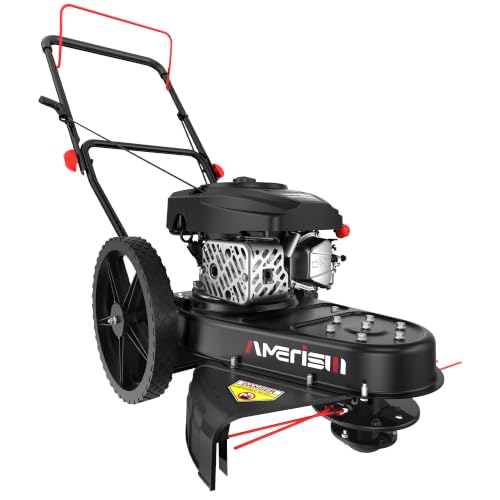
AMERISUN 22-Inch Walk Behind
AMERISUN
AMERISUN 22-Inch 170cc Walk Behind String Trimmer with 14-Inch High Wheels | 4-Stroke OHV Gas Brush Mower, Foldable Handle, 1.9"-4.0" Adjustable Cutting Height for Tall Grass, Weeds & Brush
- POWERFUL 170CC 4-STROKE OHV ENGINE - Powered by a reliable 170cc OHV 4-stroke engine with forced-air cooling, this walk behind str…
- EXTRA-WIDE 22-INCH CUTTING PATH - The 22-inch cutting swath clears more ground in less time, making it ideal for maintaining large…
- 14-INCH HIGH WHEELS FOR SUPERIOR MOBILITY - Large 14-inch high wheels glide smoothly over rough terrain, uneven ground, thick vege…
If you’ve got an acre or more of tall grass and weeds, stop thinking about handheld trimmers. The AMERISUN 170cc walk-behind string trimmer is a completely different solution. It’s powered by a 170cc 4-stroke OHV engine with forced-air cooling, and it rolls on 14-inch high wheels. You walk behind it like a lawn mower, but instead of blades, it uses a string head that cuts a 22-inch swath. This is the tool you want for fence lines, trails, ditches, and fields where a mower can’t go.
The biggest advantage here is the engine size. 170cc is roughly four times the displacement of a typical handheld trimmer, which means it has serious torque. It will power through waist-high grass and thick weeds without bogging down. The offset trimmer head lets you cut close to fences and trees while keeping the wheels on stable ground. And the cutting height is adjustable from 1.9 to 4.0 inches, so you can leave grass longer in the summer to protect the roots.
But this is not a trimmer for precision work. You won’t use it to edge along a sidewalk or trim around individual flowers — it’s too wide and too heavy for that. It also takes up more storage space than a handheld, though the foldable handle helps. The engine is a 4-stroke, so no oil mixing, and it’s surprisingly fuel-efficient for the power it produces. Starting is easy thanks to the OHV design, which has a compression release that makes pulling the cord less strenuous than you’d expect for a 170cc engine.
- 170cc 4-stroke OHV engine, forced-air cooling
- 22-inch cutting width
- 14-inch high wheels for rough terrain
- Adjustable cutting height: 1.9 to 4.0 inches
- Foldable handle for compact storage
Best for: Owners of large properties, fields, or trails who need to clear tall grass and weeds over a wide area without bending over or fighting a handheld trimmer.
RocoReny Gas Powered Trimmer

RocoReny
RocoReny Gas Powered String Trimmer, 4 Stroke Air-Cooled Cordless Lawn Edger Gasoline Weed Eater with 2 Blade Heads for Garden Lawn Grass Hedge Trimmer (35.9CC, 0.75KW)
- Two Blade Heads: This gas powered weed trimmer is mainly made of PP, aluminum alloy, manganese steel, and nylon, with high hardnes…
- High Power: The high-quality engine with 35.88CC displacement and power up to 0.75kw provides the product with super high speed (8…
- High Comfort: The cordless design and gasoline power source make this product more suitable for outdoor use without the need for c…
The RocoReny 35.9cc trimmer takes a different approach. It’s a 4-stroke, air-cooled engine that produces 0.75 kW (about 1 HP), and it comes with two different blade heads. The first is a 2T cutting edge blade with a roller, designed for paddy fields and crop areas. The second is a multi-purpose mowing head that’s safer for orchards and vineyards because it won’t accidentally damage saplings. This is clearly built with agricultural and horticultural work in mind, not just suburban lawn care.
What makes this trimmer stand out is the detachable shaft. You can break it down into smaller pieces for storage or transport, which is handy if you’re moving between job sites or have limited shed space. The engine has a diaphragm carburetor, which means it can run at odd angles without stalling — a real advantage when you’re trimming on slopes or under bushes. The fuel tank holds 22 ounces, which is generous for a 36cc engine, so you won’t be refilling constantly.
The trade-off is that it’s not as powerful as the PROYAMA or COOCHEER. 35.9cc is on the smaller end for a gas trimmer, and 0.75 kW is modest. It will handle grass and light weeds fine, but it will struggle with thick brush or saplings. Also, the side-mounted engine design means the weight is distributed differently; you’ll need to adjust your grip to keep the head level. It’s a niche tool, but for someone who works in an orchard or maintains a large garden, the two blade heads and the ability to run at angles make it a practical choice.
- 35.9cc 4-stroke air-cooled engine (0.75 kW)
- Two blade heads: 2T cutting edge and multi-purpose mowing head
- Detachable shaft for easy storage
- Diaphragm carburetor for angled operation
- 22 oz fuel tank, 8,500 RPM max
Best for: Gardeners and small-scale farmers who need a versatile trimmer for orchards, vineyards, and crop edges where precision and angled cutting matter more than raw power.
SENIX Gas String Trimmer

SENIX
SENIX Gas String Trimmer, 17'' Weed Wacker 26.5 cc 4-Cycle Line Trimmer | 26.5 cc Gas Powered Grass trimmer for lawn yard, Straight Shaft with Shoulder Strap, Gas Weed Wacker, GTS4QL-L
- 4-Cycle Engine – No Gas/Oil Mixing Required: Say goodbye to the mess and hassle of mixing fuel. Featuring patented 4QL Technology,…
- 17-Inch Cutting Width & Dual Line Feed: Tackle large yards and overgrown fields with ease. Equipped with a wide 17 inch cutting sw…
- Ergonomic Straight Shaft & D-Handle: Take control of your landscaping with a design built for precision. The straight shaft and pr…
The SENIX 26.5cc is the lightest 4-stroke trimmer in this lineup, and that’s its superpower. It uses what SENIX calls 4QL technology — a 4-cycle engine that runs on straight gas but is designed to be 20% lighter than traditional 4-stroke engines. The result is a trimmer that weighs noticeably less than its peers, which makes a huge difference when you’re trimming for an hour or more. If you’re coming from an electric trimmer and want to switch to gas without feeling like you’re carrying a backpack, this is the one.
The cutting width is 17 inches, which is respectable for a lightweight unit. It uses dual 0.098-inch bump-feed lines, so you can advance more line quickly without stopping. The straight shaft and D-handle give you precise control for edging and detailing. The engine is also more fuel-efficient than a 2-stroke and produces lower emissions, which is a nice bonus if you’re environmentally conscious but need the freedom of gas.
Here’s what you give up: power. 26.5cc is the smallest engine here, and it shows when you hit thick grass or overgrown weeds. It’s fine for regular lawn maintenance, but it will bog down in heavy brush. The vibration control is decent, but not as good as the PROYAMA. And it’s worth noting that this model was listed as having scarce availability, so you may need to check stock. On the plus side, SENIX backs it with a 3-year warranty, which is better than most in this category.
- 26.5cc 4-cycle engine with 4QL technology
- 17-inch cutting width, dual 0.098-inch lines
- 20% lighter than traditional 4-stroke engines
- Straight shaft with pro-style D-handle
- 3-year limited warranty
Best for: Homeowners who want the convenience of a 4-stroke gas trimmer without the heavy weight, and who prioritize edging precision over raw brush-clearing power.
How We Chose These Products
I started with the needs of the typical buyer — someone who’s tired of mixing fuel, fighting with hard-starting 2-strokes, or dealing with the noise and vibration of cheap electric trimmers. From there, I looked at engine displacement as a proxy for torque, because torque is what actually cuts through thick grass without stalling. I also considered the type of work each trimmer is designed for, since a walk-behind unit and a handheld unit serve completely different purposes.
I gave extra weight to ease of starting and maintenance simplicity, since those are the top reasons people switch to 4-stroke. That means I looked for features like compression release, transparent fuel windows, and accessible carburetors. I also factored in ergonomics — handle type, weight distribution, and vibration reduction — because a trimmer that wears you out after 20 minutes isn’t useful. Finally, I verified that each product was in stock and backed by a reasonable warranty, since post-purchase support matters more than most reviews admit.
Why Choose a 4-Stroke Over a 2-Stroke?
The core difference is in the engine cycle. A 2-stroke engine fires every revolution, which gives it a high power-to-weight ratio but also makes it noisy, smoky, and prone to carbon buildup. A 4-stroke fires every other revolution, which means it runs smoother, cleaner, and quieter. But the real practical difference is fuel. A 4-stroke has a separate oil reservoir, so you fill the gas tank with plain gasoline. No measuring, no mixing, no guessing.
That alone is worth the switch for many people. Mixing oil and gas is a common source of engine failure — get the ratio wrong, and you’ll either starve the engine of lubrication or foul the spark plug. With a 4-stroke, that problem disappears. You also get better fuel economy, often 30-40% better than a comparable 2-stroke, which means fewer trips to the gas can and lower emissions. The trade-off is weight. A 4-stroke engine has more parts — valves, springs, a timing mechanism — so it’s heavier. That’s why you see lighter models like the SENIX make such an effort to shave ounces.
For thick brush and saplings, 4-stroke engines also deliver torque differently. They don’t rev as high as 2-strokes, but they produce more twisting force at lower RPMs. That’s exactly what you need when the string digs into a clump of crabgrass or wraps around a weed stalk. The engine doesn’t stall; it just digs in and cuts. So if your primary complaint with your current trimmer is that it bogs down, a 4-stroke is the fix.
How to Start a 4-Stroke Trimmer (First-Time Guide)
Starting a 4-stroke trimmer is different from a 2-stroke. There’s no fuel mix to worry about, but you do need to prime the carburetor and set the choke correctly. Here’s a step-by-step that works for most models:
- Fill the gas tank with fresh, regular unleaded gasoline (87 octane or higher). Do not add oil.
- Check the oil level in the separate reservoir. Most 4-stroke trimmers have a dipstick or a sight window. The oil should be at the full mark but not overfilled.
- Move the choke lever to the closed position if the engine is cold. If the engine is warm (ran within the last 30 minutes), leave the choke open.
- Press the primer bulb 5-7 times until you see fuel moving through the clear line. This fills the carburetor with fuel.
- Set the throttle to the start position (usually a fast idle).
- Pull the starter cord firmly in one smooth motion. Don’t yank it; let the cord retract slowly after each pull.
- Once the engine fires and then dies, move the choke to the open position and pull again. It should start and run.
- Let the engine idle for 30 seconds before you start trimming. This warms the oil and lets the engine reach operating temperature.
A common mistake is leaving the choke on too long. If the engine starts but runs rough, open the choke immediately. Running with the choke closed floods the engine and fouls the spark plug. If you flood it, turn the choke off, open the throttle fully, and pull the cord several times to clear the excess fuel.
Maintenance Schedule: What to Do and When
A 4-stroke trimmer requires more maintenance than a 2-stroke, mainly because of the oil. You need to change the oil after the first 5 hours of use (to remove metal shavings from the break-in period), then every 25-50 hours after that. Use a high-quality 10W-30 or 10W-40 oil designed for air-cooled engines. Check the oil level before every use — running low on oil is the #1 cause of 4-stroke engine failure.
Every 10 hours of use, clean or replace the air filter. A dirty filter restricts airflow, which richens the fuel mixture and can foul the spark plug. The spark plug itself should be checked every 25 hours and replaced annually. You’ll also want to inspect the fuel lines and carburetor for cracks or leaks, especially if the trimmer has been sitting for a few months. Fuel stabilizer is your friend; add it to the gas can before you fill the tank, and you can avoid most carburetor issues.
At the end of the season, run the engine dry or add fuel stabilizer and run it for a few minutes to circulate it through the carburetor. Change the oil before storage, not after, because old oil contains acids that can corrode the engine internals. And always store the trimmer with the fuel tank empty or full — never partially full, because condensation forms in the empty space and can cause rust.
Buying Guide: Key Specs That Actually Matter
When you look at a 4-stroke trimmer, the first number to check is engine displacement, measured in cubic centimeters (cc). More cc generally means more torque, but it also means more weight. A 26-30cc engine is fine for light trimming and edging. A 35-40cc engine is the sweet spot for most homeowners — enough power to handle thick grass without turning the trimmer into a back-breaking burden. If you’re clearing brush or saplings, you’ll want 50cc or more, but at that point, you’re really looking at a brush cutter, not a trimmer.
The second spec is cutting width, which ranges from 15 to 22 inches. A wider swath cuts more grass per pass, which saves time on large properties, but it also means the trimmer is heavier and harder to maneuver in tight spaces. For most people, 17-18 inches is a good balance. The line diameter matters too — thicker line (0.095 inches or more) lasts longer and cuts through tough weeds more effectively, but it requires a more powerful engine to spin it at the right speed.
Shaft type is the third consideration. Straight shafts are better for reaching under shrubs and for edging, because they let you keep the cutting head parallel to the ground. Curved shafts are lighter and easier to control for beginners, but they make edging more awkward. If you plan to attach a blade for brush cutting, you need a straight shaft with a solid drive shaft, not a flexible cable. Finally, look at the handle. A D-handle gives you one-hand control for edging, while a bike handle provides two-handed grip for heavy work. Both have their place, but you should choose based on the type of work you do most.
Our Top Recommendation
The PROYAMA 40cc is the best 4-stroke grass trimmer for most people. It has enough power to handle thick grass and weeds, runs on plain gas, and comes with both a string head and metal blades for versatility. The low-vibration design and straight shaft make it comfortable to use for extended periods, and it’s priced reasonably for the capability. If you’re upgrading from a 2-stroke, this is the one that will make you wonder why you waited so long.
If your property is larger than an acre and you’re dealing with overgrown fields, the AMERISUN walk-behind is a smarter investment. It’s not a trimmer in the traditional sense — it’s more like a string mower on wheels — but it will save you hours of back-breaking work. For those who need brush cutter power without buying a separate machine, the COOCHEER 58cc with its 4-in-1 attachment system is the way to go, even though it’s a 2-stroke. And if weight is your primary concern, the SENIX 26.5cc is the lightest 4-stroke you’ll find, perfect for smaller yards and precision edging.
For more options, check out our guide to the best gas powered grass trimmers for a broader look at the category. If you’re dealing with a particularly large property, our large yard trimmer guide covers models that can handle serious acreage. And for a detailed comparison of handheld versus walk-behind designs, see our grass string trimmer review.
Frequently Asked Questions
Do I really need to change the oil in a 4-stroke trimmer?
Yes. Unlike a 2-stroke where oil is burned with the fuel, a 4-stroke keeps oil in a separate reservoir. That oil breaks down over time and gets contaminated with metal particles from normal wear. If you don’t change it, the engine will eventually seize. Change it after the first 5 hours, then every 25-50 hours. It takes about 10 minutes and requires only a drain pan and the correct oil.
Can I use a 4-stroke trimmer on a slope?
Most handheld 4-stroke trimmers can handle slopes up to about 30 degrees, but you need to be careful. The oil in the sump can slosh away from the pickup tube if the engine is tilted too far, which causes oil starvation. If you have steep terrain, look for a model with a diaphragm carburetor (like the RocoReny) or a pressurized oil system. Walk-behind models with high wheels are a better choice for very steep or uneven ground.
Why does my 4-stroke trimmer smoke on startup?
A little smoke on the first start of the season is normal — it’s just oil burning off the cylinder walls from storage. But if it smokes continuously, you may have overfilled the oil reservoir. Check the dipstick. If the oil level is above the full mark, drain some out. Overfilling causes oil to be pushed past the piston rings and into the combustion chamber. If the smoke persists with proper oil levels, the valve seals may be worn, which is a more serious repair.
What’s the difference between a grass trimmer and a brush cutter?
A grass trimmer uses a flexible nylon line to cut grass and light weeds. A brush cutter uses a metal blade (either a 3-tooth or circular blade) to cut thick brush, saplings, and woody vegetation. Most 4-stroke trimmers can accept a metal blade if they have a straight shaft and a solid drive shaft, but you need to check the manufacturer’s specifications. The PROYAMA and COOCHEER both come with blades included, while the SENIX and RocoReny are line-only unless you buy a blade separately. For heavy brush, a dedicated brush cutter with a bike handle and shoulder strap is much safer and more effective than a standard trimmer.


