
You spent months building your greenhouse. The plants are in, the soil is prepped. Then the forecast shows a hard freeze. Your first instinct is to grab any heater you can find. But a quick search reveals dozens of propane heaters, some marked ‘indoor safe,’ others ‘outdoor only,’ and the safety warnings sound scary. Picking the wrong one could kill your plants or worse.
The good news is that unvented propane heaters work well in greenhouses when you pick the right size and follow basic safety steps. They produce heat directly without a flue, which means nearly all the energy goes into warming your space. But you need to pay attention to BTU output, oxygen depletion sensors, and whether the unit is rated for enclosed areas. Not every propane heater belongs inside a greenhouse.
We looked at five models from Mr. Heater, a brand that makes more propane heaters than just about anyone else. These cover everything from a tiny 3,800 BTU unit for a seedling tray up to a 60,000 BTU forced-air machine for a commercial greenhouse. Here is what you need to know before you buy.
Here is a quick look at how these five heaters compare at a glance:
| Features | Mr. Heater 18K | Mr. Heater 9K | Mr. Heater 3.8K | Mr. Heater 540-D | Mr. Heater 60K |
|---|---|---|---|---|---|
| BTU Output | 18,000 BTU | 4,000/9,000 BTU | 3,800 BTU | 30-45,000 BTU | 30-60,000 BTU |
| Max Coverage Sq Ft | 700 sq ft | 225 sq ft | 95 sq ft | Outdoor use only | 1,500 sq ft |
| Ignition Type | Electronic | Piezo (manual) | One-button | Manual (regulator) | Continuous spark |
| Key Safety Feature | Built-in thermostat | Low oxygen shutdown | None specified | Tip-over shut-off | Continuous ignition |
Mr. Heater 18,000 BTU Vent-Free

Mr. Heater
Mr. Heater 18,000 BTU Vent Free Radiant Propane Heater
- 18,000 BTU/HR
- Heats up to 700 sq. ft.
- Electronic Ignition
This is the heater most greenhouse owners end up buying. The 18,000 BTU vent-free model covers up to 700 square feet, which matches the size of a typical backyard greenhouse. It uses an electronic ignition and comes with a built-in thermostat, so you set a temperature and forget it. No power outlet needed — it runs entirely on propane.
What stands out is the thermostat. Most radiant heaters lack one, meaning you have to manually adjust the gas valve all day. The 18,000 BTU model automatically cycles on and off to hold your chosen temperature. That saves propane and keeps your plants from cooking when the sun comes out. The heat output is enough to keep most greenhouses above freezing even on a 20°F night.
There is a trade-off: this heater is vent-free, which means combustion gases stay in the room. Carbon dioxide and water vapor build up. For a greenhouse, that is actually less of a problem than in a house — plants need CO2 and extra humidity can help. But you still need to crack a vent or leave a door slightly open to maintain fresh air. Also, the thermostat dial is basic; don’t expect digital precision.
- 18,000 BTU per hour
- Covers up to 700 square feet
- Electronic ignition, no electricity needed
- Built-in thermostat for auto control
- Approved for indoor use (with ventilation)
Best for: medium greenhouses where you want temperature control without running power.
Mr. Heater 9,000 BTU Portable
Mr. Heater
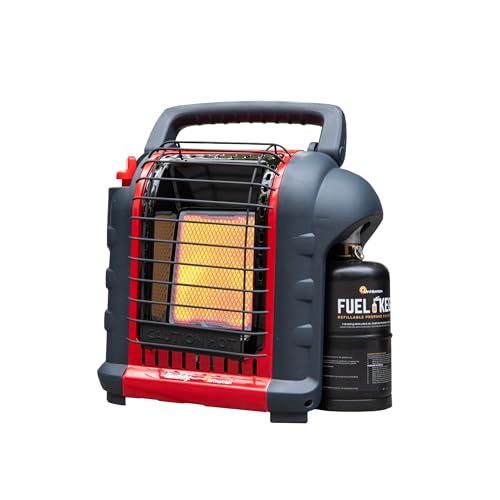
Mr. Heater 9,000 BTU Portable Buddy Radiant Propane Heater
- Emits 4,000 or 9,000 BTU/hr radiant heat
- Designed and approved for indoor and outdoor use
- Heats up to approximately 225 square feet
If the 18,000 model feels like overkill, the 9,000 BTU Portable Buddy is the logical step down. It heats up to 225 square feet — perfect for a small hobby greenhouse or a cold frame. Two heat settings let you choose 4,000 or 9,000 BTUs. It weighs next to nothing and sits on the floor or a table.
The biggest strength is the emergency low-oxygen safety system. This heater is specifically approved for indoor use, meaning it meets strict standards for oxygen depletion shut-off. If the oxygen level in the greenhouse drops too low, the heater shuts off automatically. That is a real comfort if you plan to run it overnight. The radiant heat feels warm fast, and the small size means you can move it where needed.
On the downside, 225 square feet is a hard limit. Push it into a larger space and your plants will stay cold. The piezo ignition sometimes takes two or three clicks. And without a thermostat, you have to check the temperature and adjust the dial yourself. For a small greenhouse that is fine, but for anything bigger you will want the 18,000 model.
- Two heat settings (4,000 and 9,000 BTU)
- Heats up to 225 square feet
- Low-oxygen safety shut-off
- Portable, indoor-rated
- Runs on 1 lb or 20 lb tank with hose
Best for: small greenhouses under 200 square feet where safety and portability matter most.
Mr. Heater 3,800 BTU Little Buddy

Mr. Heater
Mr. Heater 3,800 BTU Little Buddy Portable Radiant Propane Heater
- 3,800 BTU per hour
- For use with propane gas
- Heats up to 95 sq ft
The Little Buddy is the smallest unit in the lineup, with just 3,800 BTUs and a 95 square foot max. It is almost comically tiny — an 8-inch round base that fits in the corner of a cold frame or a germination tray. One-button ignition gets it going instantly.
For the right situation, this heater is brilliant. If you have a small pop-up greenhouse or a covered seedling table, the Little Buddy provides just enough heat to lift temperatures a few degrees. It uses very little propane, so a 1 lb cylinder lasts a long time. The low profile means it is easy to store when not in use.
But the limitations are real. There is no thermostat and no oxygen depletion sensor listed in the specs. The heater does not cycle off, so you have to monitor it. And 95 square feet is smaller than many people expect. A standard 6×8 greenhouse is 48 square feet, so it works, but you will push it to the limit. For anything bigger, move up to the 9,000 model.
- 3,800 BTU per hour
- Covers up to 95 square feet
- One-button ignition
- 8-inch round stand
- Uses 1 lb propane cylinders
Best for: tiny greenhouses, cold frames, or emergency backup heat.
Mr. Heater 540-Degree Tank Top

Mr. Heater
Mr. Heater Original 540-Degree 45,000 BTU Tank Top Radiant Propane Heater
- Multi-directional radiant propane heater mounts directly to a 20 lb tank for easy portability
- High-medium-low regulator: 45,000-36,000-30,000 BTUs
- Tip-over safety shut-off switch
This heater takes a different approach. It screws directly onto a 20 lb propane tank and radiates heat in a full 540-degree circle. Three output levels let you choose 30,000, 36,000, or 45,000 BTUs. On high, it runs about 9.5 hours per tank.
The 540-Degree is a beast for open areas. If you have a greenhouse that is more of a high tunnel with open ends, or you use it for outdoor work areas, this heater throws heat everywhere. The tip-over shut-off adds safety. It is also easy to move — just pick up the tank and go.
Here is the catch: Mr. Heater explicitly says this unit is for outdoor use only. Using it inside a sealed greenhouse is dangerous. The heater does not have an oxygen depletion sensor, and the radiant output is so intense that plants too close could get scorched. Stick to ventilated or open-sided structures only.
- 30,000 to 45,000 BTU output
- Mounts directly to a 20 lb tank
- Tip-over safety shut-off
- Approx. 9.5 hour runtime on high
- Outdoor use only
Best for: high tunnels, open shelters, or outdoor greenhouse work areas.
Mr. Heater 60,000 BTU Forced Air

Mr. Heater
Mr. Heater 60,000 BTU Quiet Burner Technology Forced Air Propane Heater
- QBT Technology - 50% Quieter than a standard propane heater
- 60,000 BTU Propane Forced-air Heater"
- Variable 30,000-60,000 BTU Output (Runs Up To 14 hrs on 20 lb. tank (low setting))
At the top of the range sits the 60,000 BTU forced-air heater. It uses a fan to blast warm air across a large space — up to 1,500 square feet. The output is variable from 30,000 to 60,000 BTUs, so you can dial it down for milder days. Mr. Heater calls it Quiet Burner Technology, and it is noticeably quieter than older forced-air units.
This is the only heater in the bunch that needs electricity. The fan requires a 120V outlet. If your greenhouse lacks power, you will need a generator or extension cord. The continuous ignition means no pilot light to babysit. On the low setting, a 20 lb tank lasts up to 14 hours, which is impressive for such a high output.
The forced-air design has pros and cons for a greenhouse. It circulates air, which helps prevent mold and hot spots. But it also moves dust and can dry the air fast. You will need to water more frequently. And despite the ‘quiet’ branding, it still makes a steady hum. Not a silent heater.
- 60,000 BTU max output
- Heats up to 1,500 square feet
- Variable output 30,000 to 60,000 BTU
- Continuous ignition, 120V required
- 50% quieter than standard forced air
Best for: large greenhouses with electrical access where you need rapid, even heating.
How We Chose These Products
We started by looking at the most common greenhouse sizes — from small 6×8 hobby units up to 20-foot commercial tunnels. BTU requirements vary wildly, so we needed a range. We stuck with Mr. Heater because they own this category. Their heaters are widely available, parts are easy to find, and they have been making propane heaters for decades. Alternatives exist, but the safety and reliability track record is hard to beat.
Our selection criteria focused on three things: BTU range, safety features, and indoor/outdoor rating. For an unvented heater to work in a greenhouse, it needs either a low-oxygen shut-off or you must be willing to provide serious ventilation. We excluded units that lacked any safety mechanism. We also paid attention to ignition type — electronic or piezo — because fighting with a manual lighter in a cold greenhouse is miserable.
Buying Guide: What Really Matters
BTU sizing is the first thing to get right. A rough rule of thumb: for a moderately insulated greenhouse in a climate that drops to 30°F at night, plan on about 30 BTUs per square foot. So a 100 sq ft greenhouse needs roughly 3,000 BTUs. A 200 sq ft space needs 6,000. If you want to keep plants alive on a 10°F night, double that estimate. Do not over-size too much — a heater that cycles on and off too fast can cause temperature swings that stress plants.
Safety equipment matters more than brand. Any heater you run inside a greenhouse should have an oxygen depletion sensor (ODS). This shuts the gas off if oxygen levels fall too low. It is not optional. Also, consider a separate carbon monoxide detector. Even vent-free heaters produce some CO, and a detector costs very little.
Ventilation is not a suggestion, it is a rule. Unvented means the combustion gases — mainly CO2 and water vapor — stay inside. That is fine in small amounts, but sealed greenhouses can quickly reach unhealthy levels for you and your plants. Always leave a small vent open when the heater is running. A cracked door or a roof vent is enough to keep air fresh.
Our Top Recommendation
For most greenhouse owners, the Mr. Heater 18,000 BTU Vent-Free model is the strongest pick. It covers the typical 6×10 to 8×12 greenhouse, the thermostat saves you constant fiddling, and it runs without electricity. The safety features are solid, and the propane consumption is manageable. If your greenhouse is smaller than 150 square feet, go with the 9,000 BTU Portable Buddy — the low-oxygen shut-off gives peace of mind, and the size is easy to store. For large commercial spaces with power available, the 60,000 BTU Forced Air heater moves enough heat to handle even cold climates.
Frequently Asked Questions
Can I use an unvented propane heater in a greenhouse safely?
Yes, as long as you follow a few rules. The heater must have an oxygen depletion sensor. You need to provide ventilation — a cracked door or vent opening. Never run the heater while you are inside sleeping. And keep a carbon monoxide detector nearby.
What size propane heater do I need for a 100 square foot greenhouse?
A 3,800 to 4,000 BTU unit will hold temperatures above freezing on mild nights. For hard freezes, bump up to a 9,000 BTU heater. The exact number depends on your greenhouse’s insulation and the outdoor temperature. It is better to have a little extra capacity and run it on low than to max out a small heater.
Will an unvented heater damage my plants?
Indirectly, yes if misused. The main concern is ethylene gas, which can form from incomplete combustion or from propane impurities. Ethylene causes plants to drop leaves and flowers. Using high-quality propane and keeping the heater clean reduces this risk. Excessive humidity from the combustion can also encourage mold. Good ventilation solves both issues.
Do I need a thermostat for a greenhouse heater?
Not strictly, but it makes a big difference. Without a thermostat, you have to check the temperature and adjust the gas valve manually. On a sunny day, the greenhouse can overheat quickly. A thermostat cycles the heater off once the target temperature is reached, saving fuel and protecting your plants. The 18,000 BTU model includes one; the smaller units do not.