
You spent the summer mowing, watering, and fighting crabgrass. Your lawn looked decent in July. By mid-October it’s thin, patchy, and tired. The grass knows winter is coming. If you skip fall feeding, you’ll see the damage come spring: bare spots, weak roots, and a long recovery. The wrong fertilizer can waste money or even burn the turf. So which fall fertilizer actually works?
Jonathan Green Winter Survival is a specialist product. It’s a 10-0-20 blend with zero phosphorus and extra potassium. That ratio is unusual. Most fall fertilizers pack nitrogen for green-up. This one focuses on root storage and cold hardiness. The potassium helps cells resist freezing. The low nitrogen avoids top growth that would die back anyway. It’s not a general-purpose feed. It’s a targeted winterizer designed for lawns in cold climates. Used correctly, it delivers thicker grass next spring with less disease.
Below I cover five ways to buy this fertilizer: single bags, two-packs, three-packs, four-packs, and a full-season program that includes Winter Survival plus three other products. Each option fits a different lawn size, budget, and management style. I’ll walk through the real trade-offs so you can pick the right one without guessing.
Here is a quick comparison of the key differences.
| Features | Single Pack | Two Pack | Three Pack | Four Pack | Lawn Program |
|---|---|---|---|---|---|
| Pack Count | 1 bag | 2 bags | 3 bags | 4 bags | 4 products (1 each) |
| Nutrient Ratio | 10-0-20 | 10-0-20 | 10-0-20 | 10-0-20 | Varied per season |
| Application Season | Fall only | Fall only | Fall only | Fall only | Year-round |
| Best Use Case | Small lawns up to 5,000 sq ft | Medium lawns up to 10,000 sq ft | Large lawns up to 15,000 sq ft | Very large lawns or multiple properties | Alkaline lawns needing full program |
Jonathan Green Single Pack

Jonathan Green & Sons
Jonathan Green & Sons Inc 12400 10-0-20 Winter Survival Fall Fertilizer, 1 (Single Pack)
- WINTER LAWN CARE: Designed as a winterizer lawn fertilizer to prepare grass for colder months and promote strong root growth for a…
- FALL FERTILIZER BENEFITS: Ideal as a fall lawn fertilizer to help grass recover from summer stress and store nutrients for winter…
- BALANCED NUTRIENT FORMULA: Contains essential nutrients to support lawn health, making it suitable as a grass fertilizer for thick…
The single bag is the straightforward entry point. You get one 10-0-20 Winter Survival fertilizer bag. Coverage is roughly 5,000 square feet. That fits a typical suburban front lawn or a smaller backyard. If you have a single property and just need fall feeding, this is all you require.
The granular formula spreads evenly with a broadcast spreader. No mixing, no batteries, no fuss. The high potassium content is the standout feature. Most homeowners don’t realize their soil is often short on potassium heading into winter. This product corrects that directly. The zero-phosphorus formula also respects local phosphorus bans common in northern states. You can apply it without worrying about runoff regulations.
The trade-off is stock availability. This single pack is currently scarce. It sells out fast in October because everyone wants the same thing. If you see it in stock, grab it. The other limitation: one bag won’t cover a large yard. For anything over 5,000 square feet, you’ll need more fertilizer. Buying multiple single bags costs more per square foot than the multi-packs.
- NPK ratio: 10-0-20 (no phosphorus, high potassium)
- Coverage: approximately 5,000 square feet per bag
- Granular formula, works with standard broadcast spreaders
- Designed for fall application before first frost
- Zero phosphorus – safe for areas with phosphate restrictions
Best for: Homeowners with lawns 5,000 sq ft or smaller who want a reliable winterizer without leftover product.
Jonathan Green Two Pack

This packs two identical bags in one purchase. Total coverage hits around 10,000 square feet. That matches what many front-plus-back-yard homeowners need. You apply one bag in early fall, save the second for late fall if you want a split application. Or use both at once for a larger single lawn.
The two-pack is where the value starts to show. You pay less per bag compared to buying singles separately. Shipping cost is also lower per unit. For whoever manages a typical quarter-acre lot, this is the sweet spot. You don’t end up with a half-used bag sitting in the garage until next year.
One catch: the bags are identical. If you only need one bag and the two-pack is on sale, it’s tempting. But storing fertilizer for a year reduces potency. The nitrogen may volatilize, and the granules can cake. Better to buy only what you’ll use this season. The two-pack works only if you actually have the square footage to justify it.
- Two bags, each 5,000 sq ft coverage
- Total coverage: 10,000 square feet
- Same 10-0-20 formula as single pack
- Cost-effective per square foot versus buying singles
- Good for split applications (early and late fall)
Best for: Homeowners with lawns between 5,000 and 10,000 sq ft who want to save a few dollars over buying two singles.
Jonathan Green Three Pack

Three bags deliver 15,000 square feet of fall feeding. This jumps into the realm of larger suburban yards or properties with substantial turf. Maybe you have a big front lawn, a side yard, and a back yard that all need treatment. The three-pack covers it in one order.
The convenience factor matters here. Instead of tracking down bags at multiple stores or placing repeat orders, you get everything at once. The three-pack is also the first quantity where the per-bag cost drops significantly. For heavy users, that adds up.
But the size itself can become a problem. Three 18-pound bags take up shelf space. If you don’t have a dry garage or shed, the bags may absorb moisture. Also, if your soil test shows you actually need phosphorus or a different ratio, buying three bags of a fixed formula locks you in. Consider getting a soil test before committing to a large quantity.
- Three bags, 5,000 sq ft each
- Total coverage: 15,000 square feet
- Best per-bag price among the multi-packs
- Requires proper dry storage for leftover bags
- Ideal for homeowners who don’t want to reorder mid-season
Best for: Large lawns or multiple properties where 15,000 sq ft of coverage is needed and you want the lowest cost per bag.
Jonathan Green Four Pack

The four-pack is the bulk option. It covers 20,000 square feet – enough for a full acre or a large lawn plus a sports field. If you manage a community garden, a church lawn, or a small farm, this makes sense. You get all four bags in one shipment, and the per-bag price is at its lowest.
From a logistics standpoint, ordering one box with four bags beats four separate purchases. Inventory management is simpler. You also have flexibility to use three bags now and save one for next year, though that storage issue returns. For a property that big, you likely have a shed anyway.
The main downside is upfront cost. You pay more money at once, even though it’s cheaper per bag. If your lawn is only 10,000 sq ft, you’ll have two bags left over. That’s fertilizer you might not use before potency drops. The four-pack is for people who are certain they need the volume, not for speculative stockpiling.
- Four bags, 5,000 sq ft each
- Total coverage: 20,000 square feet
- Lowest cost per bag of all pack sizes
- Bulk shipping – arrives as a single heavy box
- Best for properties near 1 acre or larger
Best for: Owners of large lawns, acreages, or multiple rental properties requiring consistent fall feeding across a wide area.
Jonathan Green Lawn Program
Jonathan Green
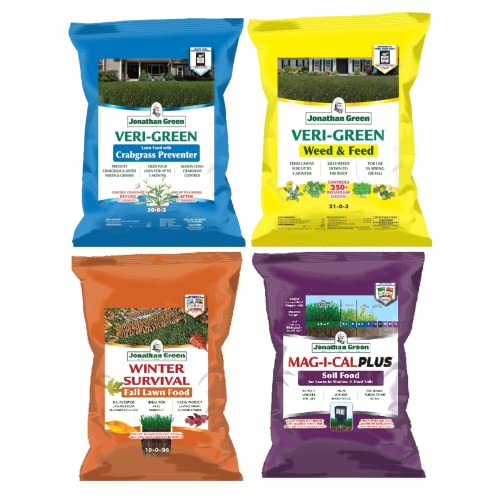
Jonathan Green Lawn Enhancement Fertilizer Program (Pack of 4) (5,000 Square Feet Coverage, Designed for Alkaline Lawns)
- You will receive 1 of each of the products shown.
- Early Spring – Apply Crabgrass Preventer plus Veri-Green Lawn Fertilizer to feed the lawn and provide season long crabgrass preven…
- Late Spring – Apply Weed & Feed Lawn Fertilizer to feed the lawn and kill over 250 broadleaf weeds like dandelions, chickweed, clo…
This is a different animal. Instead of four bags of the same winterizer, you get four distinct products: early spring crabgrass preventer, late spring weed & feed, summer Mag-I-Cal Plus for alkaline soil, and the Winter Survival fall fertilizer. It’s a complete year-round program designed for lawns with high pH and hard soil.
What makes this stand out is the holistic approach. Most people apply fertilizer sporadically. This program forces a disciplined schedule. Each product addresses a specific seasonal issue. The Mag-I-Cal Plus lowers pH and loosens compacted soil, which is exactly what alkaline lawns need. The Winter Survival bag is the same formula as the single pack above, so you get that final feeding.
The limitation is flexibility. You cannot swap out products. If you already have a crabgrass preventer you like, you’re stuck with this one. The summer product is targeted at alkaline soil; if your soil is acidic, it’s useless. Also, the program doesn’t include a soil test. You have to know your lawn’s pH before buying. The coverage is 5,000 square feet total across the whole program. That’s less than a single bag of the winterizer alone.
- Four different products: crabgrass preventer, weed & feed, Mag-I-Cal Plus, Winter Survival
- Designed for alkaline lawns and hard soil
- Total coverage: 5,000 square feet for the full program
- Follows a seasonal schedule: early spring, late spring, summer, fall
- Winter Survival bag is identical to the single pack product
Best for: Homeowners with consistently alkaline soil who want a simple, pre-planned feeding routine and are willing to commit to one brand for the whole year.
How We Chose These Products
I started with the core product – Jonathan Green Winter Survival 10-0-20 fertilizer. It’s a proven winterizer used by professional landscapers across the Northeast and Midwest. I then looked at purchasing options. The single bag, two-pack, three-pack, and four-pack are the same formulation. The only variables are quantity and price per unit. I included them all because your lawn size dictates which one makes sense. Buying too much wastes money; buying too little means a second trip to the store.
The fifth product, the Lawn Enhancement Fertilizer Program, stood apart. It offers a complete seasonal plan rather than just a fall feed. That’s valuable for people who want a hands-off approach. I evaluated it based on how well each component works together and whether the program covers the most common lawn issues: crabgrass, broadleaf weeds, soil pH correction, and winter survival. The Mag-I-Cal Plus is a unique addition that addresses alkaline soil – a problem many homeowners don’t know they have until they test their lawn.
Buying Guide: What Really Matters
Before you click add to cart, measure your lawn. Use Google Maps or a walking wheel. A standard fertilizer bag covers 5,000 square feet. If your lawn is 7,500 square feet, you need two bags but will have some left over. That leftover can be stored for next fall if kept dry and cool. Check the bag label for an expiration date – granular fertilizer can lose potency after 12 months.
Understand your soil’s phosphorus levels. Many states restrict phosphorus use on established lawns. The 10-0-20 formula has zero phosphorus, so it’s compliant everywhere. But if your soil test shows low phosphorus, you might need a separate phosphorus source in spring. Winter Survival won’t fix that. Also, high potassium is great for winter hardiness, but too much potassium can interfere with magnesium uptake. If you use a mag-i-cal product like the one in the program, it balances that out.
Timing matters more than you think. Apply winterizer after the last mowing but before the ground freezes – typically late October to early November in northern zones. The grass should still be green but growth has slowed. Water it in lightly if no rain is expected within 48 hours. Don’t apply on frozen ground; the granules will wash away without penetrating the soil.
Our Top Recommendation
For most homeowners, the Jonathan Green Two Pack is the best value. It covers 10,000 square feet – enough for a typical quarter-acre lot with a house and driveway. The per-bag cost is noticeably lower than buying singles. You can do a split application: half in early fall, half in late fall, which maximizes root development. If your lawn is larger than 15,000 square feet, step up to the Three Pack. The Four Pack only makes sense for properties over 20,000 square feet or if you’re sharing cost with a neighbor.
If your soil is alkaline and you want a no-brainer annual plan, choose the Lawn Enhancement Fertilizer Program. It costs more upfront, but you eliminate the guesswork of which product to buy each season. Just follow the schedule and your lawn gets consistent nutrition. For smaller lawns (under 5,000 sq ft), the Single Pack is all you need – just act fast because it’s often low in stock.
Frequently Asked Questions
Can I use Jonathan Green Winter Survival on a new lawn seeded this fall?
Yes, and it’s actually recommended. Apply the fertilizer on the same day you seed. The high potassium helps seedlings develop strong roots before winter. The zero phosphorus won’t harm germination – most starter fertilizers use phosphorus to boost root growth, but Winter Survival’s potassium does a similar job for cold tolerance.
How long does it take to see results from Winter Survival?
You won’t see a green flush like a spring fertilizer. The goal is root growth, not top growth. In mild fall weather, roots may thicken within two weeks. The real payoff comes in early spring when your lawn greens up faster and fills in bare spots more quickly than an untreated lawn. You’ll notice the difference around April.
Is this product safe for dogs and kids after application?
Yes, once the granules are watered in and the lawn is dry. The label says to keep pets and children off the grass until it’s dry after watering. The ingredients are standard synthetic fertilizers – no pesticides. But if you have dogs that eat grass, wait until after a second rain to be safe.
Why does the four-pack cost more upfront even though it’s cheaper per bag?
Good question. The four-pack has the lowest per-bag price because you’re buying in bulk, but the total cart price is higher. That can be a hurdle if you’re on a tight budget. Also, shipping is heavier, so some sellers may charge extra handling. Always compare the final total cost, not just the per-bag figure, before deciding.

