Three winters ago I killed a $40 rosemary plant under a lamp I bought because the listing said ‘full spectrum.’ It was full spectrum, technically. It was also about as strong as a nightlight. That mistake sent me down a two-year rabbit hole of PAR meters, wattage claims, and returns.



A grow light has to match your plants, your space, and your patience. Succulents want intensity. Herbs want hours. Seedlings want gentleness and a schedule you don’t have to remember. The lights below cover those jobs without pretending to be something they aren’t.
Two of these are small halo-style lamps with bases, one clips onto a shelf, one is a four-head gooseneck, and one is a proper T5 bar setup. If you want the short version: the Aokrean base model is the easiest all-rounder, the GooingTop is the best cheap clip-on, and the Barrina T5 is what you buy when you’re done messing around.
Here’s how the five compare on the specs that actually change your results.
| Features | Aokrean Base Halo | GooingTop Clip-On | LEOTER 4-Head | Aokrean Wood Grain | Barrina T5 Bar |
|---|---|---|---|---|---|
| Light Source | Full spectrum halo | 6000K white, 10 red | 80 LEDs, red/blue/white | Full spectrum halo | 5000K white full spectrum |
| Brightness Control | 10 levels, 3 spectrums | Not dimmable | 10 levels, 3 modes | 5 levels, 3 spectrums | On/off per bar |
| Timer Options | 3H / 9H / 12H | 4H / 8H / 12H | 3H / 9H / 12H | 6H / 12H / 16H | None built in |
| Mounting Style | Soil stake or base | Clamp and gooseneck | Clamp, 4 goosenecks | Soil stake or base | Tape, clips, cable ties |
| Best Use Case | Desk and floor plants | Small houseplants | Shelf and tent grows | Decor-friendly plant corners | Seed starting and shelving |

Aokrean Grow Lights for I…
This is a halo light on a telescoping pole with a weighted base, and it solves a problem most cheap grow lights ignore: your plant is taller than a desk lamp. The pole extends to roughly 26 inches and rotates 90 degrees, so you can aim it down over a monstera or sideways across a row of pots.
The 10 brightness levels and three spectrum modes (white, warm white with red, and a mix) give you real control. White light is what you’ll use most, because it doesn’t make your living room look like a rave. The 3H/9H/12H timer runs on a 24-hour cycle once you set it, which means you can leave for a weekend and come back to plants that got their light.
Here’s the catch nobody mentions in the listing: the base isn’t weighted enough on its own. The instructions say to press it down with a flower pot, and they mean it. A light pot on top of the base is the difference between a stable lamp and a floor accident. It also isn’t wireless, so you’ll need an outlet nearby.
- Telescoping pole reaches about 26 inches and rotates 90 degrees
- Two mounting options: push the stake into soil, or stand it on the base
- Timer memory holds your schedule as long as power stays connected
- Assembly is tool-free and takes a couple of minutes
Best for: Anyone with medium-to-tall houseplants who wants one light that sits on the floor and looks like furniture.
GooingTop Grow Light,6000…
The GooingTop is the light I’d hand to someone who just bought their first pothos and doesn’t want to think hard. It clamps to a shelf or table edge, bends wherever you point it, and runs off USB or a wall adapter. Ten watts of draw, which the brand compares to a 50W halogen bulb.
That 6000K color temperature is the closest thing here to noon sunlight, and the color rendering index is rated at 95. In plain terms, plants look normal under it and so does your room. It’s flicker-free, so it doubles as a reading lamp without giving you a headache. The 4H/8H/12H timer works the same way as the others: pick a duration, and it repeats daily.
What you give up is intensity and adjustability. There’s no dimmer, no spectrum switching, and 10 watts won’t push a fruiting pepper plant through winter. The clamp is strong, but it needs a lip to grab. Thin glass shelves and rounded rails are out.
- Runs on USB or AC power, so a laptop brick works in a pinch
- Roughly $2 a month in electricity at 12 hours a day, per the brand
- Flexible gooseneck holds its position without drooping
- 365-day warranty and a replacement policy if something fails
Best for: Small houseplants, herbs on a kitchen shelf, and anyone who wants a plug-and-forget starter light.
LEOTER Grow Light for Ind…
LEOTER
LEOTER Grow Light for Indoor Plants - Upgraded Version 80 LED Lamps with Full Spectrum & Red Blue Spectrum, 3/9/12H Timer, 10 Dimmable Level, Adjustable Gooseneck,3 Switch Modes
- 🌻Efficient LED Combination: This LED lamp has grow lights made up of 80 efficient growing LEDs ( 32 red lights, 12 blue lights,20…
- 🌻Upgraded Auto ON/OFF Timer: Plant grow lights come with the circular memory timer function allows to automatically turn on/off ev…
- 🌻10 Dimmable Modes: Our grow lamps provides 10 dimmable modes to suit varied stages of plant growth. It has 10 levels of light int…
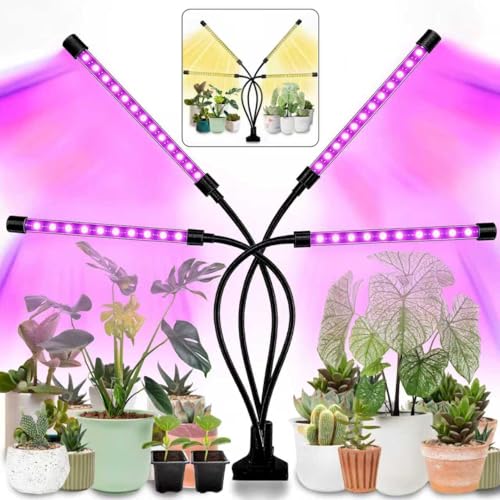
Four separate gooseneck heads on one clamp. That’s the whole pitch, and it’s a good one if you’re lighting a shelf of seedlings rather than one big plant. Each head bends independently, so you can spread coverage across a foot or two of pots.
The LED mix is the most deliberate of the group: 32 red, 12 blue, 20 yellow, 16 white. Red and blue at 660nm and 460nm are the wavelengths plants actually absorb for flowering and fruiting, and the full-spectrum mode covers rooting and sprouting. Three switch modes let you pick full spectrum, red-blue only, or the mix. Ten dimming levels handle the jump from seedling to vegetative growth.
Two honest gripes. First, the timer resets if you cut power, so a smart plug or a power strip switch will wipe your schedule. Second, the aviation-grade heat sink is real, but four heads at full brightness still throw noticeable warmth onto leaves a few inches away. Give seedlings six to twelve inches of clearance.
- 80 LEDs across four independently adjustable heads
- Three spectrum modes and 10 brightness levels
- Circular memory timer at 3H, 9H, or 12H
- USB connector with AC adapter included
- Metal clamp fits most table and shelf edges
Best for: Seed starters and shelf growers who need to cover several small pots at once.
Aokrean Grow Light, Full…
Same core design as the first Aokrean, wrapped in a wood-grain finish. If the plain white halo lamp felt like a piece of lab equipment in your living room, this one blends in. It’s the pick for people who care how the corner looks.
The trade-off is control. This version gives you 5 brightness levels instead of 10, but the timer jumps to 6H/12H/16H. That 16-hour setting matters for plants that want long days, like lettuce and most leafy greens. Same telescoping pole, same 26-inch reach, same two mounting options.
Be realistic about the wood grain. It’s an imitation finish on plastic, not veneer, and up close it reads that way. The base stability issue from the other Aokrean carries over here too, so weight it with a pot. And 5 brightness steps is coarser than 10 if you’re fine-tuning for a fussy plant.
- Wood-grain housing doubles as a decorative lamp
- 16-hour timer option suits long-day leafy crops
- Stake or base mounting, tool-free assembly
- Pole extends to about 26 inches with 90-degree rotation
Best for: Plant owners who want grow-light function without an industrial look in a living space.
Barrina T5 Grow Lights fo…

Barrina
Barrina T5 Grow Lights for Indoor Plants, 5000K Full Spectrum, 1FT, 4 Packs | 1FT LED Growing Lamp, Plant Light Strip for Seed Starting, Vegetables and Greens, Plug and Play, Linkable
- 5000K White Full Spectrum Light: Barrina T5 grow lights 1ft provide indoor plants with full-spectrum sunlight replacement. We prov…
- Super Bright and High PPFD: Consuming only 20W with 96 LEDs totally, replace 120W general plant lights. Over 95% light energy can…
- Separately Controllable: Each t5 grow lights fixtures have on off switch on the surface of housing, controlling the lights separat…
This is a different animal. Four 1-foot T5 bars, 96 LEDs total, 20 watts of draw that the brand says replaces 120W of general plant lighting. You mount them with tape, clips, and cable ties, then daisy chain up to 16 bars off a single power cord.
For seed starting and shelving, nothing else on this list comes close. The 5000K full spectrum output is bright and even, and each bar has its own on/off switch. That matters more than it sounds, because you can run two bars for seedlings and four for a fuller canopy without unplugging anything. Over 95% of the light energy is usable by plants, per Barrina, which is the kind of claim that usually means a decent PAR output for the wattage.
Downsides are real. There’s no timer, no dimmer, and no remote. You supply the schedule with a smart plug. The mounting tape won’t stick to rough, dusty, or freshly plastered surfaces, and the bars aren’t magnetic. Plan your mounting spots before you peel anything.
- Four 1-foot bars, linkable up to 16 units in series
- 20W total draw across 96 LEDs
- Individual on/off switch on each bar housing
- Hardware included: tapes, clips, ties, connecting cords
- No built-in timer or dimming
Best for: Seed starting racks, propagation shelves, and anyone scaling up past a single lamp.
How We Chose These Products
Every light here had to answer three questions. Does the wattage make sense for the coverage it claims? Does the timer actually repeat without being reset? And can a normal person mount it in a normal apartment without drilling?
We skipped anything with vague spectrum claims and no stated LED count. We also weighted honest limitations heavily. A light with a known quirk and a clear use case beats a light that claims to do everything. If you want a second opinion on the broader category, this roundup of grow lights that hold up in real apartments covers similar ground.
Buying Guide: What Really Matters
Wattage from the wall is the number to check first. A 10W clip light is fine for a pothos and useless for a tomato. As a rough rule, leafy herbs and houseplants want 10-20W per square foot of canopy, while fruiting plants want 30W or more. Ignore ‘equivalent to 120W’ marketing and find the actual draw.
PPFD is the measurement of usable light hitting the leaf, and DLI is how much of it accumulates over a day. Seedlings want roughly 100-200 PPFD for 14-16 hours. Vegetative plants want 300-600. Flowering plants want 600-900. None of these five lights publish PPFD maps, which is common at this price point, so use wattage and distance as your guide.
Spectrum matters less than intensity for most home growers. Full spectrum white covers everything from seed to flower. Red and blue blends push flowering harder, which is why the LEOTER includes that mode. Succulents want the most intensity and the least water. Herbs want long hours. Flowering plants want both intensity and a red-heavy spectrum.
How Much Does Running a Grow Light Cost?
The math is simple. Watts times hours times your kWh rate, divided by 1000. At a US average of about 16 cents per kWh, a 20W light running 14 hours a day costs roughly $1.35 a month. A 10W light at 12 hours costs about 58 cents.
Even four Barrina bars at 20W total stays under $1.50 a month. The electricity is never the expensive part. Replacing plants you cooked or starved is.
Safety and Heat Management
LEDs run cooler than the old blurple panels, but they still produce heat at the diode. Keep any light at least six inches from leaf surfaces unless the manufacturer says otherwise. Twelve inches is safer for seedlings.
Cheap units cut corners on heat sinks and driver quality. If a light gets too hot to touch after an hour, return it. Don’t daisy chain more bars than the rated limit, and don’t run any of these on an extension cord that’s already loaded. The LEOTER’s temperature-controlled heat sink is a genuine plus here.
Common Mistakes to Avoid
Running lights 24 hours a day is the most common error. Plants need a dark period to respire, and most species do best with 12-16 hours of light. More isn’t better.
Second mistake: hanging the light too far away. A 10W clip light at three feet does almost nothing. Move it to six to twelve inches and the same lamp suddenly works. Third: ignoring the timer reset issue. If your power flickers and your light has no memory, your schedule is gone. A $10 smart plug fixes this on any of these models.
Frequently Asked Questions
Can I use a regular desk lamp as a grow light?
Only if you swap in a full-spectrum LED bulb rated for plants. A standard warm-white bulb lacks the blue and red peaks plants use. It’ll keep a plant alive for a while, but growth will be leggy and slow.
Do I need red and blue LEDs, or is white enough?
White full spectrum handles the whole growth cycle. Red and blue blends give you a push during flowering and fruiting. For houseplants and herbs, white alone is fine. For peppers or anything you want to fruit indoors, a red-heavy mode helps.
How do I know if my plant is getting enough light?
Watch the stems. Stretching, pale leaves, and wide gaps between nodes mean not enough. Bleached or crispy patches on top leaves mean too much. Move the light two inches and wait a week before changing anything else.
Can these lights run on a smart plug?
Yes, all five work with a standard smart plug. That’s the workaround for the Barrina’s missing timer and the LEOTER’s reset issue. Set the plug schedule and leave the light’s own timer off.
Our Top Recommendation
The Aokrean base halo light wins for most people. It adjusts in height, aims where you need it, runs three timer cycles, and covers a floor plant without a shelf or clamp. The base needs weight, but a pot solves that in five seconds.
If your budget is tight and your plants are small, the GooingTop does the job for less and doubles as a reading lamp. If you’re starting seeds by the tray, skip both and get the Barrina T5 bars. They’re the only pick here built for real coverage, and the daisy chain means you can grow into them.