

Hedge Trimmers With Safety Switch: Two Reliable Picks
Contents
Standing in my yard last spring, staring at a row of overgrown boxwoods, I realized my old trimmer was done. The blade was dull, the cord kept tangling, and honestly, the lack of any safety switch made me nervous every time I picked it up. I spent two evenings scrolling through listings, but every product page sounded the same. Lots of buzzwords, not much real information.
After digging through the specs and thinking hard about how different yards demand different tools, I narrowed it down. The real question isn’t which trimmer has the most power. It’s which one fits how you actually work. Do you need to roam far from an outlet? Or do you stick close to the house and want unlimited runtime? Those are the decisions that matter.
I settled on two trimmers that both handle the core safety requirement well: a dual-switch setup that stops accidental startups. The SOARFLY 22-inch cordless model gives you freedom of movement. The GARCARE 24-inch corded unit offers endless power near an outlet. They serve different masters, and I’ll break down exactly who should buy which.
Here is a quick look at how they compare on the specs that actually drive your decision.
| Features | SOARFLY 22-Inch Cordless | GARCARE 24-Inch Corded |
|---|---|---|
| Power Source | 2x 20V 2.0Ah batteries | 120V corded electric |
| Blade Length | 22 inches, 65Mn steel | 24 inches, dual-action |
| Cutting Speed | 3000 RPM | 3200 SPM |
| Max Cut Thickness | 0.8 inch | 0.7 inch |
| Handle Adjustment | 180-degree rear, 4 angles | 90-degree rotary, both ways |
| Safety Features | Dual switch, baffle, gloves | Dual switch, guard, cord retainer |
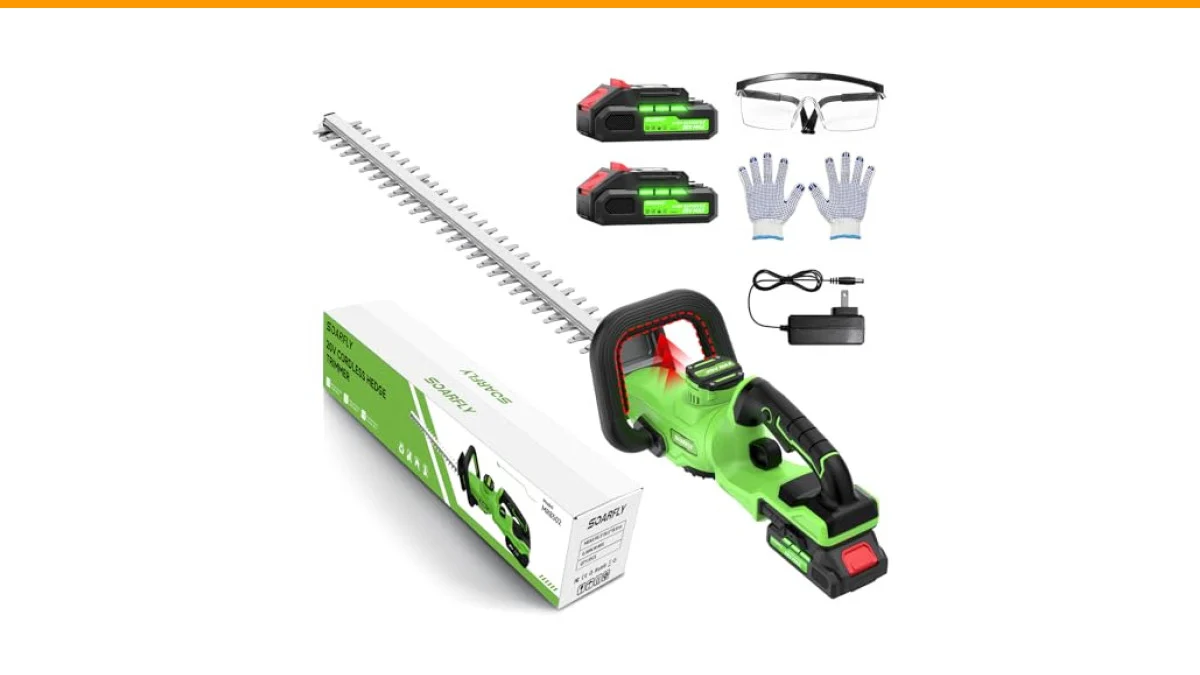
SOARFLY 22-Inch Cordless
1st Pick
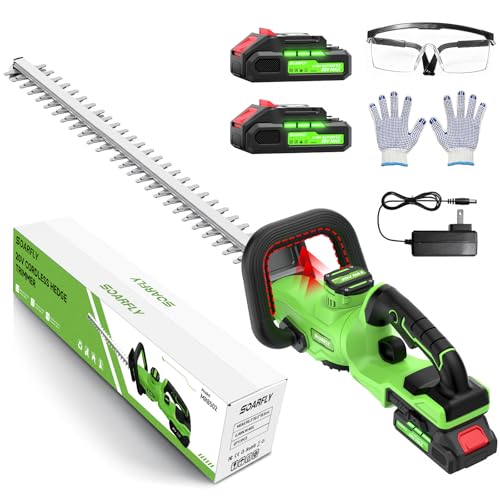
SOARFLY
SOARFLY 22'' Hedge Trimmer Cordless with 2×2.0Ah Battery 3000RPM
- 22-Inch Extended Cutting Blade: This hedge trimmer is equipped with a 22-Inch dual-action blade which made of durable 65Mn steel.…
- Equipped with 2Packs 20V 2.0Ah batteries: The hedge trimmer is equipped with two 2000mAh lithium batteries and comes with a charge…
- Powerful & Stable Performance: The pure copper motor drives the shrub trimmer working at the speed of up to 3000RPM delivers smoot…
The SOARFLY is for the homeowner whose hedge work happens all over the property. If your shrubs line a long driveway or sit behind the garage, dragging an extension cord across wet grass is a hassle and a hazard. This trimmer cuts that problem loose. It runs on two 20V batteries, so you swap packs instead of hunting for outlets.
What stands out here is the rotating rear handle. It adjusts to four angles: 45 and 90 degrees on both the left and right sides. That means you can trim the top of a tall hedge without raising your arms above your head awkwardly, and you can shape the sides with your wrists in a natural position. The 22-inch blade made from 65Mn steel handles branches up to 0.8 inches thick, which covers most routine maintenance on established shrubs. The dual-action blade design also cuts down on vibration, a detail you appreciate after twenty minutes of work.
There are trade-offs. The 2.0Ah batteries give you about 60 minutes of total runtime when you use both packs. That sounds fine, but heavy, dense growth will drain them faster. If you have a long perimeter of tall hedges, you might run out of juice before you run out of work. The charger takes about two hours to refill a pack, so plan your breaks accordingly. It’s also a bit heavier than a corded model because you’re carrying the batteries with you.
- Two 20V 2.0Ah lithium batteries included, plus a charger
- 22-inch dual-action blade cuts branches up to 0.8 inches thick
- 180-degree rotating rear handle with four preset angles
- Dual safety switch requires pressing two buttons to start
- Comes with safety baffle, pair of gloves, and goggles
Best for: Homeowners with scattered shrubs and hedges far from power outlets who want a cordless tool with a genuinely useful rotating handle.
GARCARE 24-Inch Corded
2nd Pick

GARCARE
GARCARE 24-Inch Corded Electric Hedge Trimmer 4.5Amp Handheld Bush Trimmer
- Powerful 4.5 Amp Motor: This electric shrub trimmer corded features a robust 4.5 Amp motor, delivering up to 3200 SPM for efficien…
- 24-Inch Dual-Action Blades: Equipped with 24-inch dual-action blades, this electric bush trimmer corded handles large areas effort…
- Adjustable Rotary Handle: The garcare corded hedge trimmer features a rotary handle that rotates 90 degrees in both directions, of…
The GARCARE is the opposite school of thought, and for many people, it’s the smarter play. If your trimming is confined to the front foundation plantings and a few bushes near the house, a cord is not a burden. It’s a promise of unlimited runtime. This 4.5-amp motor spins the 24-inch blade at 3200 strokes per minute, which is noticeably brisk. It chews through overgrown boxwoods and junipers without bogging down.
The longer 24-inch blade is the headline feature here. It covers more ground per pass than the SOARFLY, which makes a real difference on long, straight hedge rows. Fewer passes means less fatigue. The rotary handle turns 90 degrees in either direction, giving you solid access to vertical surfaces and top edges. It’s not quite as flexible as the SOARFLY’s 180-degree rear handle, but it covers the most common angles you’ll actually need.
Let’s be honest about the limitations. You are tethered to an outlet, and the included cord retainer is essential because pulling the tool away from your body can yank the plug loose mid-cut. The 0.7-inch max cutting thickness means very thick, woody branches will require a manual pruner first. And while the dual safety switches work well, the overall build feels utilitarian rather than premium. It’s a working tool, not a showpiece.
- 4.5-amp motor delivers 3200 strokes per minute
- 24-inch dual-action blade for fewer passes on long hedges
- Rotary handle adjusts 90 degrees left or right
- Dual safety switches prevent accidental startups
- Cord retainer keeps the power cable secure during use
Best for: Homeowners with hedges close to the house who want powerful, uninterrupted cutting without worrying about battery charge levels.
How We Chose These Products
My criteria started with safety, since that’s the whole point of this roundup. A hedge trimmer with a safety switch is non-negotiable. I looked for models with dual-action switches that require two deliberate presses to start the blade. That feature stops the trimmer from firing up if you accidentally bump the trigger while picking it up or carrying it across the yard.
From there, I evaluated power source practicality. Cordless models offer freedom but introduce battery anxiety. Corded models offer endurance but create cable management issues. I selected one strong representative from each category so you can choose based on your property layout. I also weighed blade length against cutting capacity, handle adjustability, and the included safety accessories. Every specification mentioned here comes directly from the manufacturer’s product data, with no embellishment.
Buying Guide: What Really Matters
Before you click buy, measure your actual work area. Walk the perimeter of your house and note where every hedge and shrub lives. If the furthest bush is within 50 feet of an outlet, a corded trimmer like the GARCARE is simpler and often more powerful for the price. If you have outbuildings, back property lines, or islands of landscaping, the SOARFLY’s cordless design saves you from extension cord headaches.
Pay close attention to the blade length versus the thickness of your plants. A longer blade covers more area but can be unwieldy in tight spaces between shrubs. The cutting capacity tells you the maximum branch diameter the blade can slice cleanly. Anything thicker needs a lopper. Both models here handle standard hedge maintenance, but neither is a chainsaw replacement.
Consider the handle system carefully. A rotating rear handle is not a luxury feature; it is a back saver. Trimming the top of a tall hedge with a fixed handle forces you into awkward overhead positions. Being able to angle the cut reduces strain and produces a cleaner, more level surface. Check the angle options and make sure they match the kinds of cuts you perform most often.
Our Top Recommendation
If I had to pick one for most homeowners, the SOARFLY 22-Inch Cordless takes the top spot. The reason is simple: versatility. The 180-degree rotating rear handle with four distinct angles makes it feel like a precision instrument rather than a blunt tool. The included second battery and safety accessories (gloves, goggles, splash guard) mean you have everything you need out of the box. For most suburban lots with a mix of foundation plants and accent shrubs, the cordless freedom outweighs the runtime limits.
That said, the GARCARE is the better value if your trimming is strictly close to the house. You get a longer blade, slightly faster cutting action, and zero concern about battery life. It’s the right call for dense, long hedge rows where stopping to swap batteries would break your rhythm. Check the current prices on Amazon, because corded tools often undercut their cordless counterparts significantly.
For those who want to explore more options, take a look at other safety-focused reviews or consider models with lighter frames if fatigue is a concern. There is also a guide on rechargeable battery options if you want to compare more cordless units.
Frequently Asked Questions
Do I really need a safety switch on a hedge trimmer?
Yes. A hedge trimmer with a safety switch requires you to press two separate buttons at the same time to start the blade. This prevents the tool from turning on if you brush against the trigger while carrying it or setting it down. It is a simple mechanical safeguard that significantly reduces the risk of accidental injury.
How long will a cordless hedge trimmer battery actually last?
With the SOARFLY’s two 2.0Ah batteries, you get roughly 60 minutes of combined run time. That is a general estimate. Dense, thick growth forces the motor to work harder and drains the battery faster. Light trimming of new growth will stretch that time further. The batteries take about two hours to fully recharge.
Can a corded trimmer cut the same branches as a cordless one?
In this comparison, yes. The GARCARE cuts branches up to 0.7 inches thick, while the SOARFLY handles 0.8 inches. The difference is negligible. Both are designed for standard hedge maintenance, not heavy tree pruning. For any branch thicker than those limits, use a manual pruning saw.
Is a longer blade always better?
Not always. A 24-inch blade covers more area per pass, which speeds up work on long, straight hedges. But a longer blade is heavier and harder to maneuver in tight corners or between closely spaced shrubs. The 22-inch SOARFLY blade is a good middle ground that balances reach with control.


