I spent three weekends trying to find a decent grass edger. Every listing looked the same. One promised 4-in-1 versatility, another bragged about pure copper motors, and a third showed a wheel that somehow cut through sod. The reviews felt copied. The specs didn’t match the photos. And nobody explained what edging actually does to a lawn.
A good edger for grass cuts a clean trench along sidewalks, driveways, and landscape beds. It separates turf from hard surfaces without scalping the crown. The best choice depends on yard size, soil type, and how much you hate dragging an extension cord. Battery-powered edgers suit small yards. Manual edgers win on price and control. Gas models still rule for acreage.
I narrowed the field to five machines that solve different problems. The WeGofly 4-in-1 handles trimming and edging with two batteries. The ALSO GO 24V offers five blade types for mixed vegetation. BlumeTrec and BARAYSTUS make manual wheel edgers for tight budgets. The WORX WG928 bundle adds a leaf blower for fall cleanup. Here’s how they compare.
Compare the key specs side by side before you read the full reviews.
| Features | WeGofly 4-in-1 | ALSO GO 24V | BlumeTrec Manual | WORX WG928 | BARAYSTUS Rotary |
|---|---|---|---|---|---|
| Power Source | 2x 21V 6.0Ah batteries | 2x 24V 2.0Ah batteries | Manual push | 20V battery | Manual push |
| Cutting Width | 13 inches | Not specified | Serrated scissor blades | 12 inches | Serrated rotary blades |
| Weight | 5.2 lbs | Lightweight with wheel | Not specified | 5.3 lbs trimmer | Not specified |
| Blade Types | Line, metal, saw | 5 replaceable blades | Steel serrated | String trimmer line | Self-sharpening steel |
| Best Use Case | Mixed yard tasks | Overgrown vegetation | Sidewalks and driveways | Trimming plus blowing | Budget lawn borders |

In this article
WeGofly 13″ Electric Weed…
WeGofly
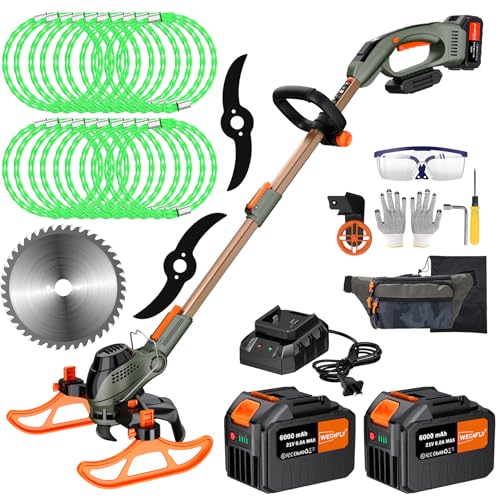
WeGofly 13" Electric Weed Wacker, 4 in 1 Cordless String Trimmer/Lawn Edger/Lawn Mower/Brush Cutter with Steel Gears, 2×21V 6.0Ah Batteries & Charger, 5.2 LBS Lightweight Grass Trimmer for Yard Garden
- 🌿🌿【4-in-1 Multifunctional Garden Tool】:All-in-one design works as string trimmer, lawn edger, mini lawn mower and brush cutter. Pe…
- 🌿🌿【3 Types of Cutting Blades】:The newly designed Weed Wacker can DIY switch between trimmer lines, metal blades, and saw blades to…
- 🌿🌿【2x6.0Ah Long Lasting Battery & No Frequent Charging】:Comes with two upgraded 21V 6.0Ah rechargeable batteries and a matched cha…
The WeGofly 4-in-1 targets homeowners who want one tool for everything. It converts between string trimmer, lawn edger, mini mower, and brush cutter. The 13-inch cutting width covers more ground per pass than most cordless trimmers. Two 21V 6.0Ah batteries ship in the box, which is rare at this price point. You won’t stop mid-job to recharge.
What stands out is the steel gear set and brushless motor. Cheap trimmers burn out when you hit thick weeds. This one runs at 15,000 RPM without jamming. The adjustable cutting head pivots for slopes and tight corners. A telescopic pole fits users from about 5 feet to over 6 feet tall. The 5.2-pound weight makes it manageable for seniors and beginners. Swap the trimmer line for a metal blade when you hit blackberry vines.
Trade-offs exist. The 13-inch width is great for open lawns but awkward in narrow flower beds. Battery life depends on which blade you use. Metal blades drain the 6.0Ah packs faster than string. The plastic components feel less durable than commercial-grade edgers. And the instruction manual is thin on blade-changing tips.
- Two 21V 6.0Ah batteries and charger included
- 15000 RPM brushless motor with steel gears
- 13-inch cutting width for faster coverage
- Adjustable head and telescopic pole
- 5.2 lbs with ergonomic non-slip handle
Best for: Homeowners who want one battery-powered tool for trimming, edging, and light brush clearing.
24V Electric Weed Wacker…

ALSO GO
24V Electric Weed Wacker Edger Lawn Tool,2 2.0Ah Battery Powered Weed Eater | 3-in-1 Lightweight Brush Cutter/Lawn Edger/Grass Trimmer Cordless, 5 Types Blades & Wheels for Yard Garden Maintenance
- 5 Replaceable Blades for Multi-Scenario Yard Trimming: This cordless weed wacker comes with assorted blades to fit all garden task…
- Adjustable Telescopic Pole & Angled Cutting Head: The extendable shaft adjusts from 35 to 47 inches to fit users of all heights. P…
- 650W Pure Copper Motor & Dual 24V 2.0Ah Batteries: Powerful 650W copper motor hits 11,000 RPM no-load speed for heavy-duty cutting…
The ALSO GO 24V edger suits people who deal with mixed vegetation. It ships with five replaceable blades. Metal blades cut thick weeds. Saw blades prune branches. Plastic blades handle tender lawn grass. That flexibility matters if your property has both manicured turf and wild edges. The 650W pure copper motor spins at 11,000 RPM no-load speed. Two 24V 2.0Ah batteries provide steady power for most suburban yards.
A telescopic pole adjusts from 35 to 47 inches. The pivoting cutting head reaches under fences and along retaining walls. Dual safety lock switches prevent accidental startups, which is a genuine concern with cordless tools. An auxiliary wheel supports the weight during long edging sessions. That wheel reduces arm fatigue for older users or anyone with shoulder issues.
The manual includes a specific warning: rest the motor 15 minutes after every 30-45 minutes of continuous use. That’s a real limitation. You can’t edge a half-acre lot in one go. The 2.0Ah batteries also drain faster than the 6.0Ah packs on the WeGofly. Blade changes require a wrench and some patience. And the wheel helps on flat ground but struggles on steep slopes.
- 650W copper motor with 11,000 RPM no-load speed
- Five blade types for weeds, branches, and grass
- Adjustable shaft from 35 to 47 inches
- Dual safety lock switches
- Auxiliary wheel for maneuverability
Best for: Gardeners who need one tool for both delicate grass edging and rough brush cutting.
BlumeTrec Manual Edger La…

BlumeTrec
Manual Edger Lawn Tool, 75 Inch Wheel Rotary Edger for Lawn with Extra-Wide Wheel, Grass Edge Trimmer with Adjustable Handle, Ideal Hand Edging Tool for Sidewalk, Driveways and Landscaping
- High-Strength Serrated & Scissor Blades: Rust-resistant alloy steel blades stay sharp longer for reliable, long-lasting performanc…
- 2.6" Wide Heavy-Duty Wheel: This sidewalk edger features a wide 2.6" rubber wheel that keeps it stable and balanced along lawn edg…
- Heavy-Duty Reinforced Metal Frame: BlumeTrec lawn edger features a reinforced metal frame that resists bending or warping during u…
BlumeTrec makes a manual wheel edger for people who refuse to deal with batteries. You push it. The serrated alloy steel blades spin as the wheel rolls. Scissor-style action slices through overgrown grass along sidewalks and driveways. A 2.6-inch rubber wheel keeps the tool stable on uneven surfaces. The reinforced metal frame resists bending when you hit a root.
What sets this apart is the adjustable handle. Five sections offer four height options: 33.5, 47.5, 61, and 75 inches. That range fits a teenager or a tall adult. The wide wheel distributes weight evenly, so you don’t tip over on sloped curbs. Rubber grips reduce hand fatigue. Assembly takes about ten minutes with the included screws and threaded pipe.
Manual edgers have limits. You provide the pushing force. Thick sod or wet clay demands real effort. The blades stay sharp for a season or two, then need replacement. This tool works best on flat surfaces. Areas near flower beds require careful handling to avoid slicing irrigation lines. And you’ll clear debris from the wheel axle regularly to prevent resistance.
- Serrated alloy steel blades with scissor action
- 2.6-inch wide rubber wheel for stability
- Four handle heights from 33.5 to 75 inches
- Reinforced metal frame with thickened brackets
- No batteries, no gas, no cords
Best for: Budget-conscious homeowners with small to medium yards who want zero maintenance and full control.
WORX 20V 12″ Cordless Str…
WORX
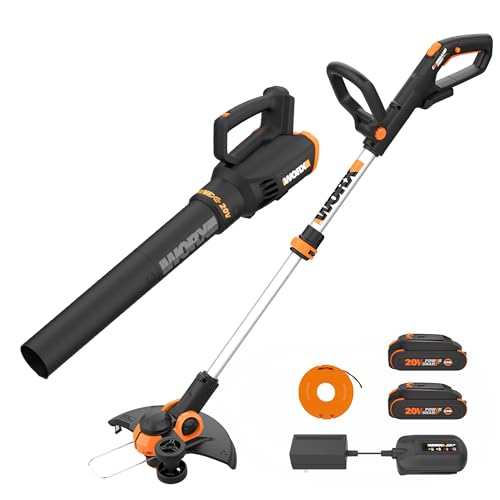
WORX 20V 12" Cordless String Trimmer & 360CFM Leaf Blower Kit, WG928 | Electric Weed Wacker with Command Feed, Blower with Speed Control, 2 x 2.0Ah Batteries & Charger Included, PowerShare
- TWO-TOOL LAWN CARE COMBO: Includes a 12'' cordless string trimmer/edger and 360 CFM leaf blower to trim grass, edge walkways, and…
- 2-IN 1 TRIMMER: Convert the string trimmer to an edger by pivoting the head, making it easier to maintain lawn borders, sidewalks,…
- COMMAND FEED LINE SYSTEM: Push-button line feed provides fresh trimmer line on demand so you can keep cutting without bumping the…
The WORX WG928 bundle combines a 12-inch string trimmer and a 360 CFM leaf blower. Both run on the same 20V batteries. The trimmer converts to an edger with a pivot of the head. That’s three tools in one kit. Two batteries and a quick charger come included. The blower weighs 4.4 pounds with the battery attached. The trimmer weighs 5.3 pounds. Both are light enough for extended use.
Push-button line feed is the standout feature. You tap a button to advance fresh string. No bumping the head on concrete. The Turbine leaf blower moves 360 cubic feet per minute at 75 mph. That’s enough for dry leaves and grass clippings. The trimmer’s 12-inch cut width handles standard suburban lawns. The edger mode works best for light touch-ups along driveways.
This is not a heavy-duty edger. The 20V motor lacks the torque of the 24V ALSO GO or the 21V WeGofly. Thick weeds will stall the string. The edger conversion requires you to rotate the head manually, which takes practice. The blower is a bonus, not a primary tool. And the 2.0Ah batteries deliver shorter runtime than the 6.0Ah packs on the WeGofly.
- Converts from trimmer to edger with head pivot
- Push-button line feed system
- 360 CFM leaf blower included
- Two 20V batteries and quick charger
- Trimmer weighs 5.3 lbs; blower weighs 4.4 lbs
Best for: Homeowners who want a lightweight trimmer, edger, and blower combo for small to medium yards.
BARAYSTUS Wheel Rotary Ed…

BARAYSTUS
BARAYSTUS Wheel Rotary Edger Lawn Tool, Grass Edge Trimmer, Sidewalk Manual Lawn Edger, Strong 3 Sections Stainless Steel Handle with Cushion Grip, 58.3-Inch
- New Design: Wheeled Rotary Edger is designed to trim grass edger along sidewalks, driveways, and flower beds. The serrated blades…
- Sharp and Durable: The garden edger both blades with CNC grinding and cutter with sharp grinding to keep it working smoothly. Anti…
- Adjustable height: Rotary edger has three heights can be adjusted to different length: 30.7 INCH / 44.5 INCH / 58.3 INCH; This law…
BARAYSTUS sells a wheel rotary edger for tight budgets. It uses serrated blades that self-sharpen and self-clean as you push. The stainless steel handle adjusts to three heights: 30.7, 44.5, and 58.3 inches. That fits most adults and some taller teens. The working parts are anti-rust plated. Assembly is straightforward. You align the holes, insert screws, and twist the threaded pipe.
The design prioritizes simplicity. A weighted wheel does most of the work. You guide the tool with a steady pushing motion. The blades cut through grass and sod along sidewalks, driveways, and flower beds. The CNC-ground cutters stay sharp longer than stamped blades. The handle uses thicker tubing than many competitors at this price. Cushion grips reduce vibration.
This manual edger demands physical effort. Rocky soil or thick roots will stop the wheel. You must clear grass from the axle regularly to prevent winding. The tool performs poorly on steep slopes. And the 58.3-inch maximum height is shorter than the BlumeTrec’s 75-inch option. Tall users may hunch over. The blades eventually wear out and need replacement.
- Self-sharpening serrated blades
- Three handle heights: 30.7, 44.5, 58.3 inches
- Stainless steel handle with cushion grip
- Anti-rust plated working parts
- CNC-ground cutters for smooth cutting
Best for: Renters or homeowners with small, flat yards who want a cheap, no-fuss edging tool.
How We Chose These Products
I focused on real-world use cases rather than spec-sheet bragging. Every pick solves a specific problem. The WeGofly handles mixed tasks with two batteries. The ALSO GO offers blade variety for overgrown lots. BlumeTrec and BARAYSTUS serve manual-edging purists. The WORX bundle adds value with a blower. No product made the list because of a flashy feature.
I weighed five factors: power source, cutting width, weight, blade type, and adjustability. Battery runtime mattered more than peak RPM. Handle height range mattered more than motor wattage. I also checked for common failure points. Cheap plastic gears, thin handles, and single-battery kits got cut. Every pick here has at least one feature that justifies its place.
Buying Guide: What Really Matters
Blade depth and guide wheels separate good edgers from frustrating ones. A guide wheel keeps the blade at a consistent depth. Without one, you’ll scalp the lawn or leave a ragged edge. Manual edgers rely on the wheel’s weight and diameter. Powered edgers need a blade guard to prevent kickback. Look for adjustable depth settings if you edge different surfaces.
Weight and balance matter more than raw power for most homeowners. A 5-pound trimmer feels heavy after 20 minutes. A 12-pound gas edger wears you out in 10. Cordless models win on weight. Gas models win on runtime. Manual models win on price and control. Match the tool to your yard size. A quarter-acre lot doesn’t need a gas edger. A two-acre property will kill a 2.0Ah battery in one pass.
Runtime and battery compatibility drive long-term satisfaction. Two 6.0Ah batteries beat one 2.0Ah pack every time. Cross-compatibility matters if you already own tools from a brand. The WORX 20V system shares batteries with other WORX tools. The WeGofly and ALSO GO use proprietary batteries. Replacement packs cost money. Factor that into your purchase.
Cost of ownership over three years tells the real story. A manual edger costs nothing after purchase. A cordless edger needs replacement batteries every 2-3 years. A gas edger needs fuel, oil, spark plugs, and air filters. String trimmers need replacement line. Metal blades need sharpening or replacement. Add it up before you buy. The cheapest tool upfront isn’t always the cheapest over time.
For more independent testing data, see Bob Vila’s lawn edger reviews and Popular Mechanics’ edger testing.
Our Top Recommendation
The WeGofly 4-in-1 is the best edger for most lawns. Two 6.0Ah batteries eliminate runtime anxiety. The 13-inch cutting width speeds up edging along long driveways. The brushless motor and steel gears survive thick weeds. The adjustable head and telescopic pole fit different users. It’s not perfect for narrow beds or commercial work, but it covers 90% of homeowner needs.
For smaller yards on a budget, the BlumeTrec manual edger wins. It costs less, never needs charging, and gives you full control. The BARAYSTUS is a close second if you want a lighter manual option. For mixed vegetation and brush, the ALSO GO 24V offers five blade types. The WORX WG928 bundle makes sense if you also need a leaf blower.
Frequently Asked Questions
How often should I edge my lawn?
Edge every 2-3 weeks during growing season. Weekly edging keeps lines crisp but takes more time. Skip edging in drought or winter when grass stops growing. A sharp blade cuts faster and leaves a cleaner trench than a dull one.
Can I use a string trimmer as an edger?
Yes, if the head rotates 90 degrees. The WORX WG928 and WeGofly both convert to edger mode. Hold the trimmer sideways and walk forward. The string cuts a shallow trench. This works for touch-ups but not for deep, defined edges. A dedicated edger or manual wheel edger does a better job on overgrown borders.
What’s the difference between edging and trenching?
Edging cuts grass along a hard surface. Trenching digs a deeper channel to create a physical barrier. Edging maintains an existing border. Trenching establishes a new one. Most homeowners only need edging. Trenching suits landscape beds with metal or plastic edging installed.
How do I avoid cutting irrigation lines or cables?
Know where your lines run before you edge. Most irrigation tubing sits 6-12 inches deep. Cable and internet lines run deeper but can surface near pedestals. Mark sprinkler heads with flags. Use a manual edger near flower beds where you’re unsure. Powered edgers cut faster but cause more damage if you hit a line. Start with shallow passes and increase depth gradually.