

Best LED Grow Lights for Vegetables: Real PPFD, Wattage, and Coverage Tested
Contents
Your tomato seedlings are stretching toward a window that gets four hours of weak winter sun. The basil on the counter has gone pale and leggy. You’ve probably already tried rotating trays and moving pots around, and it didn’t fix much.
Vegetables need two things a windowsill can’t reliably give: enough light intensity and a consistent daily duration. A good LED fixture solves both. The trick is matching the light to what you’re actually growing, because a rack of microgreens and a fruiting pepper plant have very different demands.
Below are five lights that cover the realistic range of indoor vegetable growing, from 20W strip bars to a 252W T8 system. Each entry includes wattage draw, coverage, and the honest drawback. There’s also a buying guide with PPFD and DLI numbers per vegetable type, plus the monthly electricity math most reviews skip.
Here’s a quick spec comparison before the detailed reviews.
| Features | VIPARSPECTRA 70W | Barrina T5 1FT | LEOTER 4-Head | Barrina T8 4FT | BESTVA DC1000 |
|---|---|---|---|---|---|
| Actual wattage draw | 70W | 20W total | Not listed | 252W total | 100W |
| Coverage area | 2×2 ft veg | Small seedling trays | Clamp-on spot | 4ft shelf rows | 1.5×1.5 ft core |
| Dimmable | 4 levels | On/off per bar | 10 levels | On/off per bar | Two modes |
| Timer built in | No | No | Yes, 3/9/12H | No | No |
| Best use case | Seedlings to veg | Microgreens, herbs | Small counter herbs | Full shelf garden | Fruiting crops |
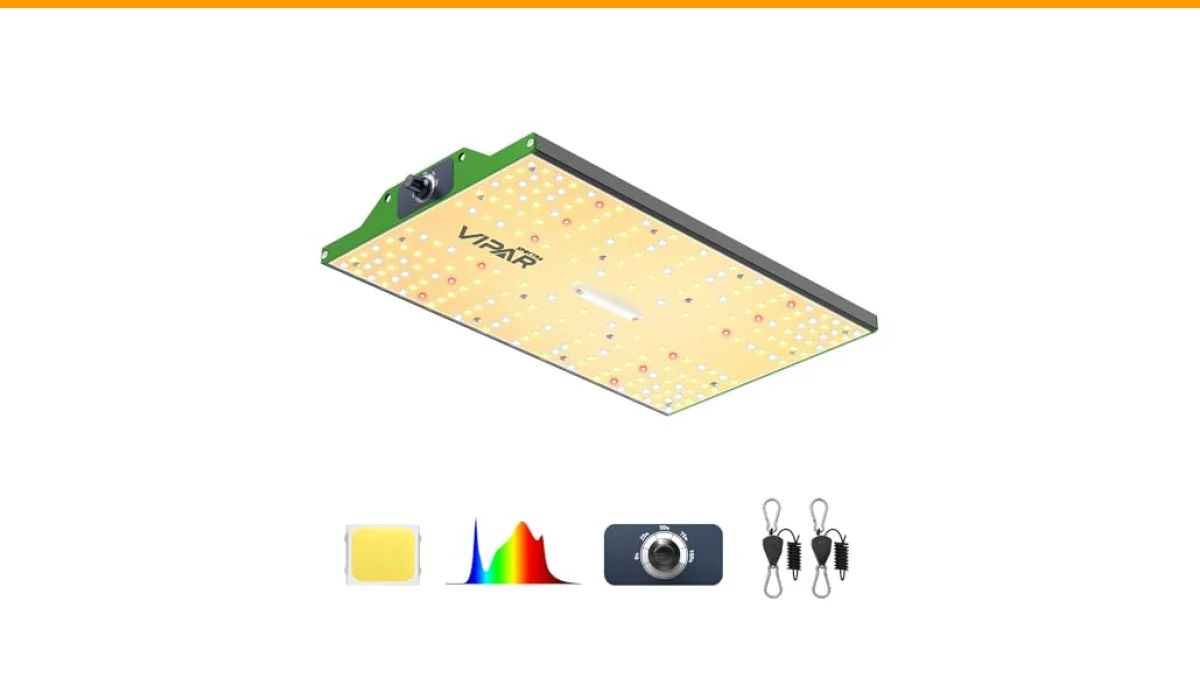
VIPARSPECTRA 70 Watt Grow Light
This is a compact panel built for the first six weeks of a vegetable’s life. It pulls 70 watts from the wall and pushes 11,000 lumens, which is a lot of output for a fixture this size. Seedlings and leafy greens in a 2×2 tent or a small shelf will do well under it.
The diode layout mixes 660nm red with 3000K and 5000K white. That combination matters because white diodes carry a broad spectrum, and the red peak supports stem thickness and leaf expansion. A 4-level dimmer lets you run it gently over fresh sprouts and then crank it as plants bulk up. There’s no fan, just aluminum heat sinks, so it runs silent. For a grower who wants one light that handles seed starting through early vegetative growth without a lot of fuss, this hits a sweet spot.
The trade-off is coverage. Two feet by two feet is the realistic footprint at useful intensity, and it shrinks fast if you hang it high. Fruiting crops like tomatoes and peppers will want more light than this can deliver at the flowering stage. It’s also not built for daisy-chaining many units together, so scaling up means buying separate fixtures.
- 70W draw, 11,000 lumens output
- 4-level dimmer for stage-by-stage control
- Fanless aluminum heat sink, quiet operation
- Balanced 660nm red plus 3000K/5000K white spectrum
- Rated as a 150W HPS/MH replacement
Best for: Seed starting and leafy greens in a 2×2 space where quiet operation matters.
Barrina T5 Grow Lights for Indoor Plants
Four one-foot bars, 20 watts total, 96 LEDs. This is the light you buy when your goal is a dense tray of microgreens or a row of herb pots on a windowsill shelf. It’s not a powerhouse, and it’s not meant to be.
Each bar has its own switch, which is genuinely useful. You can run two bars over newly sown seeds and switch on all four once true leaves appear. The 5000K white spectrum looks close to daylight, so it doesn’t turn your kitchen counter into a purple cave. Mounting is simple: double-sided tape, clips, and cable ties are all in the box. You can link up to 16 bars in a series off one outlet, which is the real selling point for anyone building a shelf system.
Twenty watts spread across four feet of bar isn’t much. It won’t carry a tomato plant to fruit, and it won’t do much for a big pepper plant either. The bars also get warm to the touch after a few hours, and the tape mounting isn’t reliable on textured or dusty surfaces. Plan on clips or screws for anything permanent.
- 20W total across four 1ft bars
- 5000K full spectrum, daylight appearance
- Individual on/off switch per bar
- Link up to 16 bars in one series
- Includes tape, clips, cable ties, and connectors
Best for: Microgreens, herbs, and seedling trays on a tight shelf where looks matter. If you want a deeper breakdown of this category, our guide to the best grow lights for microgreens covers similar setups.
LEOTER Grow Light for Indoor Plants
A four-head clamp lamp with flexible goosenecks. This is the light people buy for a single basil plant on a desk or a small pot of lettuce on a counter. It’s plug-and-play and it looks like a desk lamp, which is exactly the point.
The built-in timer is the standout feature. You set 3, 9, or 12 hours, and it repeats daily without you touching it. That matters more than people realize, because inconsistent light duration is one of the most common reasons indoor vegetables stall. Ten dimming levels and three spectral modes (full spectrum, red+blue, and a mix) let you shift from rooting to flowering without buying a second fixture. The goosenecks hold position well, and the clamp fits most table edges.
Output is modest. Eighty LEDs spread across four heads won’t produce enough intensity for fruiting vegetables at any reasonable distance. It’s also USB-powered, which limits placement to somewhere near an outlet or a powered USB hub. And the timer resets if the light loses power, so a brief outage means you’ll need to set it again.
- 80 LEDs across four adjustable heads
- 3/9/12-hour repeating timer with memory
- 10 dimming levels, 3 spectral modes
- 360-degree flexible gooseneck arms
- USB powered, includes AC adapter
Best for: One or two small herb or lettuce plants on a desk or kitchen counter.
Barrina 4FT T8 Plant Grow Light
Six four-foot bars, 252 watts total, 1,152 LEDs. This is the shelf-garden workhorse. If you’re running a multi-tier rack with lettuce, kale, spinach, or a full round of seedlings, this is the fixture that makes it possible.
Each bar puts out 3,100 lumens, and the aluminum housing handles heat without needing fans. That combination means you can run these for 14 to 16 hours a day without cooking your plants or your shelf. The 5000K spectrum is easy on the eyes, which sounds trivial until you’re working next to it for hours. Daisy-chaining up to six bars off one outlet keeps cable clutter down, and the included mounting hardware gets you set up in an afternoon.
Two things to know. First, these are 4-foot bars, so they need a shelf or frame that’s at least that wide. Second, the newer generation uses a different connector than the older one, so if you’re mixing old and new Barrina bars, you’ll need the updated male-female connector cables. Buy the whole set at once and you avoid the issue.
- 252W total across six 4ft bars
- 3,100 lumens per bar, 1,152 LEDs total
- 100% aluminum housing, fanless cooling
- Link up to six bars in a series
- Compatible with Barrina GM Series cords (new generation)
Best for: Multi-tier shelf gardens growing lettuce, greens, and large seedling batches.
BESTVA DC1000 Full Spectrum LED Grow Light
A 100-watt panel with 640 LEDs and two selectable modes. This is the pick for anyone growing tomatoes, peppers, cucumbers, or strawberries indoors and actually wanting fruit. It covers a 1.5×1.5-foot core area well and stretches to 2×2 feet for herbs and greens.
The two-mode design is the practical advantage. One mode pushes the blue and white wavelengths for leafy growth, and the other leans on red for flowering and fruiting. Switching mid-cycle takes a second, and it lets one fixture serve two very different plant stages. Cooling comes from multiple quiet fans plus aluminum radiators, which keeps the panel running cooler than most comparable lights. That matters for fruiting crops, because leaf burn from a hot panel can undo weeks of progress.
The DC1000 name is marketing, not a wattage claim. It draws 100 watts, not 1,000. That’s still efficient for what it does, but don’t expect it to replace a true 1,000-watt HID. It also runs fans, so there’s a faint hum in a quiet room. For a small fruiting garden, that’s a fair trade.
- 100W actual draw, 640 LEDs
- Two modes: vegetative and flowering/fruiting
- 3000K, 5000K, 460nm, and 660nm wavelengths
- Active cooling with fans and aluminum radiators
- 3-year service, 90-day return window
Best for: Indoor tomatoes, peppers, and other fruiting vegetables in a 2×2 tent.
How We Chose These Products
We looked at actual wattage draw first, because that’s the number that determines both light output and your electric bill. Marketing names like DC1000 or 150W equivalent got set aside. What mattered was the wall-plug wattage and the coverage area the manufacturer states for vegetative growth.
Next came spectrum and dimming. Vegetables have different needs at the seedling, vegetative, and flowering stages, so a light with adjustable intensity or switchable modes covers more of a plant’s life than a fixed-output fixture. Heat management, mounting options, and daisy-chain limits rounded out the evaluation. A light that runs hot or can’t be expanded usually ends up replaced within a season.
Buying Guide: What Really Matters
Ignore the wattage in the product name. A light called 1000W almost never draws 1,000 watts. Check the actual draw in the specs, then compare it to the coverage area. A 100W panel covering 2×2 feet is reasonable. A 30W panel claiming 4×4 feet is not.
Match the spectrum to what you’re growing. Leafy greens and herbs do fine under 5000K white with some blue. Fruiting crops like tomatoes and peppers need a strong red peak around 660nm during flowering, plus enough overall intensity to support fruit set. If you’re growing both, a switchable-mode light saves you from buying two fixtures.
Think about mounting height and spread before you buy. LED bars work best 6 to 12 inches above canopy for seedlings and 12 to 18 inches for mature greens. A panel with a focused beam needs to hang higher to cover the same footprint, which reduces intensity at the leaf. For shelf systems, bars are almost always the better choice. For a tent with one big plant, a panel wins. If you’re also growing herbs alongside your vegetables, our roundup of the best grow lights for herbs covers the lower-intensity options that work well for that.
Our Top Recommendation
The VIPARSPECTRA 70W is the best all-around pick for most indoor vegetable growers. It’s quiet, dimmable, efficient at 70 watts, and handles the seedling-to-vegetative stretch that trips up most beginners. It won’t fruit a tomato, but it will get you to the point where a stronger light makes sense.
For fruiting crops, the BESTVA DC1000 is the runner-up to beat. Two modes, 100 watts, and active cooling make it a solid choice for a 2×2 tent with peppers or tomatoes. Budget growers running microgreens or herbs should look at the Barrina T5 four-pack. And anyone building a full shelf system should go straight to the Barrina T8 six-pack, which is the only fixture here designed for multi-tier production from the start.
Frequently Asked Questions
How many hours a day should I run a grow light on vegetables?
Leafy greens and herbs do well with 12 to 14 hours of light. Fruiting vegetables like tomatoes and peppers usually want 14 to 16 hours during vegetative growth and can handle 16 during flowering. Give plants 8 hours of dark. They use that period for respiration and it affects yield more than most people expect.
What PPFD do vegetables actually need?
Lettuce and leafy greens grow well at 200 to 400 PPFD. Herbs sit in a similar range. Tomatoes, peppers, and cucumbers want 400 to 600 PPFD during vegetative growth and closer to 600 to 900 during flowering and fruiting. If your light’s PPFD at canopy height is below 200, expect slow, leggy growth no matter how long you run it.
Is a 100W LED really as good as a 1000W HID?
No. A 100W LED can match a 250W to 400W HID in usable light output, depending on efficiency. The 1000W equivalence claims are marketing. What matters is actual wall draw and the PPFD the fixture delivers at your canopy distance. A true 1000W HID still outperforms a 100W LED in raw output, but it also uses ten times the electricity and produces far more heat.
How much does it cost to run a grow light every month?
Multiply the actual wattage by your daily hours, divide by 1,000, then multiply by your electricity rate and by 30. A 100W light running 14 hours a day at 15 cents per kWh costs roughly $6.30 a month. A 252W T8 system running 14 hours costs about $15.90. A 20W T5 setup costs around $1.25. Efficiency gains matter more at higher wattages, which is why fanless aluminum designs are worth the extra cost.
Common Mistakes and Safety Tips
Hanging a light too far above seedlings is the most common error. Seedlings stretch toward light, and a fixture 3 feet above the tray guarantees leggy stems. Start 6 to 8 inches above the canopy and raise it as plants grow. The second mistake is running a light 24 hours a day. Plants need darkness to process the energy they absorb, and continuous light can stress fruiting crops.
On safety, respect the daisy-chain limits. Six Barrina T8 bars in a series is the stated maximum. Exceeding it risks overloading the circuit. Keep cords away from watering zones, and don’t mount tape-backed bars on dusty or textured surfaces. If you’re growing in a humid space like a basement, use clips or screws instead of adhesive. And check the heat output of any panel-style light after the first hour. If the housing is too hot to touch, raise it higher or add airflow.