
You pull the mower out for the first cut of spring, fire it up, and the grass looks ragged instead of clean. The deck is fine, the engine is fine, but the blade hasn’t been sharpened since last fall. You could replace it, but a quality blade costs $20 to $40, and you’ll be doing this again in a few months anyway. What you really need is a way to put a fresh edge on that blade in your own garage, without making a mess of the heat-treated steel.

Sharpening a mower blade comes down to one tool decision: which abrasive you put against the metal. Files work but take forever. Angle grinders are fast but easy to mess up. A proper grinding wheel or disc-based sharpener gives you a consistent bevel and removes the guesswork. The catch is that the market is split between little drill attachments, dedicated benchtop machines, and replacement discs for grinders you might already own. Each approach serves a different kind of user.
After digging through the specs and thinking about how each tool actually gets used in a home workshop, I settled on five picks that cover the range. There’s a simple drill attachment for occasional sharpeners, a full sharpening station for people who maintain multiple mowers, and replacement discs for those with a 9-inch grinder. Below is a comparison table to help you sort them quickly, followed by detailed reviews.
Here is a quick look at the key specs of each product I reviewed:
| Features | UF-SHARP Diamond | SporGain Sharpener | Innisle 9-inch Discs | Calsoling Corundum | Holdwell S Grinder |
|---|---|---|---|---|---|
| Type | Drill attachment | Benchtop machine | Replacement discs | Drill attachment | Benchtop grinder |
| Abrasive | Diamond 120 grit | Sanding discs (60/180) | Zirconia 60 grit | Corundum | Ceramic 9-inch |
| Power Source | Any power drill | Brushless motor | 9-inch grinder | Any power drill | 1/2 HP motor |
| Speed Control | Drill dependent | Up to 3000 RPM | Max 1700 RPM | Drill dependent | Fixed |
| Best For | Quick touch-ups | Multi-blade households | Grinder owners | Budget buyers | Heavy-duty use |
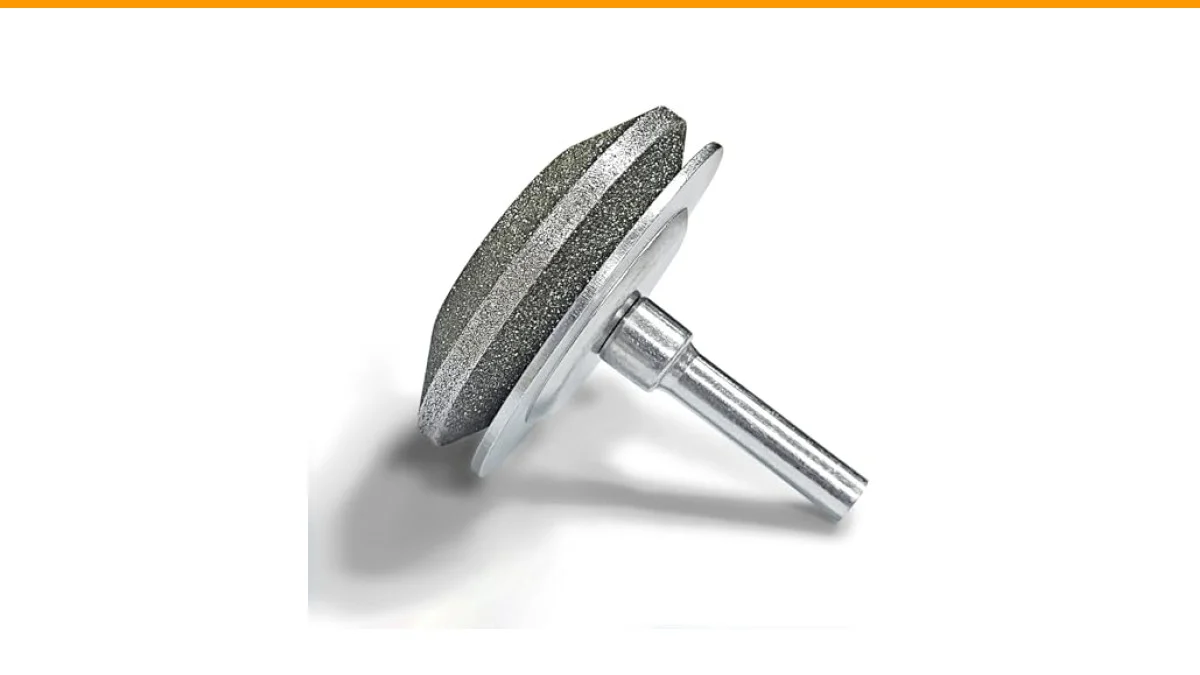
UF-SHARP Diamond Drill Attachment

UF-SHARP
UF-SHARP Diamond Lawn Mower Blade Sharpener, 120 Grit, All-Metal Construction, for Any Power Hand Drill (120 Grit)
- New Materials: The lawn mower blade sharpener tool is made of all-metal accessories and diamond grinding wheels, which has a longe…
- Easy to use: The 5mm handle fits any electric drill.Just need to attach the sharpener to an electric drill to start using it
- Durable Construction: Built with all-metal components for long-lasting performance and reliability.Grinding wheel can be used on b…
This is the simplest way to start sharpening blades without buying a dedicated machine. The UF-SHARP is a small diamond wheel that mounts to any standard power drill via a 5mm shank. You clamp the blade in a vise, run the drill along the existing bevel, and you’re done in a few minutes. It’s ideal for the homeowner who sharpens two or three blades a year and doesn’t want to dedicate bench space to another tool.
The all-metal construction sets it apart from cheaper plastic-backed sharpeners that flex and produce uneven edges. The 120-grit diamond surface cuts aggressively on hardened mower blade steel, and because the wheel is double-sided, you get twice the life before replacement. Diamond grit also runs cooler than aluminum oxide, which matters when you’re trying to avoid overheating the thin edge of a blade. For a drill attachment, this one feels solid in the hand and doesn’t wobble at speed.
The trade-off is that you’re relying on your own steadiness to maintain the factory bevel angle. There’s no guide or rest to lock the tool at 30 or 45 degrees. If you’re not careful, you can round over the edge or create a wavy bevel. Also, the 120-grit is fairly fine, so if your blade has nicks or is severely dull, it will take longer to remove that material than a coarser wheel would.
- All-metal body with diamond abrasive on both sides
- Fits any drill with a 5mm chuck
- 120-grit for finishing and light sharpening
- Works on mower blades, rototiller tines, and garden scissors
- No bench space required
Best for: The occasional sharpener who wants a cheap, no-fuss way to maintain blades in place without a dedicated machine.
SporGain Brushless Sharpener

SporGain
SporGain Lawn Mower Blade Sharpener,Brushless Motor,Lifetime Motor Warranty
- Brushless Motor for Powerful Performance: SporGain mower blade sharpener tool is equipped with a high-performance brushless motor,…
- Lifetime Motor Warranty: This durable lawnmower blade sharpener comes with a lifetime motor warranty, ensuring long-term reliabili…
- Adjustable Speed up to 3000RPM: The lawn blade sharpener features adjustable speed control up to 3000RPM, allowing you to choose t…
If you’ve got a couple of mowers, a tractor deck, or you help neighbors with their blades, the SporGain is a step up. It’s a complete sharpening station with a brushless motor that spins sanding discs up to 3000 RPM. The kit includes ten 60-grit discs for the initial grinding pass and sixty 180-grit discs for the fine edge. Two angle guides (30 and 45 degrees) bolt on to keep your bevel consistent, which is the biggest advantage over freehand methods.
The brushless motor is the headline here. It runs quieter and cooler than a brushed motor, and it comes with a lifetime warranty on the motor itself. That tells you the manufacturer expects it to last. The adjustable speed dial is genuinely useful: you can slow it down for a final pass to avoid overheating the blade, then speed it up for quick material removal on a badly nicked edge. The guides hold the blade at the correct angle while you slide it across the disc, so even a first-timer gets a professional-looking bevel.
Assembly is straightforward, but it’s not a tool you’ll use without setting it up first. The base needs to be bolted to a workbench or a sturdy piece of plywood, because at full speed it will walk across a table. The included discs are decent, but you’ll eventually need to buy replacements, and the 9-inch size is less common than 7-inch, so check availability before you commit. Also, the 60-grit discs are aggressive; if you push too hard, you can gouge the blade.
- Brushless motor with lifetime warranty
- Variable speed up to 3000 RPM
- Includes 70 sanding discs (60 and 180 grit)
- 30° and 45° blade guides for consistent bevels
- Designed for high-lift, low-lift, gator, and flat blades
Best for: The dedicated home mechanic who sharpens multiple blades each season and wants repeatable, accurate results without the cost of a commercial grinder.
Innisle 9-Inch Sanding Discs

Innisle
50 Pack 9" Sanding Disc for 1HP 750W Lawn Mower Blade Sharpener
- Universal Compatibility: 30 Pack 9" sanding disc grinding wheel size is 9"x 5/8", which can replace 1Hp 750w 9 inch lawn mower bla…
- Fast & Efficient Sharpening: 9in sandpaper for lawnmower blade sharpener ensures precise, fast and effcient sharpening, makes shar…
- Upgrade Material: 9 in sandpaper for lawnmower adopt aggressive 60 grit zirconia sticky that's cuts grinding time and minimizes du…
These are not a standalone tool. The Innisle discs are replacement abrasive wheels for a 9-inch lawn mower blade grinder, specifically the 1HP 750W models that are common in workshops. If you already own one of those grinders, this 50-pack of 60-grit zirconia discs is the consumable you’ll need to keep it running. Zirconia is a step up from standard aluminum oxide because it stays sharp longer and resists glazing, which means fewer disc changes and less dust.
The 9-inch diameter with a 5/8-inch arbor fits the standard shaft on most bench-mounted blade grinders. These are aggressive discs, so they’ll chew through a dull blade quickly, but they’re also designed to run at a maximum of 1700 RPM. That’s slower than a typical bench grinder, so don’t try to use them on a 3450 RPM grinder—they’ll fly apart. The sticky backing adheres to the backing pad securely, and the discs peel off cleanly when worn.
The main limitation is that you need the grinder to use them. If you’re starting from scratch, buying a grinder plus these discs is a bigger investment than a simple drill attachment. But if you’re already in the ecosystem, this is a cost-effective way to keep sharpening without paying for a new wheel every time. The 60-grit is a good middle ground for most blades, but you might want a finer grit for the final edge.
- 50 discs per pack, 9-inch diameter, 5/8-inch arbor
- 60-grit zirconia for fast cutting and long life
- Compatible with 1HP 750W 9-inch blade grinders
- Maximum speed 1700 RPM
- Sticky backing for secure attachment
Best for: Owners of a 9-inch blade grinder who need a bulk supply of quality discs to handle multiple sharpenings without reordering constantly.
Calsoling Corundum Drill Set

Calsoling
Calsoling 【NEW】 4 Pieces Double Layer Corundum Lawn Mower Blade Sharpener for Any Power Hand Drill,high Temperature Resistance and Hardness (Blue 4+1)
- New Upgrade: The new upgraded Lawn Mower Blade Sharpener is different from the old version. New version Lawn Mower Blade Sharpener…
- Multi-Scenario Application: Widely used for sharpening lawn blade, drill blade, mower, sickle bar cutter, rototillers, and so on.T…
- Simple to Use: Mower blade sharpener can simply attach to power drills and sharpen the blade easily and quickly.Making the edge be…
This is the budget pick that still gets the job done. The Calsoling set comes with four double-layer corundum sharpening stones and a blade balancer. Corundum is a natural abrasive that’s harder than aluminum oxide, and the double-layer design means you get a coarse side for heavy grinding and a finer side for the edge. The stainless steel base adds rigidity, which helps when you’re pressing against a blade.
Installation takes about ten seconds: pop the stone into your drill chuck, tighten, and go. The 50mm by 47mm size is small enough to maneuver along the blade’s bevel, and because it’s a drill attachment, you can use it in place without removing the blade from the mower—though that’s not recommended for safety. The included balancer is a nice bonus, because an unbalanced blade causes vibration that tears up your spindle bearings.
What you give up with this set is precision. There’s no angle guide, so you’re freehanding the bevel, and the corundum stones wear faster than diamond. They also generate more heat, so you need to take light passes and let the edge cool. The set is best for a homeowner who wants to sharpen a blade once or twice a season and doesn’t mind a little practice to get a good edge.
- Four corundum stones with double-layer abrasive
- Fits any power drill with a standard chuck
- Includes a blade balancer
- Works on mower blades, drill bits, and rototiller tines
- 12-month warranty and responsive support
Best for: The budget-conscious DIYer who wants a complete sharpening kit with a balancer for under $30.
Holdwell S 7-Inch Grinder
The Holdwell S is a serious piece of equipment that sits at the top of the home-shop range. It’s a benchtop grinder with a 1/2-horsepower motor that spins a 9-inch ceramic wheel. Ceramic abrasive is the premium choice for mower blade steel because it runs cool and cuts fast, and the 60-grit wheel is aggressive enough to reshape a badly damaged edge in a few passes. The aluminum-cased motor dissipates heat well, so you can work for longer without the motor bogging down.
What makes this grinder stand out is the included accessories. You get a pre-installed 30-degree angle mount and a spare 40-degree mount, so you can switch between blade types without resetting anything. The kit also includes a blade balancer to check your work after sharpening, plus six hole adapters that fit different center hole sizes on mower blades. That means you can secure the blade properly without it slipping, which is a safety feature as much as a convenience.
This is overkill if you sharpen one blade a year. The motor is loud, the wheel is large, and the whole unit takes up significant bench space. But if you maintain a fleet of mowers for yourself and a few neighbors, or you do this as a side business, the Holdwell S will pay for itself quickly. The steel base and integrated design keep vibration low, so you get a smooth, controlled grind that’s hard to achieve with a drill attachment.
- 1/2 HP motor with aluminum housing
- 9-inch 60-grit ceramic wheel for fast, cool cutting
- Includes 30° and 40° angle brackets
- Comes with blade balancer and 6 hole adapters
- Assembles in three steps with included tools
Best for: The serious home mechanic or small-scale landscaper who needs a dedicated, accurate sharpening station with all the extras included.
How We Chose These Products
I looked at the actual conditions of sharpening a mower blade, not just the marketing specs. The key factors were: how well the abrasive matches the hardness of mower blade steel, whether the tool helps you maintain a consistent angle, and how much control you have over speed and pressure. A wheel that’s too soft will wear out fast; one that’s too hard will burn the blade. The products above cover the spectrum from fine diamond to aggressive ceramic, so there’s a match for every skill level.
I also considered the real-world context of who buys these tools. A homeowner with a single mower doesn’t need a commercial grinder, but someone with a large property or multiple machines does. The drill attachments are cheaper and portable, but they demand a steady hand. The benchtop machines cost more but take the guesswork out of the bevel angle. My picks reflect that range, with the Holdwell S and SporGain as the top options for those who want precision, and the UF-SHARP and Calsoling as budget-friendly entry points.
Buying Guide: What Really Matters
Before you buy any grinding wheel or sharpener, figure out what size grinder you have or plan to buy. Most bench grinders take 6-inch or 8-inch wheels, while dedicated blade sharpeners often use 7-inch or 9-inch discs. A 9-inch disc won’t fit an 8-inch grinder, and an 8-inch wheel won’t give you the reach you need on a wide mower blade. Measure the arbor hole too—most are 5/8-inch, but some are 7/8-inch. Getting this wrong means the wheel won’t mount safely.
Grit is the next big decision. Coarse grits like 36 or 60 remove material fast and are good for reshaping a damaged edge. Fine grits like 120 or 180 produce a smooth, sharp edge but take longer. For mower blades, a 60-grit wheel is the sweet spot for most work. It’s aggressive enough to cut through nicks and dullness, but not so coarse that it leaves a ragged edge that will dull quickly in the grass. If you only have one wheel, go with 60-grit.
Speed matters more than you might think. A wheel that spins too fast generates heat that can ruin the temper of the blade steel, making the edge soft and prone to rolling over. The ideal speed for sharpening mower blades is around 1700 to 2026 RPM. If your bench grinder spins at 3450 RPM, you need to use very light pressure and keep the blade moving to avoid overheating. Dedicated blade sharpeners often have speed control, which is a big advantage.
Our Top Recommendation
The Holdwell S 7-Inch Grinder is the best overall pick for most people who want to sharpen blades properly. The ceramic wheel runs cool, the angle guides ensure a consistent bevel, and the included balancer and hole adapters make it a complete solution. It’s not the cheapest option, but it’s the one that will give you professional results every time, and it’s built to last.
If you want to save money and already have a drill, the UF-SHARP Diamond Attachment is the best budget choice. It’s simple, effective, and won’t take up any permanent space. For those who already own a 9-inch grinder, the Innisle discs are the best value replacement. And if you’re somewhere in between, the SporGain offers a nice balance of price and precision with its brushless motor and adjustable speed.
Frequently Asked Questions
Can I sharpen a lawn mower blade without removing it from the mower?
Technically yes, but it’s a bad idea. You can’t see the bevel angle properly, and you risk damaging the deck or the blade mount with a power tool. Always remove the blade, clamp it in a vise, and sharpen it on a flat surface. It takes five extra minutes and gives you a much better edge.
How do I know if I’ve overheated the blade while sharpening?
If the edge turns blue or purple, you’ve overheated it. That discoloration means the steel has lost its temper and will dull quickly, even if it looks sharp. To fix it, you need to grind past the discolored area, which means removing more material. To avoid it, use light pressure, keep the blade moving, and dip it in water every few passes.
What’s the difference between a grinding wheel and a sanding disc for mower blades?
A grinding wheel is rigid and typically mounted on a bench grinder. It removes material fast but can overheat the blade if you’re not careful. A sanding disc is flexible and mounted on a backing pad, usually on a dedicated blade sharpener. It runs cooler and is easier to control, but it wears out faster and needs to be replaced regularly.
How often should I sharpen my mower blade?
Every 10 to 15 hours of cutting time, or about twice a season for a typical suburban lawn. If you mow frequently or hit rocks and sticks, you’ll need to sharpen more often. A good rule is to check the blade every month during the growing season. A sharp blade cuts clean, while a dull one tears the grass, leaving it brown at the tips.